Painting blue hull advice please

mattonthesea

Well-Known Member
Joined
28 Nov 2009
Messages
1,518
Location
Bristol
ayearatsea.co.uk
We are thinking of repainting our blue hull as it has got quite tatty. I am completely new to boat painting. I know about filling and fairing but I have a couple of questions.

The surface is in relatively good condition. Do I need to do anything more than sand it; or does it need priming?

Has anyone experience of the single coat stuff? Primer and undercoat and top coat mixes. Does it stay on and keep condition?

TIA

M
 
Use good quality paint (you will spend a lot of time in preparation and you do not want to do it twice).
Follow the recommendations for preparation and coats to the letter.

A good finish comes from good surface preparation and applying the paint correctly thinned and at the right temperature so the brush marks disappear and not too thin so you get runs.

You also need to ensure that there is no dust flying about. I.e. you almost certainly need to cover the boat some how.

Good luck.
I paid a fortune for a yard to do it for me.
 
If it is GRP use two pot polyurethane, ideally when temperature is about 16 to 20 degrees and not high humidity - follow preparation and application instructions - remove any wax polish - make sure any cleaning products are well removed -use two pot resin filler- .takes a lot of knocks - lasts quite a few years - much harder than gel coat - have used over many years - One manufacturer can supply virtually any colour.
 
Last edited:
International Marine gloss paint. One coat of undercoat/primer if needed. one to two coats of top coat. Roll on then gently brush.
Brilliant paint, good for about 3-4 years. It will wear thin in places where dinghy's or ropes rub but it does not peal.....ever
 
Painting a GRP hull is really last resort on an older boat. The gel coat surface can usually clean up with a bit of graft and suitable materials. However if you do want to paint then the prep is a similar amount of work to get a fair and sound surface. Modern single pots such as International Toplac are easy to apply and will last well - 10 years or more. The maker provides very clear instructions on preparation and application. Follow that and you will get a good durable finish.
 
If it's gelcoat I'd do everything possible to renovate that rather than paint, but you do say "REpainting".

Months on (working around a busy job) I'm still mucking about with the paint on mine because I didn't think I'd need a cover, and then never got the temperature/ thinning quite right (and I tried 4 times!). Admittedly I'm fussy, but dark colours are not forgiving. If you're halfway serious then invest the time in covering the boat to give yourself a relatively controlled climate - it'll pay itself back in time lost to weather, and the result achieved.
 
Thanks everyone. Given your advice we are exploring the possibility of moving her undercover while we paint.

We can't renovate the gelcoat because she has too many dinks and scratches. She's a very well used boat
 
Just remember to not mix paint systems! When you say "repainting " is the finish now 2 pack or 1?
1 pack will happily go over 2 ....2 pack over 1....not so much!!
 
I spray painted my blue boat to make it white.

I certainly did use primer.

A good primer and a good paint.

A lot of prep and fine grit wet and dry paper was used.

I had an old compressor. New ones can be cheap. You need a filter type thing on the compressor so the air contains no oil or water.

I did it outside my house so there was some shelter from wind.

It took a long long time because I wanted a good job.

People thought it was original gel coat when I did eventually finish.

Rolling and tipping avoids compressor and thinning the paint and cleaning the spray gun and reasonable results can be achieved with practice.
 
Last edited:
I've painted a boat three times. I must be a glutton for punishment.

First was a previously painted 27ftr which I recoated between tides against a wall using Teamac single pack PU. I didn't really have a clue what I was doing. It actually looked ok, for a few weeks, but maybe I didn't let it cure long enough before going in to a marina and the fenders rubbed through. But it was a pretty low effort job and did ok for the four years I owned the boat. It was easy to touch up the scratches and when I came to sell, I had her looking pretty good.

Second was a 33ftr that I put way more effort in to. I had her neaped on the shore using legs, and build a platform around her using planks. This time I researched meticulously, and eventually chose International pre-kote followed by Toplac. It was hellish. I basically lost my whole summer that year, any good weather I had I spent working on that boat. In the end I only got two top coats on, the finish on the second was good enough and I wasn't brave enough to add another. It did look pretty damn good, very high gloss and now that I knew about rolling, tipping, and thinning, I definitely got a better result. I sold the boat almost immediately afterwards and have no idea how well it stood up. In hindsight, it was absolutely not worth the time, effort, and money.

Third might not really count, it was an 11ft ply/epoxy dinghy that I built during lockdown. Because I wasn't applying the paint over any previous coatings, I could use two pack. I was also doing the job indoors in a dry, warm, dust free environment. What an absolute pleasure. I'm now a big convert to two pack. I used Lustre from SML, it was far cheaper than International, needed no primer, and other than the smell was fantastic to work with. I was able to get a really decent finish which has stood up very well, pretty good for a plywood dinghy which is in daily use carting bikes and kedge anchors around.

Sorry for the ramble but I thought it might be useful!
 
I've painted a boat three times. I must be a glutton for punishment.

First was a previously painted 27ftr which I recoated between tides against a wall using Teamac single pack PU. I didn't really have a clue what I was doing. It actually looked ok, for a few weeks, but maybe I didn't let it cure long enough before going in to a marina and the fenders rubbed through. But it was a pretty low effort job and did ok for the four years I owned the boat. It was easy to touch up the scratches and when I came to sell, I had her looking pretty good.

Second was a 33ftr that I put way more effort in to. I had her neaped on the shore using legs, and build a platform around her using planks. This time I researched meticulously, and eventually chose International pre-kote followed by Toplac. It was hellish. I basically lost my whole summer that year, any good weather I had I spent working on that boat. In the end I only got two top coats on, the finish on the second was good enough and I wasn't brave enough to add another. It did look pretty damn good, very high gloss and now that I knew about rolling, tipping, and thinning, I definitely got a better result. I sold the boat almost immediately afterwards and have no idea how well it stood up. In hindsight, it was absolutely not worth the time, effort, and money.

Third might not really count, it was an 11ft ply/epoxy dinghy that I built during lockdown. Because I wasn't applying the paint over any previous coatings, I could use two pack. I was also doing the job indoors in a dry, warm, dust free environment. What an absolute pleasure. I'm now a big convert to two pack. I used Lustre from SML, it was far cheaper than International, needed no primer, and other than the smell was fantastic to work with. I was able to get a really decent finish which has stood up very well, pretty good for a plywood dinghy which is in daily use carting bikes and kedge anchors around.

Sorry for the ramble but I thought it might be useful!
I am also firmly in the two pack polyurethane camp. Jotun do great paints and are good value. I recently built a hardtop for our boat and sprayed it in the garage using Jotun 2 pack. I am not the best with a spray gun but the results are better than roller and tipping.
For the OP. Painting any dark colour will show up every imperfection in your prep work. White would be an easier colour to get a reasonable finish.
 
Do I need to do anything more than sand it; or does it need priming?
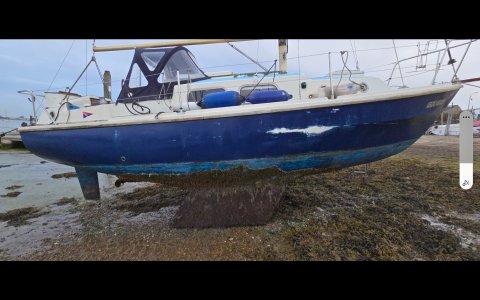
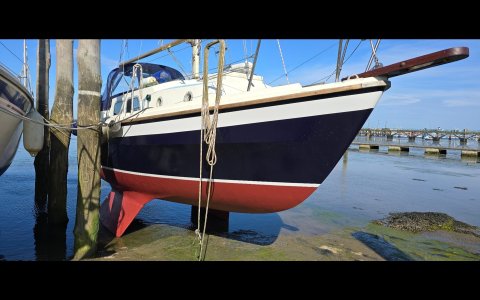
I Did this boat on the foreshore between tides in 6 days. Below is a before and after. Cost about £200 using international toplac and appropriate undercoat.
Sand the hull to provide a key. Fill if needed. I didn't have to fill anything ! I used a cheap 18v powerwash. It was brilliant for rinsing off all the sanding dust and didn't have a single speck of dust in any of the paint. Once sanded paint with undercoat as this gives good depth and shine to the gloss coast and it's better for adhesion. I lightly sanded the undercoat to remove the 4" roller orange peel effect. I used a short hair mohawk roller.
Applied the toplack and thinned it a fair amount as it kind of self levels more. A very light sand and applied a 2nd top coat which gave a good finish.
I could have flattened it again and polished but that's just lots more work and it already looked great i thought but still cant find anyone interested in buying it 😢Screenshot_20250725_103341_Photos.jpgScreenshot_20250725_103510_Photos.jpg
 
I'd love to show you mine !!! Used epifanes single part, superb finish, good prep is key but most important is correct thinning and wndless day .. We thinned more than twice as much as recommended to stop it orange peeling . Put simply you want it as thin as possible but without it running roll and tip definitely needs 2 people to do it properly . Ours has been on 4 years now and people still comment on the finish ,I think ill do it again next year but a simple key and paint on the existing paint can be done in 2 days .including overnight to let the oils come to the surface . I'm no expert painter but got advice from a jim who used to work for epifanes and he really knows his stuff
 
I Did this boat on the foreshore between tides in 6 days. Below is a before and after. Cost about £200 using international toplac and appropriate undercoat.
Sand the hull to provide a key. Fill if needed. I didn't have to fill anything ! I used a cheap 18v powerwash. It was brilliant for rinsing off all the sanding dust and didn't have a single speck of dust in any of the paint. Once sanded paint with undercoat as this gives good depth and shine to the gloss coast and it's better for adhesion. I lightly sanded the undercoat to remove the 4" roller orange peel effect. I used a short hair mohawk roller.
Applied the toplack and thinned it a fair amount as it kind of self levels more. A very light sand and applied a 2nd top coat which gave a good finish.
I could have flattened it again and polished but that's just lots more work and it already looked great i thought but still cant find anyone interested in buying it 😢View attachment 196721View attachment 196722

In most places in the civilized world, sanding a boat outside on the foreshore and washing it off into the environment is illegal.
 
I Did this boat on the foreshore between tides in 6 days. Below is a before and after. Cost about £200 using international toplac and appropriate undercoat.
Sand the hull to provide a key. Fill if needed. I didn't have to fill anything ! I used a cheap 18v powerwash. It was brilliant for rinsing off all the sanding dust and didn't have a single speck of dust in any of the paint. Once sanded paint with undercoat as this gives good depth and shine to the gloss coast and it's better for adhesion. I lightly sanded the undercoat to remove the 4" roller orange peel effect. I used a short hair mohawk roller.
Applied the toplack and thinned it a fair amount as it kind of self levels more. A very light sand and applied a 2nd top coat which gave a good finish.
I could have flattened it again and polished but that's just lots more work and it already looked great i thought but still cant find anyone interested in buying it 😢View attachment 196721View attachment 196722
Similar experience to me but on a smaller scale. Being in the north west of Scotland I really struggled with weather.
I recognise what you say about thinning- I ended up thinning much more than International suggested, just to get the paint to flow and to keep a wet edge for long enough. I was mostly on my own which certainly didn't help.
 
Top