Painting an outboard

wombat88

Well-Known Member
Joined
1 Oct 2014
Messages
1,313
Visit site
We have a 50hp Suzuki that lives outside on our boat which is in the water the whole time.

The alloy leg is oxidising nicely wherever it has been touched by a spanner and the prop doesn't look that great due to occasional 'gardening'.

I know it is probably the correct course of action but I don't want to take the boat out of the water, drop the leg and spray it. I don't want to paint the whole thing, just touch up the offending areas so at least it looks like someone has done something!

What to do? Is it case of Hammerite 'special metals primer' and some topcoat or is there something better?

Suggestions welcome.
 
Not Hammerite etching primer on alloy .

It's difficult, almost impossible, to make something last in that environment.

A bit of insight for you in a Mercury PDF here

Even if you took it to a professional, with sandblasting, spray booth and drying oven, it won't last. And if you want new decals, it's another financial surprise - in a bad way.

A friend had his sterndrive treated by a company that paints offshore wind turbines and parts. Took ages and was expensive, but only lasted a couple of seasons.

So you can do it. Just set your expectations to zero and you won't be too disappointed.
 
Last edited:
We are all DOOMED!

Just use the Hammerite special metals primer after a good rub down. Finish with black brushing enamel.

Easy and cheap, can re-touch if required.

Photograph the decals and visit your local Signmaker.

Only OE decals cost a bomb.

ChromeDome IS correct-it wont last very long, couple of seasons perhaps.

My 2008 5HP Suzuki is on the workshop stand waiting for the same treatment.
 
Last edited:
I just wire brushed and then sprayed with car based lacquer safe on alloys. It dries quick ... easy to touch up later ... nothing special to do.

This Evinrude 18 Fast Twin was bought cheap of a guy - it has a cracked leg as you see ...

aBoX89K.jpg


The strength of leg was still there though - he'd had a 'mishap' on a canal ...

Cleaned up .. High strength Metal based filler ... sand back ... wire brushed ... car lacquer ... good as new .... 13yrs later still as good ....

Rz9DgID.jpg


rEl0h32.jpg


hx6HhBb.jpg


No intention to sell ... so its my problem if it fails ... but as I say - 13yrs already and no sign of failure at all ...
 
Due to berthing arrangement, my outboard stays in the water for long periods. I clean off, use a cheap basic metal primer then anti foul it every year. Only takes an hour plus drying time to do a quick job and it looks nice for the duration of being sat in the yard. Oh and if it stays in the water like mine does, then the anode needs to changed every year.
 
Due to berthing arrangement, my outboard stays in the water for long periods. I clean off, use a cheap basic metal primer then anti foul it every year. Only takes an hour plus drying time to do a quick job and it looks nice for the duration of being sat in the yard. Oh and if it stays in the water like mine does, then the anode needs to changed every year.

That's ok - as long as both Primer and Antifoul do not affect alloy ... most legs are cast alloy and can be "eaten" by wrong formula.
 
Just wanted to point out that the original protection is very hard to copy and money spent may be wasted.

Bit negative ol'fruit ??

It only takes a wire-brush .. bit of suitable primer / top coat and it helps slow down the corrosion ...

Easy to repeat ...

Whether SW or not ... the fact is even river water is to a degree corrosive once air along with broken paint layer occurs .. agree that its far slower than full on 1025 SW ... but still a factor.
 
Thanks for the replies. There is a strong 'wouldn't bother if I were you' theme lurking here...

A non-perfect job will provide some protection, even if it will likely need to be redone at some point.

Kill 2 birds with one stone by doing the touching up in a contrasting colour = anti-theft marking.
 
A non-perfect job will provide some protection, even if it will likely need to be redone at some point.

Kill 2 birds with one stone by doing the touching up in a contrasting colour = anti-theft marking.

Pal of mine had a 50HP on back of a Mobo in Langstone HBR on a swinging mooring. It was old and hardly a nice looking specimen - but it ran good. But he decided to buy a 70hp .. this of course looked nice and showroom !!
He took a brush and pot of old paint and slapped it on the engine cover ... made it look like *****.

He put through bolts with locks and various to secure it.

Within a few days - they chainsawed the transom off and it was gone ... we salvaged the boat ... because he'd complied with insurance recc'd - they paid claim.
He then inserted a metal plate into the 'sandwich' he created to replace transom with. Then refitted the 50 ...

They stole that as well.
 
Within a few days - they chainsawed the transom off and it was gone ... we salvaged the boat ... because he'd complied with insurance recc'd - they paid claim.
He then inserted a metal plate into the 'sandwich' he created to replace transom with. Then refitted the 50 ...

They stole that as well.

That's why my dinghy outboard is painted a bright orange

 
We have a 50hp Suzuki that lives outside on our boat which is in the water the whole time.

The alloy leg is oxidising nicely wherever it has been touched by a spanner and the prop doesn't look that great due to occasional 'gardening'.

I know it is probably the correct course of action but I don't want to take the boat out of the water, drop the leg and spray it. I don't want to paint the whole thing, just touch up the offending areas so at least it looks like someone has done something!

What to do? Is it case of Hammerite 'special metals primer' and some topcoat or is there something better?

Suggestions welcome.

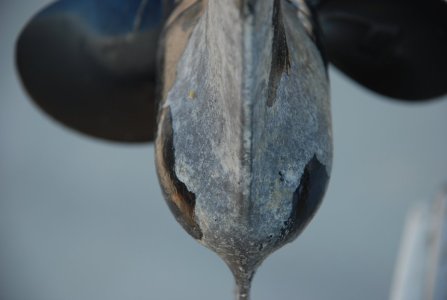
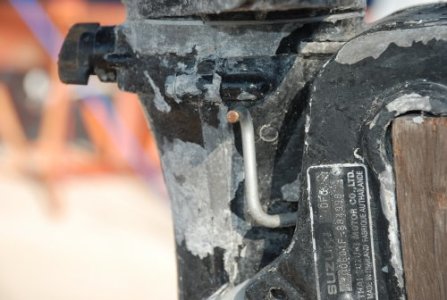
If it's anything like our Suzuki DF6, the rest of the paint will follow. Ours had no sign of undercoat/etching primer, photos a couple of months after 2 year warranty ran out, Suzuki not interested.
 

Attachments

  • Dsc_0757a.jpg
    Dsc_0757a.jpg
    110.4 KB · Views: 5
  • Dsc_0755a.jpg
    Dsc_0755a.jpg
    38.6 KB · Views: 5
That's ok - as long as both Primer and Antifoul do not affect alloy ... most legs are cast alloy and can be "eaten" by wrong formula.

Thats interesting. I've just cleaned mine off again ready for painting next year. No sign of any eating. I must have got the right stuff by accident. Do some primers have metals in them that causes dissimilar metal corrosion or is it some other mode of being eaten?


Don't know what happened there??? Hand / mouse / screen lack of co ordination.
 
Last edited:
I think it certainly worth it for protection. Unlike a saildrive leg , the metal is thin and probably not designed for continous immersion . The outboard manufactures are under pressure to keep outboards light and competively priced.

When immersed, I find the anodes wear quickly and need to be bigger . The prop and leg get about 4 coats of Trilux each year.
 
Top