Overheated Generator, now white smoke?

Tim Good

Well-Known Member
Joined
26 Feb 2010
Messages
2,888
Location
Bristol
Visit site
I was running the generator a week or two ago and the main seawater inlet was turned off accidentally during running. The overhead alarm sounded after a minute and I quickly turned it off.

I restarted it again with the seacock open after 6 hours and it appeared to be ok.

I’ve now come back to it to run the watermaker and white smoke is coming from the exhaust and there isn’t much seawater coming out. Or not as much as usually. I kept it going for 15 mins just to see if it would clear up and it overheated again. But this time with the seacock open.

Thoughts?

7036B58C-2AFD-4B13-B870-1B0DC75C6438.jpeg
 
Impeller shot?

Could be but that would be a total coincidence to it overheating right?

Oh actually..... you might be right. The impeller would have run dry and therefore probably disintegrated. No explaining the small amount of water coming out... and the white steam is just the water overheating in the exhaust.

hmm ok I’ll check.

hiping I haven’t done any lasting damage
 
It might be worth checking for impellor bits in your heat exchanger too.
 
Could be but that would be a total coincidence to it overheating right?

Oh actually..... you might be right. The impeller would have run dry and therefore probably disintegrated. No explaining the small amount of water coming out... and the white steam is just the water overheating in the exhaust.

hmm ok I’ll check.

hiping I haven’t done any lasting damage
You've probably got one or two impeller blades left pushing the small amount through, any further restarts will push the broken blades further into the system.
 
You've probably got one or two impeller blades left pushing the small amount through, any further restarts will push the broken blades further into the system.

Other than picking out what I can and checking the heat exchanger, What is the remedy for impeller bits in the system?
 
Other than picking out what I can and checking the heat exchanger, What is the remedy for impeller bits in the system?
The bits will get stuck at points where there is a change in diameter of the water channels - obviously at the end cap of the heat exchanger, but also at other joints in the pipe-work. On my (raw water) cooled system, I was caught out by a bit of impeller that got caught where the water entered the block, so look at any joint in the system, even if there isn't an obvious change in diameter. A bit of impeller that will pass down a pipe in one orientation can get stuck if minor turbulence in the pipe rotates it another way on.

And just to reinforce what others have said, mine disintegrated after running dry for less than a minute.
 
yeah sounds just like what I did.

you say inspect all the sections but without dismantling it all that’ll be practically impossible?
It isn't USUALLY too bad a job to take it apart. You can be fairly sure a bit won't get stuck in a long straight section; its joints and bends where things hang up. I got caught because I didn't think it could hang up there! And most of it will get stuck either in the pump itself or in the end cap of the heat exchanger in an indirect cooling system. If you keep the bits you find, along with the disintegrated impeller, you can do a rough check on how much there is still to find!
 
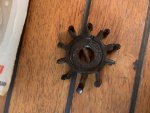
So as was suggested the impeller has disintegrated.

I’ve retrieved what pieces I can from the pump and double elbow that comes from it but there are deffo other missing bits.

I assume it would be bad practice to just bing in another impeller and hope the little bits just get flushed throug? Perhaps that’ll never happen through the heat exchanger?

8A333B7D-7229-4D4E-9EC8-CC5C7EBB384A.jpeg
72484576-441A-45EF-BFD8-CD5CF75A3275.jpeg
 
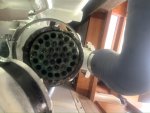
Have you had a fish around the front end cap?

Yeah I took off the cap to the heat exchanger and there is a grill which didn’t have anything in. The elbow to the grill didn’t either. I didn’t check the anti siphon loop as that would be hellish.

865BA8C1-EF90-4675-9E2E-D7C56C880498.jpeg
 
Last edited:
When I had an impeller disintegrate, I thought I'd found all the bits - looking at the bits I'd found and the remains of the impeller, it all seemed to add up. But I missed one bit, and that restricted the flow. Presumably the path in your case is seawater inlet -> pump -> heat exchanger -> exhaust elbow -> water trap -> out. The obvious suspect is the heat exchanger, or perhaps the exhaust elbow. It's difficult to see how it could get downstream of those.
 
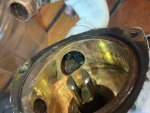
Its hard to tell from your photo but in the impeller housing the inlet (or outlet) at the top of your photo looks like it has bits of impeller in it
 
When I had an impeller disintegrate, I thought I'd found all the bits - looking at the bits I'd found and the remains of the impeller, it all seemed to add up. But I missed one bit, and that restricted the flow. Presumably the path in your case is seawater inlet -> pump -> heat exchanger -> exhaust elbow -> water trap -> out. The obvious suspect is the heat exchanger, or perhaps the exhaust elbow. It's difficult to see how it could get downstream of those.

With the grill on entering the exchanger then any large bits should have been caught there. The holes are fairly small. So the only other place would be the anti siphon loop but it’s in a pig of a place so I think I’ll get it going again and see how it goes.
 
Its hard to tell from your photo but in the impeller housing the inlet (or outlet) at the top of your photo looks like it has bits of impeller in it

Yeah that’s what I was taking a photo of. I’ve removed all those bits but it doesn’t account for all of it.
 
Reverse flush the raw water system with a hose connected to a tap.
(I have never tried doing this, but it seeems like a good idea.)
 
Reverse flush the raw water system with a hose connected to a tap.
(I have never tried doing this, but it seeems like a good idea.)

That does seem like a sensible Idea!

Ive put it all back together and now lots of water pushing out of the exhaust which is a good sign. I’ll keep an eye on it over the coming days.
 
Top