Old Autohelm instruments / ST4000 interfacing questions

Boo2

Well-Known Member
Joined
13 Jan 2010
Messages
8,603
Visit site
Hi,

I have a system comprised of an old Autohelm ST4000 TillerPilot alongside some Raymarine ST60 instruments and am trying to understand how it is all linked together.

Aiui, the Autohelm stuff still uses SeaTalk (?) so the Autohelm Multi display, the Autohelm ST4000 TillerPilot control head, the Autohelm Compass display, the Raymarine ST60 Wind instrument and the Raymarine TriData display can all communicate via SeaTalk ?

As far as I can tell from what info I've been able to dredge up from the web the only AH and Raymarine instruments I have that can talk via NMEA183 are the ST4000 control head (one input-only NMEA port used to receive GPS position) and the AH Multi display (one output-only NMEA port sending a variety of stuff). Can anyone tell me whether this is correct or not ? That assumes that the Autohelm Multi display device (see pic below) has the same connectivity as the Raymarine ST50 Plus Multi, is that true ?
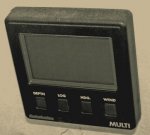
ah_multi.jpg

Anyway, if the above assumptions are correct it seems there is really only one way my system can connected together and so the current wiring diagram must be as follows : (I should say I have a Philips Mk9 GPS and a Silva S15 Radio)
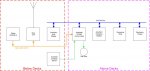
Sunrunner_cct_011.jpg

Anyone got any comments on this before I go further and say what I am trying to add / change / achieve ?

Many thanks,

Boo2
 
Last edited:
All sounds correct to me. I'm not familiar with the ST4000 control head but I agree with everything else, and the NMEA position input to the 4000 sounds very plausible.

Pete
 
Looks OK assuming the various device inputs (eg depth, speed wind) into the tridata and the GPS antenna into the Mk9 via NMEA (there is the alternative of the GPS going to the SeaTalk).
(I can't comment on the connectivity of the multi displays).
Andrew
 
Hi,

I have a system comprised of an old Autohelm ST4000 TillerPilot alongside some Raymarine ST60 instruments and am trying to understand how it is all linked together.

Aiui, the Autohelm stuff still uses SeaTalk (?) so the Autohelm Multi display, the Autohelm ST4000 TillerPilot control head, the Autohelm Compass display, the Raymarine ST60 Wind instrument and the Raymarine TriData display can all communicate via SeaTalk ?

As far as I can tell from what info I've been able to dredge up from the web the only AH and Raymarine instruments I have that can talk via NMEA183 are the ST4000 control head (one input-only NMEA port used to receive GPS position) and the AH Multi display (one output-only NMEA port sending a variety of stuff). Can anyone tell me whether this is correct or not ? That assumes that the Autohelm Multi display device (see pic below) has the same connectivity as the Raymarine ST50 Plus Multi, is that true ?

View attachment 38563

Anyway, if the above assumptions are correct it seems there is really only one way my system can connected together and so the current wiring diagram must be as follows : (I should say I have a Philips Mk9 GPS and a Silva S15 Radio)

View attachment 38566

Anyone got any comments on this before I go further and say what I am trying to add / change / achieve ?

Many thanks,

Boo2

Yes your wiring is correct and similar to the way I use with an St4000+ and ST6000 used as a repeater although I also feed Seatalk into a Shipmodul USB multiplexer for connection to a notebook. This also receives depth and wind data and forwards it out to the ST4000's nmea in with the GPS data and AP data from Polar View.
 
All sounds correct to me. I'm not familiar with the ST4000 control head but I agree with everything else, and the NMEA position input to the 4000 sounds very plausible.

Looks OK assuming the various device inputs (eg depth, speed wind) into the tridata and the GPS antenna into the Mk9 via NMEA (there is the alternative of the GPS going to the SeaTalk).

Yes your wiring is correct and similar to the way I use with an St4000+ and ST6000 used as a repeater although I also feed Seatalk into a Shipmodul USB multiplexer for connection to a notebook. This also receives depth and wind data and forwards it out to the ST4000's nmea in with the GPS data and AP data from Polar View.

Thanks for the replies, it's good to hear I am on the right track as far as understanding how my system must be currently set up. I was surprised and pleased to discover that the old Autohelm instruments communicated via SeaTalk as well - this will save me having to untangle a huge spaghetti of NMEA conections :encouragement:

What I want to do is add an e7 Chartplotter/GPS and a RO4800 VHF/AIS radio but there seems to be gotchas lurking at every step. The manual for the ST<->STNG convertor says that it doesn't work if connected to a bus having an autopilot, but I've seen references which state this is fixed in the latest software. The Page 84 of the manual for the e7 only mentions NMEA Port1 in respect of AIS reception but I am assuming Port2 works just as well. I'm basically stuck if either of these assumptions is wrong so...

I'm interested to hear if anyone knows what the AH ST4000 control unit does with the signals it receives ? I downloaded the manual in .pdf format from this site http://www.equipment.ath.cx/instrument_pdf/Autohelm/ST4000.pdf and it seems to show on page 48 that there are 3 separate SeaTalk connections to the control unit as well as the NMEA input, is this correct ? If so then does the ST4000 control unit bridge the NMEA and all 3 SeaTalk connections ? The manual silent on this, but actually I don't think it matters for my current project, though I'm still interested to hear what people know about this ?

Anyway, my intentions are to connect the e7 to the SeaTalk bus via the E22158 convertor and hopefully it will be able to display everything you'd expect like Wind etc. I am also going to configure the NMEA Port1 (the only NMEA port with a transmit function) to run at 4800 baud and connect this to the ST4000 control and the new RO4800 radio in place of the Philips Mk9 GPS. This unfortunately means that the input of Port1 also has to run at 4800 baud but that can't be helped.

The AIS output from the RO4800 is going to be connected to the NMEA Port2 input on the e7 and runs at 38400 baud (assuming this port can accept AIS data, see above).

I am also going to connect RS422-USB adaptors at strategic locations so I can see AIS and position on a laptop PC running suitable software. The NMEA issue referred to above means the PC will only be able to send waypoints etc to the e7 at 4800 baud but hopefully that won't actually matter in practice. I know that I can transmit from laptop to e7 via Wifi but the fact that Raymarine consider the protocol to be proprietry means I could only use their Voyage Planner software to accomplish that, and it's too awful to consider.

Anyway, I've attached a sketch of what I would like to end up with, please feel free to critique it in the light of what I've said.

Boo2
Sunrunner_cct_018.jpg
 
What's the NMEA connection to the ST4000 for, in the new scheme? You already have position data on the Seatalk bus via the NG converter.

Pete
 
Seems a bit over complicated.
Chartplotter nmea o/p replaces GPS o/p so seatalk converter not required.
Chartplotter stores routes so pc not necessary.
Raymarine nmea o/p provides data to Chartplotter.
In summary, just replace GPS with Chartplotter!
 
Seems a bit over complicated.
Chartplotter nmea o/p replaces GPS o/p so seatalk converter not required.
Chartplotter stores routes so pc not necessary.
Raymarine nmea o/p provides data to Chartplotter.
In summary, just replace GPS with Chartplotter!

If he wants his plotter and instruments to talk to each other, then Seatalk is by far the best bet. Early Raymarine stuff could be a bit sketchy re NMEA so I would be dubious about replacing a seatalk connection with a pair of NMEAs running to two different instruments on the bus. Even if it all works properly it will still omit Seatalk-only stuff like controlling the autopilot from the plotter (should he want to do that).

In any case, he can't go the NMEA route unless he adopts your whole plan and also ditches the laptop (not enough ports on the plotter). Now personally I don't really like computers on boats (except for domestic purposes if living aboard) and I don't pre-designate a series of waypoints and legs between them - but it's not for us to second-guess how the OP wants to do things. Presumably he wants to do all this pre-planning down below, rather than sitting up in the cockpit on a cold and rainy evening. Or even do it at home, and bring the laptop to the boat with him.

If you want complicated, try my wiring diagram :). Due to a combination of existing kit, firm ideas on how I like to do things, and shared ownership of the boat, I effectively have three entirely independent navigation systems, plus the VHF and AIS department which is separate again.

Pete
 
What's the NMEA connection to the ST4000 for, in the new scheme? You already have position data on the Seatalk bus via the NG converter.
The e7 will, as you say, presumbly be sending position data on the SeaTalk bus via the ST/NG convertor but I don't know whether the AH ST4000 control head can accept it via SeaTalk or if it needs to be on NMEA ? The manual specifically states to use NMEA but it may date from the days before position data was commonly available over SeaTalk.

One reason for keeping position on NMEA is so I can leave the old Mk9 GPS in situ and switch the ships position sensor between that, the new e7 and a Garmin handheld GPS I already have. That would give me a resilient connection whereas going via SeaTalk means the position goes down if any instrument fails.

But it's a good point and I may try the system without an NMEA connection just to see what happens.

Boo2
 
Seems a bit over complicated.
Chartplotter nmea o/p replaces GPS o/p so seatalk converter not required.
Chartplotter stores routes so pc not necessary.
Raymarine nmea o/p provides data to Chartplotter.
In summary, just replace GPS with Chartplotter!
If he wants his plotter and instruments to talk to each other, then Seatalk is by far the best bet. Early Raymarine stuff could be a bit sketchy re NMEA so I would be dubious about replacing a seatalk connection with a pair of NMEAs running to two different instruments on the bus. Even if it all works properly it will still omit Seatalk-only stuff like controlling the autopilot from the plotter (should he want to do that).

In any case, he can't go the NMEA route unless he adopts your whole plan and also ditches the laptop (not enough ports on the plotter). Now personally I don't really like computers on boats (except for domestic purposes if living aboard) and I don't pre-designate a series of waypoints and legs between them - but it's not for us to second-guess how the OP wants to do things. Presumably he wants to do all this pre-planning down below, rather than sitting up in the cockpit on a cold and rainy evening. Or even do it at home, and bring the laptop to the boat with him.
LadyInBed's suggestion would be a very good one if all I was doing was replacing the Mk9 GPS with the e7, particularly if I installed the e7 below decks : there would be almost no new wiring. However as you say, Pete, it would be nice to have the extras like pilot control etc that SeaTalk will give me.

As for the PC, I am very keen to keep it because the screen is much bigger and the raster charts much nicer to my eyes than the vector ones on the CP. I do have the fallback position that I can just send via Wifi for tracks and routes etc and use the portable Garmin GPS to get position into it as I do currently. I will install the laptop last with the attendant RS422 gubbins so will have a working system before that, hopefully. I prefer the wired connection for reliability and compatibility though so will put up with the additional complexity.

LIB's suggestion re using the Autohelm ST50 Multi's NMEA output could be useful though - I can use it instead of the e7's NMEA output as the NMEA 4800 position input to the RO4800. I don't know whether the sentences are coimptible though ? The ST50 Multi ouputs as follows :

VWR Apparent Wind Speed (knots) and Direction
DBT Depth of water below transducer (feet)
HDM Magnetic Compass Heading
HSC Locked Magnetic Compass
VHW Water Speed (knots), Magnetic and True Compass Heading
GLL Longitude and Latitude
VTG Course Over Ground, Speed Over Ground
BWC Bearing and Distance to Wavpoint
MTW Water Temperature (deg.C)

The manual for the RO4800 states "The sentences GLL, GGA, RMS, GNS shall be recognised" so we should be in with a chance, but I don't know whether GLL will do in place of the missing GGA, for instance and can't find any info at all on RMS or GNS. I'm a bit surprised actually that this list doesn't include any sentences having Heading info ? The RO4800 can display a "chart" of the AID senders it can see but I suppose it must always display them N upward ? This won't apply to the e7 AIS display so shouldn't be an issue.

If you want complicated, try my wiring diagram :). Due to a combination of existing kit, firm ideas on how I like to do things, and shared ownership of the boat, I effectively have three entirely independent navigation systems, plus the VHF and AIS department which is separate again.
:eek:

Thanks for the replies,

Boo2
 
Last edited:
Top