
You are using an out of date browser. It may not display this or other websites correctly.
You should upgrade or use an alternative browser.
You should upgrade or use an alternative browser.
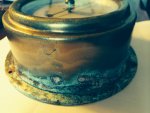
OK, where do I start on this old friend.....
- Thread starter oldvarnish
- Start date

sailorman
Well-Known Member
Dunk in Daddies sauce
I see he is a well respected friend
I see he is a well respected friend
Last edited:

jac
Well-Known Member
Might have to have the case professionally replated if it's of sentimental value.
Otherwise, are you sure the sparkle is worth it?
Otherwise, are you sure the sparkle is worth it?

nigelmercier
RIP
- Joined
- 20 Jun 2007
- Messages
- 16,234
- Location
- Live in Kent, boat in Canary Islands
Ammonia?

Seashoreman
Well-Known Member
If this is solid brass, and it looks old enough to be, I would start with something fairly coarse like No.3 wire wool or even a medium wet and dry paper. Then work down to 0000 wire wool lubricated with Brasso, then polishing rags. There are brass/chrome cleaners that are used in classic car/bike restoration that have a wax incorporated to help keep shine. I use a large buffing mop on a grind-wheel machine, prob you don't have one of those. Elbow grease is a must.
I know people recommend such things as lemon juice/vinegar/Coca-Cola, etc but I would suggest these things are ineffective or may cause pitting to the surface. Otherwise try an antique motorcycle restorer or similar.
I know people recommend such things as lemon juice/vinegar/Coca-Cola, etc but I would suggest these things are ineffective or may cause pitting to the surface. Otherwise try an antique motorcycle restorer or similar.
doug748
Well-Known Member
I have one that looked similar.
They are solid brass but lacquered so when the finish breaks down there is no real alternative than to re-polish the lot.
The glass and frame can be unscrewed. The "movement" is oft held in place by tiny screws in the face. Think about how you are going to store the works when you take them out. The pointer, and the back of the thing, are fragile.
The plastic liner and glass is probably pressed in place and best left as they are while you polish. It is a fiddly job, a Dremel is a good thing to try around the pressed base and emery cloth for the flatter areas. After going down through grades of abrasive paper I polished it up with a mop in an electric drill:
http://www.ebay.co.uk/itm/7PC-Hard-..._Metalworking_Supplies_ET&hash=item1c3dbbbe2b
I got bored and just improved the thing rather than making it perfect. You might be best to finish things off with Metal Lacquer Spray from up the £ shop.
They are solid brass but lacquered so when the finish breaks down there is no real alternative than to re-polish the lot.
The glass and frame can be unscrewed. The "movement" is oft held in place by tiny screws in the face. Think about how you are going to store the works when you take them out. The pointer, and the back of the thing, are fragile.
The plastic liner and glass is probably pressed in place and best left as they are while you polish. It is a fiddly job, a Dremel is a good thing to try around the pressed base and emery cloth for the flatter areas. After going down through grades of abrasive paper I polished it up with a mop in an electric drill:
http://www.ebay.co.uk/itm/7PC-Hard-..._Metalworking_Supplies_ET&hash=item1c3dbbbe2b
I got bored and just improved the thing rather than making it perfect. You might be best to finish things off with Metal Lacquer Spray from up the £ shop.
sailorman
Well-Known Member
If this is solid brass, and it looks old enough to be, I would start with something fairly coarse like No.3 wire wool or even a medium wet and dry paper. Then work down to 0000 wire wool lubricated with Brasso, then polishing rags. There are brass/chrome cleaners that are used in classic car/bike restoration that have a wax incorporated to help keep shine. I use a large buffing mop on a grind-wheel machine, prob you don't have one of those. Elbow grease is a must.
I know people recommend such things as lemon juice/vinegar/Coca-Cola, etc but I would suggest these things are ineffective or may cause pitting to the surface. Otherwise try an antique motorcycle restorer or similar.
I have a couple of items in HP now.
No pitting had it done so i would not have suggested it
sailorman
Well-Known Member
I have one that looked similar.
They are solid brass but lacquered so when the finish breaks down there is no real alternative than to re-polish the lot.
The glass and frame can be unscrewed. The "movement" is oft held in place by tiny screws in the face. Think about how you are going to store the works when you take them out. The pointer, and the back of the thing, are fragile.
The plastic liner and glass is probably pressed in place and best left as they are while you polish. It is a fiddly job, a Dremel is a good thing to try around the pressed base and emery cloth for the flatter areas. After going down through grades of abrasive paper I polished it up with a mop in an electric drill:
http://www.ebay.co.uk/itm/7PC-Hard-..._Metalworking_Supplies_ET&hash=item1c3dbbbe2b
I got bored and just improved the thing rather than making it perfect. You might be best to finish things off with Metal Lacquer Spray from up the £ shop.
a squirt of ACF 50 works well

Lakesailor
Well-Known Member
I bought a hand-drill polishing kit and it works a treat. http://www.thepolishingshop.co.uk/acatalog/Standard_Polishing_Kits.html
I started on my carb dash pots.
This only took half and hour. I stopped from going for the whole mirror finish as I couldn't see I would be keen enough to keep it that way.

I started on my carb dash pots.
This only took half and hour. I stopped from going for the whole mirror finish as I couldn't see I would be keen enough to keep it that way.
john_morris_uk
Well-Known Member
Agree 100% with lakesailor except I got my polishing kit from here:
http://www.axminster.co.uk/heavy-duty-polishing-kit-for-brass-copper-non-ferrous-metals
Works a dream and its little effort. I put the mandrel in the chuck of an old drill and clamp the drill in a vice. (Wear some ear-protectors as the noise is continuous and potentially hearing damaging.)
You spin the polishing mop up and dab a little of the compound (I believe that its called polishing soap in the trade.) on the mop and then manoeuvre the item to be polished up against it. The results are truly miraculous.
Good luck.
http://www.axminster.co.uk/heavy-duty-polishing-kit-for-brass-copper-non-ferrous-metals
Works a dream and its little effort. I put the mandrel in the chuck of an old drill and clamp the drill in a vice. (Wear some ear-protectors as the noise is continuous and potentially hearing damaging.)
You spin the polishing mop up and dab a little of the compound (I believe that its called polishing soap in the trade.) on the mop and then manoeuvre the item to be polished up against it. The results are truly miraculous.
Good luck.

NickRobinson
Well-Known Member
In the absence of power polishers-
Vinegar (or HP etc.. other sauces available) works well on solid brass. No pitting. Submerge the item overnight, initially it looks as if nothing is happening.
It gently takes the the hard oxidation off leaving a brown scum that rubs off with a finger, leaving TCut, Goddard or Solvol Autosol to finish with a damp cloth.
On a boat lacquer is going to be needed unless Roger the cabin boy can polish it regularly..
N
Vinegar (or HP etc.. other sauces available) works well on solid brass. No pitting. Submerge the item overnight, initially it looks as if nothing is happening.
It gently takes the the hard oxidation off leaving a brown scum that rubs off with a finger, leaving TCut, Goddard or Solvol Autosol to finish with a damp cloth.
On a boat lacquer is going to be needed unless Roger the cabin boy can polish it regularly..
N
sailorman
Well-Known Member
In the absence of power polishers-
Vinegar (or HP etc.. other sauces available) works well on solid brass. No pitting. Submerge the item overnight, initially it looks as if nothing is happening.
It gently takes the the hard oxidation off leaving a brown scum that rubs off with a finger, leaving TCut, Goddard or Solvol Autosol to finish with a damp cloth.
On a boat lacquer is going to be needed unless Roger the cabin boy can polish it regularly..
N
ACF 50 is better than lacquer as its easy to remove it

vyv_cox
Well-Known Member
I would avoid any chemical methods, not that they are likely to do much harm, but having possibly dissolved any corrosion products you will be left with pits and similar damage that will need to be abraded anyway. Commencing with coarse abrasive papers and gradually going finer is the way all professionals would do it, including we metallurgists who need a mirror finish on everything we examine.
I recently refurbished a clock that was not quite as bad as your barometer. I started with about 360 grit wet and dry, using Brasso as a lubricant. After more doses of 500 and 1000 grit I continued with Brasso only, to finish with a bright, flaw free appearance.
I recently refurbished a clock that was not quite as bad as your barometer. I started with about 360 grit wet and dry, using Brasso as a lubricant. After more doses of 500 and 1000 grit I continued with Brasso only, to finish with a bright, flaw free appearance.
Blueboatman
Well-Known Member
If it were plated, what ( non ferrous?) would be the base material?
I think I might try a judicious scratch on the hidden back, before going at it full bore..
When revarbishing and re-lining my boat interior , the various brass fitments, catches locks and hooks got the soak overnight in white Asda vinegar(?29p?) to come up like new without rubbing. But not the baro and clock.
I think I might try a judicious scratch on the hidden back, before going at it full bore..
When revarbishing and re-lining my boat interior , the various brass fitments, catches locks and hooks got the soak overnight in white Asda vinegar(?29p?) to come up like new without rubbing. But not the baro and clock.
sailorman
Well-Known Member
I would avoid any chemical methods, not that they are likely to do much harm, but having possibly dissolved any corrosion products you will be left with pits and similar damage that will need to be abraded anyway. Commencing with coarse abrasive papers and gradually going finer is the way all professionals would do it, including we metallurgists who need a mirror finish on everything we examine.
I recently refurbished a clock that was not quite as bad as your barometer. I started with about 360 grit wet and dry, using Brasso as a lubricant. After more doses of 500 and 1000 grit I continued with Brasso only, to finish with a bright, flaw free appearance.
IF it were to be pitted by chemicials those voids caused by corrosion would still be there with the wet n dry method
vyv_cox
Well-Known Member
IF it were to be pitted by chemicials those voids caused by corrosion would still be there with the wet n dry method
How is that then? The idea of the abrasive method is to lower the height of the surrounding metal until the base of the pit is reached. At this point the pit is no longer there.
sailorman
Well-Known Member
How is that then? The idea of the abrasive method is to lower the height of the surrounding metal until the base of the pit is reached. At this point the pit is no longer there.
"IF" a pit is found then yes but if not HP + metal polish job done
Seashoreman
Well-Known Member
I have been cleaning/polishing antique brass for over 30 years and have to agree with Vyv. Nothing personal but I prefer HP on my breakfast. I would like to congratulate you on using a British product but I believe HP is made in Holland now?"IF" a pit is found then yes but if not HP + metal polish job done
sailorman
Well-Known Member
I have been cleaning/polishing antique brass for over 30 years and have to agree with Vyv. Nothing personal but I prefer HP on my breakfast. I would like to congratulate you on using a British product but I believe HP is made in Holland now?
we shop in Lidl & Adli
vyv_cox
Well-Known Member
"IF" a pit is found then yes but if not HP + metal polish job done
.????? This totally contradicts your post #15
Other threads that may be of interest
- Replies
- 13
- Views
- 702
