
Oil change on a Volvo 2003

erich27

Active Member
Joined
15 Mar 2013
Messages
63
Location
Conwy
Visit site
Hello Forumites

I recently purchased a yacht fitted with a Volvo 2003 ( non turbo & raw water cooled ) and in winterising the engine have tried to extract the old engine using my normal hand pump ( used successfully on previous engines ) with minimal results as engine capacity is around 4 litres. ( engine had been run to warm the oil )

Can anyone recommend the best method and or best pump/hose combination to effectively drain the oil ?

Thanks Erich
 
If the oil's warm, you should be able to pump most of it out with a hand pump. On my 2003T, I used to use a Pela vacuum pump.
 
+1; mine is a Plastimo one, I think. You simply put the inlet tube down the dipstick hole. The only tricky bit is ensuring that the tube a) reaches the bottom of the sump and b) doesn't go any further! You also need to take some care to ensure that the various joints are air-tight. For some reason it can be a bit slow to get the first bit of oil through, but once it's flowing, there's no problem. Before I got the vacuum style oil remover, I used one of those brass pumps that chandlers often have; that worked fine, too, but was a lot messier!
 
I have the same engine and have been using a Pela for many years. The first one lasted about 10 years and the second one is going strong. I run my engine for about half an hour before extracting and I also make sure that I keep the pressure well pumped up.
 
I did my 2003T yesterday using a Lidl 12volt engine oil extractor pump with the stiff tube from an old Pela stuck (push fit) on the end of the supplied suction pipe. All went very well with engine warmed up first. The key is to have a stiff extraction pipe and carefully wangle it to the bottom of the sump.
 
Hello Forumites

I recently purchased a yacht fitted with a Volvo 2003 ( non turbo & raw water cooled ) and in winterising the engine have tried to extract the old engine using my normal hand pump ( used successfully on previous engines ) with minimal results as engine capacity is around 4 litres. ( engine had been run to warm the oil )

Can anyone recommend the best method and or best pump/hose combination to effectively drain the oil ?

Thanks Erich
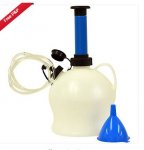
As other suggestions - cheap brass hand pump works for me. Though the Lidl one has done the job, just not easy to find 12v in the engine comparmtent. Also only change the oil maybe twice a year.

Anyway, the big thing is to not push the pipe in too far. Otherwise it bends back up and out of the oil. You will have to move it about to find odd puddles. Well I do.
Also do not let the engine get too hot, just take my word for it.
Wait for the oil to settle and drain from the filter and the engine. Always assumed that it needs to.

Ease the filer cap too, after the engine has been stopped!

Count anything near 4 litres as a result. You will dilute whatever is left with the new oil anyway.
 
I am curious whether anyone has actually drained a 2003 from the sump drain nut?
I keep wondering if it would be worth the effort to get a clean sump and be able to see how much swarf was lying around inside it.
It would be monumentally awkward to reach and undo, and probably even worse to re-assemble.
Up to now, that's a fight I have decided not to pick.
 
I have experienced several failures of the manual brass pumps. The valves seem to distort after exposure to some oils and the pump refuses to suck. I have drained my BMC 2.2 diesel with a capacity of nearly 2 gallons using a Pela, slow but effective.
 
We've had good use out of our Pela. As well as oil changes, it gets used at the end of each trip (OK, most trips) to suck the bilges dry. (Which I then wipe dry and spray with antibacterial stuff. I like a non-smelly boat!) You can cut the junction between the wider transparent hose and the thin stiff black pipe of of the suction pipe, and then use just the wide hose for sucking up water quickly. When you need to do an oil change, the black pipe (which I think is just a Bowden cable outer) can be stuffed up into the end of the transparent pipe, where it makes a good seal.
 
Top