Nut autopsy

lampshuk

Well-Known Member
Joined
10 Sep 2013
Messages
456
Location
Solent
Visit site
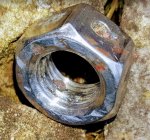
There is some debate going on (at least, inside my head) about what caused the demise of this innocent stainless steel nut, removed from the prop shaft of a Moody 31, 1988 vintage (though the nut and shaft may not be original).

The thread is so badly damaged that it's not easy to get an exact ID, even from dental records, but it measures just under 16mm internal diameter (measuring within the threads). Or approx 5/8 inch, if you prefer.

Eye-witnesses report that the murderer subjected the victim to a sustained brutal attack with a socket wrench, while muttering "Why won't you come off, you little f**ker???")

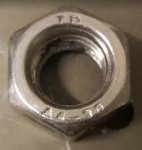
The enclosed post-mortem photo shows potentially useful identifying marks to someone with the right knowledge, but the police have nothing to go on (sorry - punchline escaped from the wrong joke).

I was wondering if the stamped figures offer some clue as to the nut size or thread standard? The full story is slightly more complicated than the facetious scene-setting above, but I was wondering if any of the Practical Engineers on this forum can deduce anything from the picture below?

Thanks for any info or opinions.

Lampsh.
Nut.jpg
 
Last edited:
There is some debate going on (at least, inside my head) about what caused the demise of this innocent stainless steel nut, removed from the prop shaft of a Moody 31, 1988 vintage (though the nut and shaft may not be original).

The thread is so badly damaged that it's not easy to get an exact ID, even from dental records, but it measures just under 16mm internal diameter (measuring within the threads). Or approx 5/8 inch, if you prefer.

Eye-witnesses report that the murderer subjected the victim to a sustained brutal attack with a socket wrench, while muttering "Why won't you come off, you little f**ker???")

The enclosed post-mortem photo shows potentially useful identifying marks to someone with the right knowledge, but the police have nothing to go on (sorry - punchline escaped from the wrong joke).

I was wondering if the stamped figures offer some clue as to the nut size or thread standard? The full story is slightly more complicated than the facetious scene-setting above, but I was wondering if any of the Practical Engineers on this forum can deduce anything from the picture below?

Thanks for any info or opinions.

Lampsh.

View attachment 69983

The A4 refers to the alloy of stainless steel and the 80 is the grade/property of the metal. The TD is the makers mark.

Www.solocoastalsailing.co.uk
 
It'll be larger than that if the ID is 16mm

Measuring the OD of the thread on the shaft should tie the size down

Also measuring across the flats and comparing with https://www.sat.dundee.ac.uk/psc/spanner_jaw.html#Jaw_Size_Table

I thought that but M18 is unusual so I guessed that it might be a bit of dodgy measuring of an M16. If it takes a 24mm spanner I'm sure it will be M16. If the spanner is 27mm it's presumably M18?

Richard
 
Presumably there are some other nuts just like it that may removed , possibly without damage and this might allow the thread pitch to be measured - unless the stud from which the damaged nut has been removed is undamaged in which case its threads on the stud may be measured with a thread gauge.
The nut AF dimension should also help identify metric or imperial although google helps with this
https://www.westfieldfasteners.co.uk/Datasheets/Nut_Hex_M.pdf
.
 
+1

I would run a die down the prop shaft thread and replace the nut. Is it a Nyloc nut? if not is there some form of locking arrangement?

Yoda

I am almost 100% sure it IS galling (cold welding) as the character of the tears to the thread is unmistakable. I had 2 of my new expensive turnbuckles destroyed this way while re-rigging my boat 3 years ago. When it once happens, it is irreparable (not sure about the condition of the shaft here, but the nut is definitely the case) and it is important to make sure it won't happen again. Application of a quality (preferably molybdenum based) anti-seize compound before assembly usually does the job.
 
As suggested, the hexagon af size is a good clue. Assuming the 16mm measurement is good, 27mm af would indicate M18.
Larger would indicate 3/4" bsf @30.5mm or BSW @ 33mm, Unified would be 28.6mm af. All fairly distinct.
Looking at the proportions in the picture, I'd go for metric, M18 is not a first choice size but is common enough.
Re galling of rigging screws, I thought that quality rigging screws had bronze barrels to avoid this problem.
 
........................................
Re galling of rigging screws, I thought that quality rigging screws had bronze barrels to avoid this problem.

I said "expensive", not "quality" :-). The expensive parts on mine was the size and a reusable swagging head. Can highly recommend, actually. But, seriously, apart of the "stainless to stainless" threads the overall quality was good too.
Re to using other substances than anti-seizing compounds to prevent galling; probably a bit of luck is needed here. I was using WD40 - failed miserably In my case.
 
Thanks, all.
Supplying further data:
This is the only nut, so I can't measure any undamaged threads .

It was locked by a through-drilled split pin. Should be a photo below.

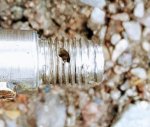
The threaded stud part has been discarded in the process of fixing the prop shaft. Which is, as Tranona suggests, 1" diameter. If I have posted the photo below you will see that it was not in great condition, to put it mildly.

I'm afraid I didn't measure the flats, and I am away from home at the mo, but will make sure to capture it on my return.

Here's the sequence of events that I am struggling with:
The nut was removed in the process of replacing the prop. It came off with the usual application of heat and force. No unexpected drama or trauma.
The new prop was supplied with a large shiny bronze(ish) nut, which spun onto the prop shaft for a few turns, then tightened up. After a few more turns under duress we gave up and concluded it was badly formed in some way so returned it, along with the original stainless steel nut, to the prop manufacturer to match the new nut to the old.
The prop was returned, and another person dry-fitted the new prop, apparently with ease, including fully threading the nut onto the shaft. I have photos apparently showing this but didn't see it in the flesh, so to speak.
At this point, having fitted the prop, we decided that the small amount of play in the cutless bearing warranted its replacement, so the prop had to come off. This was a MAJOR effort, requiring a lot of force even after the initial "pop" of the nut. But it came off.

Cutless bearing replaced ( a real song and dance, but that's another story), time to put the prop back on, but once again the new nut would not thread properly. So as a test I ran the original nut back on. It went on reasonably smoothly to start, but needed increasing encouragement until it bound tightly and needed a lot of force to remove, resulting in the damage to nut and thread.

The prop shaft was removed and taken to an engineering works who fitted a new length of studding to match the new (bronze) nut. This is apparently standard M16.

What's baffling me is how the new nut, having been (apparently) successfully applied once, could fail another time (I am certain I did not cross-thread it) and how could the original nut get so badly damaged being re-applied to its original bolt?

Is it possible that the original stud is imperial (eg 5/8") and sufficiently close in thread form to a modern M16 (say) that they could be confused, resulting in deformation to the stud thread after a couple of applications of the bronze nut, so when the original S/S nut was applied to the (now "modified") stud as a "check" it bound tightly enough to result in the galling (in so many ways) damage?

The job is completed now, but I cannot figure out what sequence of events led to me messing up the thread so badly I needed to repair the prop shaft. So your Holmesian Powers of Deduction are much needed.

Nuthole.JPG
Threadhole.JPG
 
I had to replace a propeller nut which I thought may have been 18mm but turned out to be 3/4 unc.

I think its very likely that the OP's is too

The 16mm ID quoted just does not match up with a metric thread. Neither M16 nor the "non preferred" M18.

I wondered ( # 3) if it might be 3/4" BSW but scaling the AF dimension on the picture suggests probably not

3/4" UNC I think is the most likely. The AF measurement will confirm, or otherwise.
 
Tip re galling.

One of my staff, Reg, was an engineer with a huge amount of on-the-job experience.

We had produced a macerator shaft (for the chicken factory opposite) which had a 50mm X 1mm pitch locking ring on it. Trying the ring for size, it duly locked up.

Reg suggested that we tapped the ring around its perimeter many times while easing it back and forth. Seemingly, the tapping broke the weld and eventually the ring came free.

Saved a very expensive component.
 
There is some debate going on (at least, inside my head) about what caused the demise of this innocent stainless steel nut, removed from the prop shaft of a Moody 31, 1988 vintage (though the nut and shaft may not be original).

The thread is so badly damaged that it's not easy to get an exact ID, even from dental records, but it measures just under 16mm internal diameter (measuring within the threads). Or approx 5/8 inch, if you prefer.

Eye-witnesses report that the murderer subjected the victim to a sustained brutal attack with a socket wrench, while muttering "Why won't you come off, you little f**ker???")

The enclosed post-mortem photo shows potentially useful identifying marks to someone with the right knowledge, but the police have nothing to go on (sorry - punchline escaped from the wrong joke).

I was wondering if the stamped figures offer some clue as to the nut size or thread standard? The full story is slightly more complicated than the facetious scene-setting above, but I was wondering if any of the Practical Engineers on this forum can deduce anything from the picture below?

Thanks for any info or opinions.

Lampsh.

View attachment 69983

Perhaps the previous forced on the wrong nut or cross threaded it. I have known people think that a nut with a different thread acts as a security device. It doesn't, both threads get grolleyed and then your pretty much up the preverbal creek without a dia.
 
Top