Not your average Anchor question

Its not the score that is important but are any of the anchors good all round performers - or is their score 'lifted' or knocked because they excelled or failed above or below the average
I think the best metric would be: What's the worst score after you've excluded any conditions you can reasonably avoid using it in?
 
The Rocna was a development of the Bügel anchor, not the Spade.
I might suggest that to engender credibility you do your home work

Bugel is a flat plate, no ballast, with a crown at the heel. It might be simply a welded up version of a Danforth with a roll bar. But maybe you like insulting Peter Smith.

Rocna is a concave anchor with ballast and a crown mid fluke.

The similarities are - they are both anchors.

Jonathan
 
I might suggest that to engender credibility you do your home work

Bugel is a flat plate, no ballast, with a crown at the heel. It might be simply a welded up version of a Danforth with a roll bar. But maybe you like insulting Peter Smith.
Peter Smith credits BOTH the Bugel AND the Spade as inspirations for his ORIGINAL design. The Rocna is not a copy of either, so I disagree with both of you.

"Yet, as good as the Bügel (AKA Wasi) and the Spade are, there was room for improvement, and the Rocna in a simplistic sense represents the best of both. It has a roll-bar like the Bügel, which guarantees the anchor achieves the correct attitude every time it hits the bottom. The Rocna also has a concave fluke shape, like the Spade, aiming for the optimum resistance given by the spoon form, which maximizes holding power once set." An Essay on New Generation Boat Anchors

Nor is Peter being entirely ingenuous here -- he was trying to get Spade-like performance at a lower cost, and used the Bugel's roll bar to avoid expensive cast lead ballast, and used a simple cut flat plate for a to avoid the Spade's expensive fabricated shank.

He ended up with an improved Bugel which does not match the Spade in performance, but does improve on the Spade cost of fabrication.

I do like the improved shank of the Mark II Rocna. which is beautiful as well as stronger and more streamlined, and the new cast fluke is now more like the Spade than it was, especially at the toe, but the Mk II with all this is obviously more expensive to fabricate than the original, so losing some of this advantage of his design.
 
This works, but would not a single larger anchor be a simpler and easier solution? The weight will be less than two smaller anchors and the associated chain. You will swing like most other boats that will be using a single anchor and have significantly less risk of catching dragging boats.
I assume you did not look at my link? The point of fork mooring is to reduce swing, which becomes very tiring when endured for days. Typically for us the angle of yaw reduces from about 140 degrees to about 40.

Our second anchor in this case is a Fortress with 5 metres of 8 mm chain, the remainder Anchorplait.
 
I assume you did not look at my link?
Yes, I did, and to be clear, I have no concern about deploying a second anchor for comfort.

A more common example is deploying a stern anchor to keep the bow into the swell. When used for comfort the holding ability of the second anchor is not critical to the safety of the boat, so the whole thing can be very small and light. A small Fortress with no chain is a frequently used option.

Where I do have concerns is anchor selection advice that results in the need to deploy a second anchor for security especially in conditions that are not exceptional.

If a larger anchor can be comfortably managed, this is a much better solution and will offer other advantages in more moderate conditions, such as the ability to safely use anchorages with poorer substrates and locations where shorter scopes are needed.
 
Last edited:
I had a look on Gumtree at anchors for sale in Scotland.

Prices seem all over the place, with rusty Fishermen examples apparently carrying an optimistic "antique" premium, but there were some apparently modern types below 50 quid, which I might consider.

I was a bit puzzled by this one. It looks basically like a Danforth, but the "hollow fluke" feature, "winglets" and some of the other furniture seem, to my inexpert eye, to be a bit different. I think it (and another smaller one) have been on the site for quite a while so maybe I'm not the only potential punter puzzled.

Any idea what it is?

BOAT ANCHOR fully Galvanised | in Linlithgow, West Lothian | Gumtree
86
I thought I had seen most anchor designs, but that is a new one for me.

I would stick to more conventional and proven designs.

If buying an old anchor with a pivoting blade such as Danforth or a CQR, check that the geometry (angle of the fluke) is still correct. The pivoting surfaces are sometimes worn, resulting in an anchor that performs poorly.
 
Last edited:
. . .

Where I do have concerns is anchor selection advice that results in the need to deploy a second anchor for security especially in conditions that are not exceptional.

. . .
I think that thread of the conversation started when someone asked "cannot two bad anchors equal one good one?"
 
I had a look on Gumtree at anchors for sale in Scotland.

Prices seem all over the place, with rusty Fishermen examples apparently carrying an optimistic "antique" premium, but there were some apparently modern types below 50 quid, which I might consider.

I was a bit puzzled by this one. It looks basically like a Danforth, but the "hollow fluke" feature, "winglets" and some of the other furniture seem, to my inexpert eye, to be a bit different. I think it (and another smaller one) have been on the site for quite a while so maybe I'm not the only potential punter puzzled.

Any idea what it is?

BOAT ANCHOR fully Galvanised | in Linlithgow, West Lothian | Gumtree
86
If the hollow bit were solid (and therefore heavy) the flukes would stand Jess chance of digging in wouldn’t they?

The hollow bit is there to help angle the flukes into the seabed isn’t it?
 
Nor is Peter being entirely ingenuous here -- he was trying to get Spade-like performance at a lower cost, and used the Bugel's roll bar to avoid expensive cast lead ballast, and used a simple cut flat plate for a to avoid the Spade's expensive fabricated shank.

He ended up with an improved Bugel which does not match the Spade in performance, but does improve on the Spade cost of fabrication.
I had assumed Peter took his use of the roll bar from Pete Bruce who patented the concept, but never used it. His patent predates Wasi.

The original Rocna fluke was made up of two parts, the toe of the fluke has the double thickness of steel, double to become ballast. The rear of the fluke is single thickness - the two parts were welded together. The rear of the single thickness plate was folded up, to make the shallow saucer (concave) fluke and cut to ease the folding and then once folded up - welded. He intentionally had that double thickness, because he needed the ballast (to copy Spade). It would have been much cheaper to have had a single thickness fluke , similarly he would not have had the upturned heel, with the weld - if economy was his primary focus. His focus was copying Spade - not saving money.

He might have saved some money, I'm sure he did - but the resultant Rocna anchor is hardly cheap (in chandlers).

I wonder what steel he is using for his new'thin' roller.

Jonathan
 
Last edited:
I might suggest that to engender credibility you do your home work

Bugel is a flat plate, no ballast, with a crown at the heel. It might be simply a welded up version of a Danforth with a roll bar. But maybe you like insulting Peter Smith.

Rocna is a concave anchor with ballast and a crown mid fluke.

The similarities are - they are both anchors.

Jonathan
???

I pointed out these differences in post #87 (see below). This is why the Rocna is a development of the Bügel and not a copy.

Does that get me out of detention for not doing my homework? :)

Rocna did make some significant improvements, including adopting a concave fluke, skid plates, increasing the fluke size by adopting a more complex construction and using a Delta shaped shank amongst some of the important changes. Many of these improvements were inspired or even directly copied from other anchor designs.
 
Last edited:
If the hollow bit were solid (and therefore heavy) the flukes would stand Jess chance of digging in wouldn’t they?

The hollow bit is there to help angle the flukes into the seabed isn’t it?
I dunno.

Seems to make sense, though I'd think if the hollow was solid , the anchor might actually be too heavy to handle anyway. As it is it could perhaps have internal nose ballast.

However, I wasn't really intending to attempt to deduce its function from the photographs. I suppose that might be possible, but probably not for me, not with any confidence anyway.

What I was hoping was that someone would (a) confirm it wasn't a standard Danforth, which is just my uneducated guess, and (b) identify it as a type/pattern/variant, so I could perhaps look it up.

I suppose it could be a DIY one-off, mad-inventor-welder stylee, but that seems a bit unlikely, since its fairly elaborate and there are two of them for sale.
 
Last edited:
???

I pointed out these differences in post #87 (see below). This is why the Rocna is a development of the Bügel and not a copy.

Does that get me out of detention for not doing my homework? :)

The debate may seem boring and tedious - its trying to engender new ideas - (I hope Di Bono would have approved)

Peter Smith definitely improved a Bugel, they copied a Spade (and added Peter Bruce's roll bar to their interoperation of the Spade). I actually don't think Peter improved the Bugel - Rocna design is simply too far removed to the Bugel design - and that's a personal opinion that I should not need to defend - unless you think a Spade fluke looks anything like a Bugel.

Arguably the roll bar did not add to benefits but maybe detracted - but was essential to allow the resultant anchor, Rocna, to set.

Interestingly the designers of Rocna and Mantus also seemed to think the roll bar was a distraction - and used ballast (a really retro idea).

The Bruce proves you need neither, ballast nor roll bar


I have always believed the roll bar was a step back, a lazy man's answer. Similarly I don't think ballast offers a step forward. Bruce proved you don't need either ballast nor a roll bar (he never used either) - and people swear by Bruce anchors today - 35 years (roughly) later.

Anchors are about hold - (expensive) ballast adds no hold (and what do you actually pay for?), roll bars offer clogging (so the roll bar is a negative addition)

So who is going to produce the anchor that needs neither ballast nor roll bar (you don't pay for useless steel aka ballast) nor a clog inducing roll bar). -

or is the closest to the ultimate already hidden on a bow roller near you.

Jonathan

I might add - I really don't care who did what - its a waste of time, point scoring is childish

Anchors have always developed by copying and modifying.

My motivation is - better anchors (plural) - and PBO seems a good platform to investigate.
 
Last edited:
So who is going to produce the anchor that needs neither ballast nor roll bar (you don't pay for useless steel aka ballast) nor a clog inducing roll bar). -
I agree. Both a bulky toe filled with ballast (such as the Spade) and a rollbar (Rocna) inhibit the anchor from burying. In addition, an anchor with a rollbar will not fit on many boats, and anchor manufacturers want to sell to as wide an audience as possible.

There have always been anchors such as the Danforth and Bruce, which have neither a rollbar nor balast, but these designs have their own limitations created by the unique geometry. The holy grail of anchor design has been to develop an anchor like the Spade but one without any bulky balast chamber.

When the designer of the Spade, Alain Poiraud, left the company, he released a range of anchors designed to do just that. First was the Océane, followed by the very similar Sword, then Raya.

As you might predict with a combination of no bulky balast or rollbar, users report these anchors could be excellent in some situations, but the performance was erratic. Sometimes the anchor would not adopt the correct setting position and produce very little grip. Ultimately, the models were a commercial failure, and few were sold.

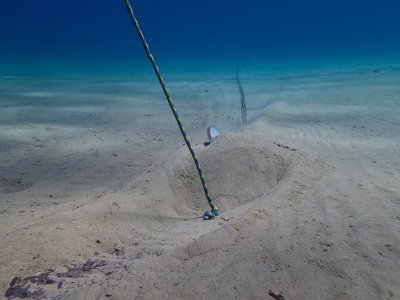
Below is my only underwater photo of one of these anchors. In this case, the Océane. You can see it has set well and is doing a great job, although the significant tilt or list hints at the main problem: without any balast or rollbar, the anchor has little incentive to adopt the correct orientation.

IMG_8895.jpeg

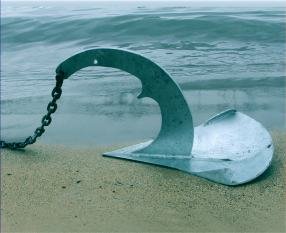
This is photo from the manufacturer showing the geometry:
IMG_8894.jpeg


The modern alternative to this is to use the high-curved shank first used on the Océane (this helps prevent the anchor from staying upside down) but also to add just a small amount of ballast to ensure greater consistency. Many anchor manufactures have released models with these features.

Companies such as Rocna, Mantus, and Viking have adopted a policy of manufacturing both a rollbar model and a non-rollbar design (for these boats where a rollbar will not fit). In this way they have a model that is compatible with bow of almost all recreational boats.
 
I agree. Both a bulky toe filled with ballast (such as the Spade) and a rollbar (Rocna) inhibit the anchor from burying. In addition, an anchor with a rollbar will not fit on many boats, and anchor manufacturers want to sell to as wide an audience as possible.

There have always been anchors such as the Danforth and Bruce, which have neither a rollbar nor balast, but these designs have their own limitations created by the unique geometry. The holy grail of anchor design has been to develop an anchor like the Spade but one without any bulky balast chamber.

When the designer of the Spade, Alain Poiraud, left the company, he released a range of anchors designed to do just that. First was the Océane, followed by the very similar Sword, then Raya.

As you might predict with a combination of no bulky balast or rollbar, users report these anchors could be excellent in some situations, but the performance was erratic. Sometimes the anchor would not adopt the correct setting position and produce very little grip. Ultimately, the models were a commercial failure, and few were sold.

Below is my only underwater photo of one of these anchors. In this case, the Océane. You can see it has set well and is doing a great job, although the significant tilt or list hints at the main problem: without any balast or rollbar, the anchor has little incentive to adopt the correct orientation.

View attachment 200839

This is photo from the manufacturer showing the geometry:
View attachment 200840


The modern alternative to this is to use the high-curved shank first used on the Océane (this helps prevent the anchor from staying upside down) but also to add just a small amount of ballast to ensure greater consistency. Many anchor manufactures have released models with these features.

Companies such as Rocna, Mantus, and Viking have adopted a policy of manufacturing both a rollbar model and a non-rollbar design (for these boats where a rollbar will not fit). In this way they have a model that is compatible with bow of almost all recreational boats.
If we want weight where we need it for balance and tip weight, but we don't want the bulky anchor tip like the Spade has, the only answer is more density.
 
If we want weight where we need it for balance and tip weight, but we don't want the bulky anchor tip like the Spade has, the only answer is more density.
Clever geometry and design can also achieve a high tip weight.

The Spade anchor traditionally had a much higher tip weight (around 50%) than all of its rivals such as Rocna, Excel, Ultra, etc. This is one of its major strengths.

However, some of the modern designs such as Mantus M1 and M2 have managed to equal this and at the same time have a less bulky tip that slides through tough substrates. The trend is to a higher tip weight with less ballast (which allows for larger fluke areas). I think this is the way of the future.
 
Last edited:
. . . Anchors are about hold - (expensive) ballast adds no hold (and what do you actually pay for?), roll bars offer clogging (so the roll bar is a negative addition) . . .
Ballast can alter balance to improve tip weight and orientation.

Ballast can add specific pressure on the flukes.

Ballast can be a really very good thing. Anchor handling is rarely limited by weight, and the anchor is a small part of the total weight of an all-chain ground tackle.

I think the best anchor has fluke area maximized to what can be reasonably handled, to give maximum possible holding power in the nightmare combination of bad seabed and reduced scope.

Which is unrelated to the question of how heavy it should be. On that point -- the heavier, the better. The more tip pressure, the better. More specific pressure on the fluke is certainly the source of the well-known 100 pound rule. Ballast is, yes expensive, but a good way to achieve that.

You say the Rocna is ballasted. But it's just an extra bit of steel plate welded to the tip of the fluke. It's not ballast like what the Spade has. Nor is the weight distribution like that of the Spade. The Rocna is balanced to come up upside-down and needs a swivel. The Rocna is quite a good anchor, mostly very effective, but the balance is a challenge.

The Gen II Rocna maybe is different. That actually looks a lot more like a Spade copy -- the fluke has similar volumes (Gen I is more a concave bent Bugel with a bit of extra plate welded to it; same manufacturing technique). They tried to do it without lead, by casting steel. Very clever idea. I haven't seen a test, but I bet it's much better than the old one.
 
Top