
Bouba
Well-Known Member
Not me. Definitely the wife. I don’t mind but it does upset me having to take orders from her dogWho would you say wears the trousers in your relationship then?

Not me. Definitely the wife. I don’t mind but it does upset me having to take orders from her dogWho would you say wears the trousers in your relationship then?

Not me. Definitely the wife. I don’t mind but it does upset me having to take orders from her dog
Very interesting resurrecting this thread and to see that the success of an N41/52 type of boat was kind of predicted. More coastal cruising than ocean crossing. Also with a bit less hull in the water the economy improves. An average of around 1 MPG at displacement speed for a Nordhavn 52 (MV Dirona blog) is not that economical.

In my experience, these views (mostly from women, but not only) are much more driven by the reverse slanted windscreen alone, rather than all the rest of the boat.
A solution that makes a lot of sense as we all know, but does scream "commercial".
They managed to smooth that a bit witn the N41, but (to my knowledge) the only Nordies where they completely departed from that principle were the 50 and 57.
Both now phased out, but occasionally available on the used market, and in several ways they can be considered among the last of their best boats.
Maybe worth showing to your wife and check out what she thinks...
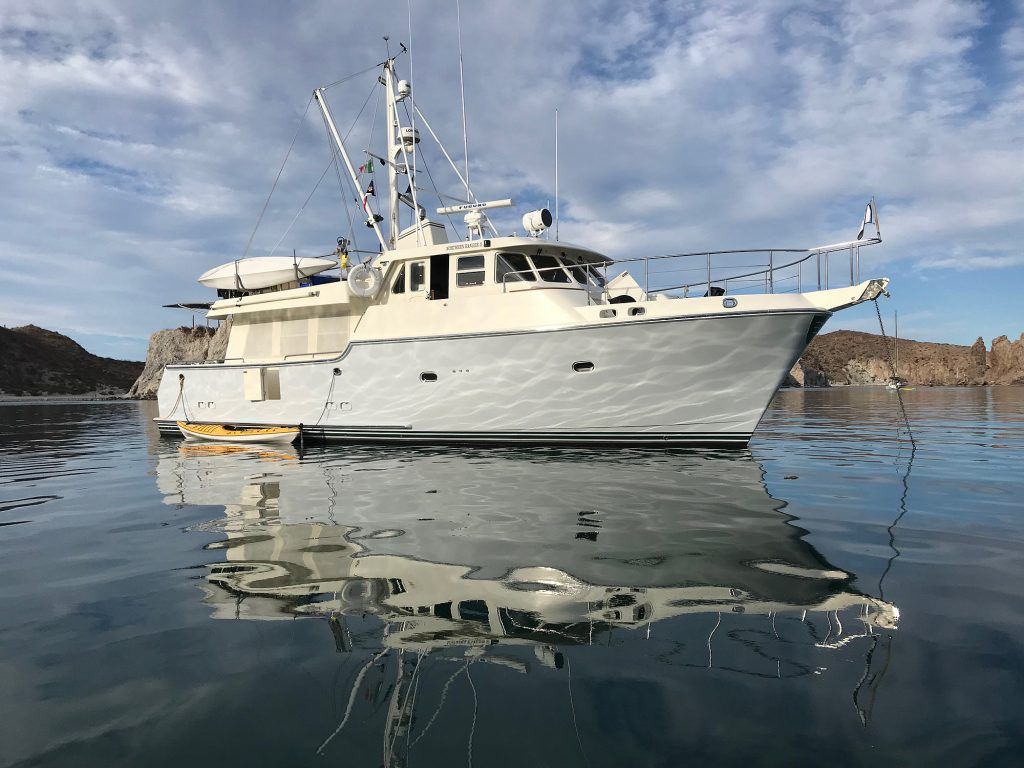

Very interesting resurrecting this thread and to see that the success of an N41/52 type of boat was kind of predicted. More coastal cruising than ocean crossing. Also with a bit less hull in the water the economy improves. An average of around 1 MPG at displacement speed for a Nordhavn 52 (MV Dirona blog) is not that economical.
The figures for Dirona are US gallons, about 3.8 litres instead of 4.5. It doesn't contradict your argument but it's worth mentioning.It is not terribly impressive. A sailing yacht of the same displacement (but always a longer DWL) will do over three times the nm/g under engine at 6.6kt. Consumption for a displacement boat is of course a function essentially of waterline, displacement and speed.

We had an early model N50 at a local (Hobart) marina, owned by a couple quite new to boating and living aboard.
I liked the lower profile of the boat, still looking a purposeful trawler and very beamy for length and height.
They have since sold the boat and bought a later model N55, which for the extra five feet in length, looks like a block of flats in comparison.

I’m told that the 55 is particularly fuel hungry. Having said that, it does offer a lot of living space for its size. A good friend of mine who had a N62 calls it a wedding cake boat.We had an early model N50 at a local (Hobart) marina, owned by a couple quite new to boating and living aboard.
I liked the lower profile of the boat, still looking a purposeful trawler and very beamy for length and height.
They have since sold the boat and bought a later model N55, which for the extra five feet in length, looks like a block of flats in comparison.
Quite. It’s all about value for money. A New Zealand build FPB was massively more expensive per square foot of boat real estate than a Chinese built Nordhavn. As you say, fuel cost doesn’t matter that much for buyers of new boats, so I agree, the new Nordys are a much more attractive purchase proposition.The figures for Dirona are US gallons, about 3.8 litres instead of 4.5. It doesn't contradict your argument but it's worth mentioning.
You are right about the comparison with a sailing yacht of the same displacement. Fuel economy was one reason why Dashew designed an ocean-crossing motorboat which has a hull form very much like a yacht - the FPB.
But Nordhavn have built over 500 boats worth billions of dollars. How many people actually bought a new FPB before they went out of production? The answer is 18 (FPB Motor Yachts Archive - Berthon International).
And why do you think there is that disparity in commercial success? I suggest that one of the reasons is that in the market for ocean-capable motorboats fuel economy has not, at least until now, been top of the list for actual buyers. And if you don't cross oceans the fuel economy is perfectly acceptable by any rational measure. We get just under a mile per litre in our 40 and diesel is literally the smallest item in our annual boating expenses.
Standing on a floating pontoon looking up at the bow and profile, at 55’, they are a serious piece of floating real estate for the length.I’m told that the 55 is particularly fuel hungry. Having said that, it does offer a lot of living space for its size. A good friend of mine who had a N62 calls it a wedding cake boat.
My favourite model (not that I could ever afford one) is the original 46 - their popularity drives up their value, and they do not seem to stay on the market for long.
I agree M, from the first time I saw the Flanders’ “Egret” many years ago, they really have a great traditional look as well as functionality.
Mind you, it also takes special people to crew these boats deep into remote oceans and high latitude locations to relay the stories we enjoy reading about.


Very interesting resurrecting this thread and to see that the success of an N41/52 type of boat was kind of predicted. More coastal cruising than ocean crossing. Also with a bit less hull in the water the economy improves. An average of around 1 MPG at displacement speed for a Nordhavn 52 (MV Dirona blog) is not that economical.
That sounds about right, Scott said Egret was doing one litre per nautical mile, mind you no more speed than six knots of speed.This American couple is travelling around the world slowly on their Nordhavn 46 'Starlet', and they are having an amazing time - Jennifer posts stories about their adventures on her Facebook page.
A few years ago they were here in Barbados; they have spent the last year or so in New Zealand, and are planning on heading west to Australia soon.
Oh, and I remember reading one post where Jennifer mentioned their fuel consumption on passage - and I am pretty sure that they were getting at least 3 - 4 miles per gallon.
Jennifer Ullmann
View attachment 117183