No GPS? No problem.....

And, a friend read Lewis about Pacific nav by the early guys; Apparently they squatted and let their testicals touch the deck. Gave a more sensitive 'read' on the motion of the sea, allowing them to find islands more accuratly. Of course, no mention of the failure rate.
Said friend was going to give it a go it, having tried to sail an old local fishing boat from near OZ to the UK. Foundered by Chrismas Island..
Goolies dragging on the deck while squatting? I can only speak for myself of course but...................
 
RAF air navigators were, in the 70s, trained to be able to use just about every form of navaid that was available. GNSS aka Satnav had not then been invented, but we used RDF kit on powerful marine beacons most of the time/whenever practicable, to get Lines Of Position/LOPs to cobble together into fixes.
Some of those had a nominal range of 200nm e.g Round Island.

I earned my keep on some RAF boats doing RORC races as I carried a laminated CONSOL chart, and could always get a usable fix. AIR there were still 3, perhaps 4, of those war-time beacons still transmitting - Ploneis/Brittany, Stavanger/Norway, and Bushmills/Ulster and, I believe, another one on the NW corner of Spain which shut down during the 1970s.

Two other sneaky tricks involved using one of HMQueen's marine sextants ( there was an MoD warehouse stuffed full of them, allegedly purchased - so the story ran - in the days when we still had some flying boats and a Marine Craft Division ). This device could provide 'horizontal sextant angles' when prominent land objects such as headlands and powerful lighthouses were visible, and an accurate fix derived. A 'verticle sextant angle' plus a compass bearing on e.g. Portland Bill or Bishop Rock lighthouse also could provide a swift and reliable fix.

The other 'clever dick' trick was that, as aircrew, I was permitted to access my base's Met Office and wheedle out of the Senior Forecaster a detailed printed forecast for the race route, including possible secondary developments and what clues-to-change to look for in the weekend skies. AIR no-one else then had such a resource.

;)
 
RAF air navigators were, in the 70s, trained to be able to use just about every form of navaid that was available. GNSS aka Satnav had not then been invented, but we used RDF kit on powerful marine beacons most of the time/whenever practicable, to get Lines Of Position/LOPs to cobble together into fixes.
Some of those had a nominal range of 200nm e.g Round Island.

I earned my keep on some RAF boats doing RORC races as I carried a laminated CONSOL chart, and could always get a usable fix. AIR there were still 3, perhaps 4, of those war-time beacons still transmitting - Ploneis/Brittany, Stavanger/Norway, and Bushmills/Ulster and, I believe, another one on the NW corner of Spain which shut down during the 1970s.

Two other sneaky tricks involved using one of HMQueen's marine sextants ( there was an MoD warehouse stuffed full of them, allegedly purchased - so the story ran - in the days when we still had some flying boats and a Marine Craft Division ). This device could provide 'horizontal sextant angles' when prominent land objects such as headlands and powerful lighthouses were visible, and an accurate fix derived. A 'verticle sextant angle' plus a compass bearing on e.g. Portland Bill or Bishop Rock lighthouse also could provide a swift and reliable fix.

The other 'clever dick' trick was that, as aircrew, I was permitted to access my base's Met Office and wheedle out of the Senior Forecaster a detailed printed forecast for the race route, including possible secondary developments and what clues-to-change to look for in the weekend skies. AIR no-one else then had such a resource.

;)
A late friend of ours was navigating in air-sea rescue boats in the Baltic after the war. One of the events was a prize for the navigator to be the first to give the final course-to-steer for home. Our friend realised that the steering compass was above his head, so he simply had to give an approximate course and later rotate the compass to compensate for any errors in his prediction. He claimed to have been a serial winner.
 
The Navy doing 1,800 miles celestially is impressive.

I don't think it really is. They had Radar, they had 24hr dedicated professional lookouts. They had a stable platform. People used to to this without a good view of the sky for weeks. People used to do this in aircraft. 12yo midshipmen used to do it.

I suspect there are many jobs on that ship an average person couldn't do. Astro nav isn't one of them.
 
Last edited:
I guess GPS has taken some of the adventure out of sailing,
Mike Peyton did a cartoon of a yacht heading in between pierheads and the crew asking "do you know what courtesy ensign yet, skipper?"
And taking several different currencies, "just in case".
 
I guess GPS has taken some of the adventure out of sailing,

Combined with proper usable engines and accurate weather forecasts that's certainly true. I knew an old boy who had, on a perfectly normal family holiday, run out of wind mid channel and drifted in circles for 4 days. He didn't really know where he was, when the wind filled in he just went sort of North and worked out where he was from the landscape.

These days with an engine that's good to take you all the way and known weather you can go over to France on a Friday night and come back Sunday in pretty certain knowledge you'll be at work on Monday.

In fact, of the three the GPS feels the least essential to me. We can always work roughly where we are, accurately enough that we could get in somewhere. Most of us couldn't make much headway against an unexpected blow on the nose. Nor could we do much about lack of wind without an engine that was good for the whole distance.

I suspect we regain adventure by going further and getting into tighter anchorages.

Edit: I predict someone is going to say "Yuloh".
 
Last edited:
I knew an old boy who had, on a perfectly normal family holiday, run out of wind mid channel and drifted in circles for 4 days. He didn't really know where he was, when the wind filled in he just went sort of North and worked out where he was from the landscape.
Which is why there were an awful lot of blokes sailing on their own, while their families went to Butlins.

I've no objection to a bit of adventure, but I have to confess that, when I get 10 miles off the coast, being able to decide which entrance to Cherbourg harbour works best for the tide, and knowing I'm going to get there, has definite advantages over wondering if that's the Val de Saire or La Hague, and even bigger advantages over, if I can't see the land, wondering if I'm heading for Caen or St Malo
 
Which is why there were an awful lot of blokes sailing on their own, while their families went to Butlins.

I've no objection to a bit of adventure, but I have to confess that, when I get 10 miles off the coast, being able to decide which entrance to Cherbourg harbour works best for the tide, and knowing I'm going to get there, has definite advantages over wondering if that's the Val de Saire or La Hague, and even bigger advantages over, if I can't see the land, wondering if I'm heading for Caen or St Malo

Most of us do, but, as DT wrote, that lessens the adventure. I think it was Tristan Gooley or maybe Alastair Humphreys who defined an Adventure as embarking on a journey with no guarantee of success. Sailing used to provide that on any longish trip. When you have an accurate forecast and a 40hp engine and a clear idea where you are, the yottie is almost certain to arrive and usually knows pretty much when and it's more of a PITA than and adventure.

Mind you, on my old Corribee the OB was very much an auxiliary so I guess I've had a fair taste of those days and it's more of a PITA than an adventure.
 
Last edited:
Sailing in recent years has certainly been enjoyable, in fact for most of us a lot more so. Even without fog, navigation and pilotage were always interesting if not challenging. In local waters it was quite usual to sail up to every buoy to read its name just to be sure. I have never had a totally unreliable engine, though some of mine have had their moments. The 2-stoke Dolphin in our Mystere was always good for a laugh when I cut the gearboxless engine as I approached a mooring or raft in order to start it again in reverse. When I eventually found the right spark plugs it was pretty reliable.

Whether these vicissitudes were good for us or made us better sailors is perhaps a philosophical point, but there was a kind of satisfaction after each trip that I don’t think I experienced when a bigger boat with multiple aids appeared.
 
Remindeds me of something Tom Cunliffe said in a podcast. Somehting about making a landfall after a month at sea using only the sun and stars, how that’s something GPS can’t give you. The Navy doing 1,800 miles celestially is impressive. What i find remarkable is how quickly that skill has been lost, and how 'traditional nav' is now treated like wizardry. 7. Engines Off, Stars On — Tom Cunliffe on Seamanship, Self-Reliance & his thriller Hurricane Force
Totally agree with Mr. C. Having a crew bet on our landfall position was great sport.

I can also remember him saying ' it's your turn to go to the bar to get the rum'.
 
Most of us do, but, as DT wrote, that lessens the adventure. I think it was Tristan Gooley or maybe Alastair Humphreys who defined an Adventure as embarking on a journey with no guarantee of success. Sailing used to provide that on any longish trip. When you have an accurate forecast and a 40hp engine and a clear idea where you are, the yottie is almost certain to arrive and usually knows pretty much when and it's more of a PITA than and adventure.

Mind you, on my old Corribee the OB was very much an auxiliary so I guess I've had a fair taste of those days and it's more of a PITA than an adventure.

Back when we used to religiously keep a log we only filled in the destination once we had actually arrived as outside of rallies quiet often something would happen to change our plans such as weather meaning we pushed on or cut short our intended trip,

Probably why I feel the loss of flexibility in having to book ahead quite keenly
 
Our daughter had a boy-friend in the navy during the first Gulf War. As well as requesting Hobnobs from the folks at home, I believe that a GPS was borrowed from a yachting source. I didn't get GPS until 1999, following Decca, but I suppose that yachtsmen must have had them in '91.
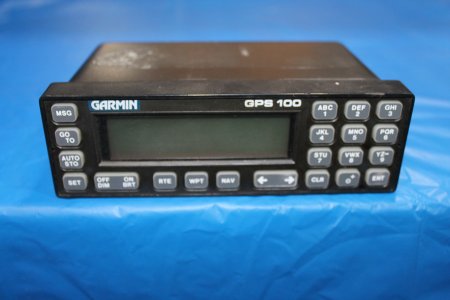
I flew an HS748 from Exeter to Singapore in 92/93 using the new Garmin GPS100.

I had to enter waypoints from the lat lon of fixes on the Jeppesen charts. I think it only stored 20 waypoints so lots of button pushing on the route Exeter-Rome-Athens-Luxor-Bahrain-Karachi-Yangon-Singapore.

GPS100WithTray_2.jpg
 
anyone remember these, I am sure they were described as pirate copies at the time.
s-l400.jpg
 
I flew an HS748 from Exeter to Singapore in 92/93 using the new Garmin GPS100.

I had to enter waypoints from the lat lon of fixes on the Jeppesen charts. I think it only stored 20 waypoints so lots of button pushing on the route Exeter-Rome-Athens-Luxor-Bahrain-Karachi-Yangon-Singapore.

View attachment 202497
My father started as a BA (BOAC) pilot in the early 50's and used a bubble sextant for Nav for most of his early career. Even the Boeing 707 had a dome for bubble sextant use though he said that it didn't get used as other forms of nav came in. INS was the main one till he retired in early 80's. The early ones could only store nine waypoints so, like you, there was a lot of button pushing. It tended to drift too so needed a correction from radio beacons when in range.

On our family boat we had Decca in the early 80's then when we changed boat GPS was fitted around 1990 I think. But like everyone else I still remember bouncing around in the middle of the channel never fully knowing exactly where you were.
 
"Navigation is not done on a chart table. It is done between the ears."

The words of the RAF's Chief Navigation Instructor still whisper down the decades. In an age when every METS boat show heralds another advance in 'black boxery' to take the thinking out of the task, we are occasionally reminded that the Pacific Ocean was explored end-to-end over centuries by Micronesian fishermen who had neither electricity nor a written language, but whose palu could find their way over hundreds of miles to a pinpoint atoll, simply by observing what was above and around them - and thinking.

It is misleading to dismiss 'astro' as a navigation art of the 18th century. Britain's Vulcan bombers planned and trained to go to war, if so required, by use of astro-navigation. No electronics, received or transmitted, were required to get to an accurate position, sufficiently close for accurate bombing. ( So also were the USAF's strategic B-52s for many years. ) A competent crew could fly a 2000-mile route, then fly down a pre-planned corridor in the sky less than half-a-mile wide on Astro and Deduced Reckoning, to drop a bomb within a couple of hundred yards of target, within 10 seconds of planned time. This was done regularly and, at NATO Bombing Competitions, to the astonishment of the Yanks, the French and, presumably, the Russians.

The two periscopic sextants in our Vulcans, and other nav equipment, were calibrated to the inch. So were the people.

The 'Murricains put more emphasis and money on their equipment, and their B-52s were equipped with astro star-trackers ( aka sextants ) which resolved the 'WTFAW' question continuously and accurately. Even more expensive astro star-trackers were built into the Lockheed SR-71 "Blackbird" - a long-range, high-altitude, Mach 3+ strategic reconnaissance aircraft - which fed precise position corrections into the most sophisticated inertial guidance package on the planet.

Every Apollo spacecraft mission carried and used a dedicated sextant.

The few smallcraft navigators who recognise the worth and the satisfaction, and who take the trouble to learn how, have the confidence to know that if/when the 'lectronics fail for any of a hundred reasons, they can bring their precious wee boat and their precious wee crew to a safe haven, using their brains and their sextant.

"Navigation is a thinking skill."
 
Last edited:
Top