Farmer Piles
Well-Known Member
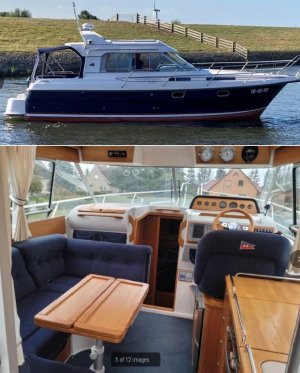
The Aquador berth is also just a shade over 6 feet long.


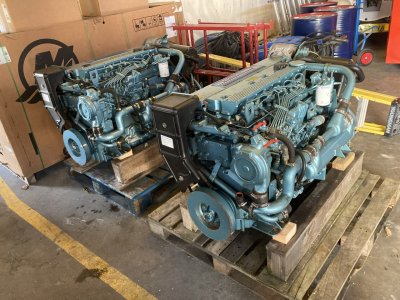
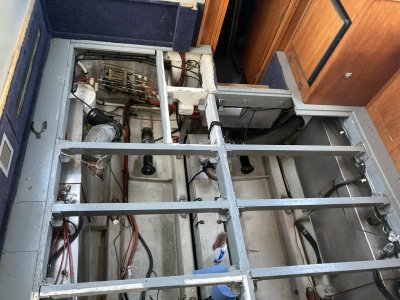
Good feedback again thank you SimonD. I use to run a single donk (Detroit 650hp) on a boat in NZ, and always felt comfortable as long as well serviced, but I know what you mean. I get the impression the Nimbus is not ideal for a twin engine setup. It’s also a good point you make about not taking the bottom, and had not considered this, though used to this as the Seaward has the same issues.If you're serious about a Nimbus you should be aware that the 310/320 was designed with a single engine. I'm not looking to start a single v twin engine debate, but it does make a difference on the Nimbus. The single engine has a decent amount of room to get round the engine. The prop shaft is supported by the shaft log; the prop sits right behind the rudder and is protected by a substantial skeg that supports the rudder. To fit twin engines (I believe at the request of the UK distributor) some space was taken from the guest cabin and still look like a tight fit. The shafts are supported by cutlass bearings and there are twin rudders behind the props which are not protected. You may or may not be bothered by the differences.
One other thing you should know. The 310/320 was never intended to dry out (even with legs). Again, you may not be bothered by this, but I found drying ability really useful on a previous twin keel boat.
Umm. I beg to differ. If that were the case, why is the Nimbus 320 in Cat B - capable of operating offshore with winds to 40 knots and significant seas to 13 feet? Also, has anyone ever heard of a 320 (or any other similar Nimbus design) having had a roof collapse? Bear in mind there are hundreds of them built over many years. I respectfully suggest you're very much mistaken (IMHO).I would examine very carefully my intended use before committing to Nimbus 320. The huge saloon 270 degrees of glass is not bonded and sits in aluminium or s/s farming, and supports the roof. That's absolutely fine for coastal cruising but is completely unsuited to having a few tons of green water hit it at 10 knots. That's just physics, and this is a strange engineering choice imho by Nimbus. So I wouldn't choose this boat for inter-island Mediterranean use or for UK use say 30 miles+ from land. Perfectly fine for UK coastal use. All imho.
The Aquador has the benefit of the frames for its sliding doors, which adds some strength and stiffness to support the roof when/if hit by green water.
Some old threads on these boats:Starting to get a bit claustrophobic in my Hardy with its one open plan space now we have more time to go on longer trips. Looking for the elusive 30-32 foot solidly built mobo and the Nimbus 320 keeps coming to the top of the list. I know it has narrower side decks than the Hardy but how do folks find it?


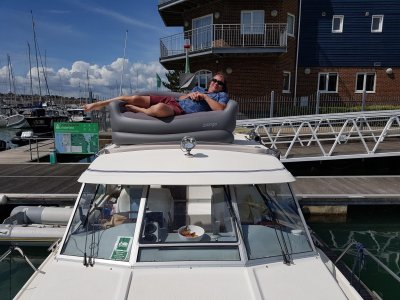
HeliumI've never thought about the strength of the roof before. But I am reminded of an attempt at a flybridge a few years ago
View attachment 168434
Helium filled settee no doubt.I've never thought about the strength of the roof before. But I am reminded of an attempt at a flybridge a few years ago
View attachment 168434

From observation of the photographs it seems to me the window frames are not supporting anything at all and are just there to carry the glass. Instead the roof structure appears to be a cantilever from the pillars at the rear of the glazed section.Picture below - not much supporting the roof when a ton of water lands and decelerates onto it. Serious classification societies insist (even with bonded windows, let alone unbonded windows a la Nimbus) on thick mullions so that roofs can take a few tonnes of water .


Seriously Martin, plenty of pleasure boats are specifically designed (using finite element analysis) to take a considerable weight of water on the roof of the inside helm, with chunky mullions designed/constructed calculated precisely for that. The boat I have in build now in Italy has precisely that engineering, hence rather fat mullions.If we are agreeing that no leisure motorboat is specifically designed for a Ton of water landing on it then I agree 100%.
My point about a canvas top sportscruiser is it has negligible resistance to a wave landing over the helm so in that respect the Nimbus is superior.
As far as cantilever structures are concerned the stiffness and deflection under any given load could be evaluated given the dimensional and properties of the structure together with young's modulus for the structural material (GRP in this case presumably) but that can't be calculated from a photograph.
I didn't realise you were a Structural EngineerYour last para is true, but telling me how to suck eggs.


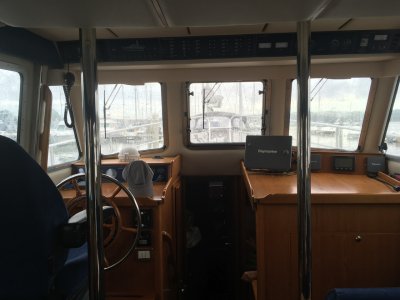
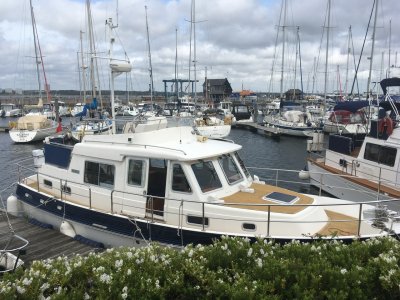
Decks wide enough to walk on , Stantions that do not flex, decent height combings....two cleats midships ..... no daft davits loading down the sternWell I reckon we have it covered on the mullion front!
Not sure SWMBO would be too keen on the ton of water test though
View attachment 168517
View attachment 168518
Decks wide enough to walk on , Stantions that do not flex, decent height combings....two cleats midships ..... no daft davits loading down the stern
Where will it all end ?
Form follows function....the boat designed to perform on the water, quite probably by a Naval Architect, as opposed to a piece of "boat art" for display in a marina and most probably somebody whos last job was designing handbags.
Mind you no room for the compulsory twin SatPhone Domes !

Lovely boat .Well I reckon we have it covered on the mullion front!
Not sure SWMBO would be too keen on the ton of water test though
View attachment 168517
View attachment 168518
Lovely boat .