Night Scope Apps for Smartphone

I imagine phones (like most cameras) have an IR filter so will do badly at night vision. It’s probable they’d do better than eyes but won’t be as good as a device designed for the task.
 
I bought a ThermalMaster P2pro for diagnostic work, which is a bit of a deviation from proper scopes. It works superbly at short range (inside the house) and I've been wanting to try it over distance too. It only has a fixed focus lens, so it should pick up things a distance away.
In fact I'll try it now as I've got a few minutes while my tea brews...
 
I bought a ThermalMaster P2pro for diagnostic work, which is a bit of a deviation from proper scopes. It works superbly at short range (inside the house) and I've been wanting to try it over distance too. It only has a fixed focus lens, so it should pick up things a distance away.
In fact I'll try it now as I've got a few minutes while my tea brews...
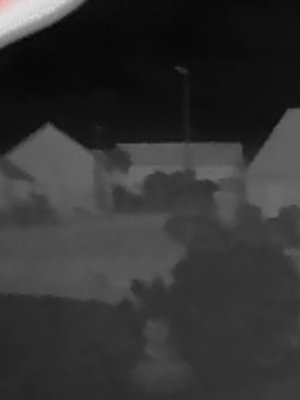
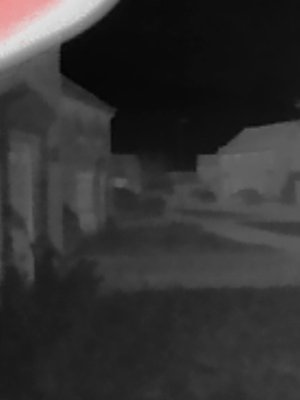
These are thermal images, not light enhancement. First pic is about 80m to the long building and second is a good 100m to the end of the road.
I saw a seagull fly past about 50m away.
These results are interesting enough to want to take it in to the boat for further tests 😁
(You can choose a range of colour interpretations, but this seems clearer than the conventional reds and purples, although on an uncluttered seascape, it might be down to personal preference).
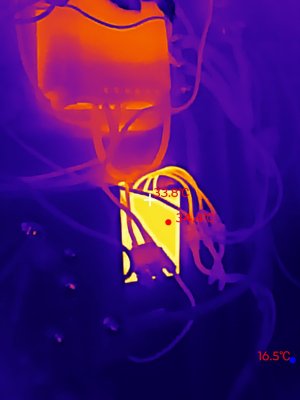
It may or may not be any use for night vision, but it might be. Either way, it is very useful for the purposes for which I bought it though (if a little alarming seeing things looking as if they're about to melt - one drawback is that it calibrates the colour ramp on the fly, between the min and max in the image, so the hottest thing is always white hot nearly. I haven't found a way to change this, which is my only gripe)
 

Attachments

  • P2_260122_130948_698.jpg
    P2_260122_130948_698.jpg
    34.3 KB · Views: 43
  • P2_260122_130958_166.jpg
    P2_260122_130958_166.jpg
    40.4 KB · Views: 18
  • P2_250715_110800_594.jpg
    P2_250715_110800_594.jpg
    96.3 KB · Views: 41
Most modern plotters support IP cameras I’ve been considering fitting one under the radome looking forwards. A lot of home security IP cameras are IR capable
 
Most modern plotters support IP cameras I’ve been considering fitting one under the radome looking forwards. A lot of home security IP cameras are IR capable
I'll take two, have them delivered to my Mayfair address :LOL:
 

Attachments

  • Screenshot at 2026-01-22 14-00-18.png
    Screenshot at 2026-01-22 14-00-18.png
    225.7 KB · Views: 41
Don’t need a marine one, they’re all waterproof. Start at £30ish on Amazon
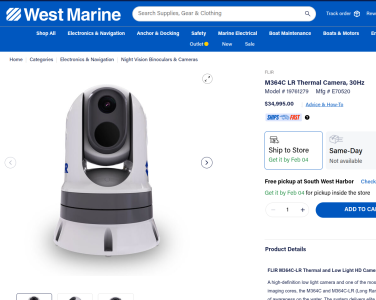
I'd guessed that, but I knew the pukka ones weren't cheap and that 30k one was rather more not cheap than I thought.
It'd be interesting to see the results of an implementation of a domestic one though - something normal people could afford...
 
Don't you mean delivered to your concierge in Mayfair.
I thought about all sorts of better things, but needed to keep it short - it would actually have gone to one's man down on the Hamble or Lymington. rather than one's own address as one would certainly not be fitting it oneself...
 
In case it's not obvious, thermal imagers, like that Flir and the mentioned P2 Pro (which appears to be a rebranded InfiRay P2 Pro) and "regular" IR cameras are completely different things.
IR-sensitive cameras are basically regular cameras, just sensitive to wavelengths a little bit outside of visible spectrum (~900 nm), they still work on reflected light. That's why "night vision" security cameras have the IR diodes to illuminate the scene with IR light.
Thermal imagers work differently, they detect radiated heat (wavelengths around 10 μm) and work even in complete darkness. Making microbolometers (the sensors) and the germanium lenses to go with them gets expensive really fast, if you need high resolution and/or high framerate.
That said, the little phone-attached thermal cameras are really useful gadgets for all sorts of things, from house inspection to electrical and electronics work. Not long ago thermal cameras were way out of budget for normal people, guess at least something good came out of covid, when chinese started developing and mass-producing affordable thermal cores with reasonable performace (to detect people with elevated body temperature). Higher res thermal cameras, while not quite Flir price, are still not particularily cheap, e.g. Thermal Imaging Dome Camera
 
I agree that there's nowadays something potentially interesting you could do with a plotter's network camera feed and either low-light or thermal cameras for not a huge amount of money, but the original post asked about smartphone "nightscope" apps and whether they were worth downloading, presumably to an ordinary phone. I haven't tried these but I am really doubtful that they can wring much more out of the phone's camera than it already does when you take a picture in bad light. The data's just not there.

There are some Android phones that have real low-light cameras or even FLIR thermal imagers built in. Some are ok and some odd-brand ones aren't all that expensive, but pick carefully. Frame rate on the thermal imagers may be limited, mine is. Could be a problem on a boat.
 
Top