Newish RCBO won't trip with test button

Bertie1972

Active Member
Joined
16 May 2016
Messages
68
Visit site
I replaced my 10 yr old RCBO a year ago because the test button wouldn't trip it.

It has been fine up to now, but now the test button won't trip the new one. (Either at the boatyard or pontoon supply)

I tried a socket tester plug and it didn't show a fault.

I'm thinking something may be awry apart from the RCBO itself - but not sure where/what to check.

What do the team suggest?
 
What do the team suggest ? An electrician?
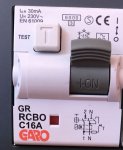
Check the diagram on the front of the breaker.
Does the test function depend on Earth being present?
Mine doesn't, so if the test button doesn't trip it, either there are not enough volts on the supply or it's broken.
 
I replaced my 10 yr old RCBO a year ago because the test button wouldn't trip it.

It has been fine up to now, but now the test button won't trip the new one. (Either at the boatyard or pontoon supply)

I tried a socket tester plug and it didn't show a fault.

I'm thinking something may be awry apart from the RCBO itself - but not sure where/what to check.

What do the team suggest?
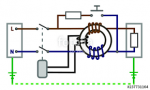
Normally the trip is a feed from the output live to the input neutral, so the RCD sees an imbalance between live and neutral lines and trips. Normally a little diagram on the front of the RCD. In the past I have had a lot of problems with some RCD's that break a little pin on trip and stop resetting after pressing the test button, never had test button not trip though.

Was it a Ebay item ?

Brian
 
This is a diagram of a typical RCD The button at the top is the test button which shortens the N and L through a resistor on different sides of the current transformer. If you RCD sis not trip there must be an open circuit in the test circuit some where.

1590860291568.png
 
I wouldn't assume the test circuit is faulty, it could be the thing is stuck due to corrosion.
It's probably a domestic item and boats can be humid...
Buy a new one.
 
Assuming your supply feed is reliable. Because if there is no power to the device then the test button will not work.

This week I came upon an RCD that appeared to work fine on my professional RCD tester, but occasionally would not work on the test button. I was not on the job for that particular problem, so plan to have another look at it next week. I will probably end up replacing it. It looked to be 15 years old and was in a high humidity location (not in a damp proof enclosure either), An RCD is a very important safety device, so if in doubt then I would replace it.

You can buy water proof enclosures for RCDs.
 
What do the team suggest ? An electrician?
Check the diagram on the front of the breaker.
Does the test function depend on Earth being present?
Mine doesn't, so if the test button doesn't trip it, either there are not enough volts on the supply or it's broken.

Here's the diagram.

I've ordered another one and will report back.


RCBO.JPG
 
Did you regularly test it using the button? A lot of people don't. Manufacturers generally suggest anything from 1 - 3 months. New regs suggest 6 months but manufacturer instructions should always be followed if less.

Could be jammed, could be faulty. As suggested above for the sake of a few quid, just swap it.

Maybe spend a few more quid on something like a Merlin or ABB instead of a generic random branded thing?
 
Sometimes the test buttons do fail due to corrosion and the RCD still works under fault conditions but it still needs replacing.
Where is it does it get damp, could you put it in a decent IP65 enclosure Garo do some nice ones 2 module about £15 from most wholesalers. A more expensive / better make might help but probably not, the Schnider, Merlin Gerin, Wylex, Hager price range ones are generally better at coping with running at full load for extended periods, the RCD side of things seem pretty similar. Your other option is to put a RCD and separate MCB in the same enclosure, you might find it easier/cheaper than getting a double pole RCBO?

As said before test it regularly as this will help to keep the contact on the test button clean and keep the mechanical part of the device running freely.

You could always test the RCD with a proper tester to see if it is just the test button, it still needs replacing but would give some reassurance that it was working for a real fault (My day job is as an electrician!)
 
They do seem to fail reasonably often.

When on shore power it is worth considering a additional RCBO that is plugged into the marina pedestal and there will protect the cord from the dock to the boat even if the marina RCD is defective or is not fitted. They are not expensive.
 
Did you regularly test it using the button? A lot of people don't. Manufacturers generally suggest anything from 1 - 3 months. New regs suggest 6 months but manufacturer instructions should always be followed if less.

Could be jammed, could be faulty. As suggested above for the sake of a few quid, just swap it.

Maybe spend a few more quid on something like a Merlin or ABB instead of a generic random branded thing?

Takeaway message for me is as you suggest, test it once a month.

I bought this one because after many hours of searching online, it was the only one that was the right spec, and had a terminal layout that fitted the prongs on the back of my electrics panel.

Ordinarily I'd choose a quality make as you recommend.
 
There could be a difference a not so obvious between say a Hager RCD and a possibly cheaper GARO. That GARO is a "Type AC" which is suitable for resistive loads (heaters, element cookers and ovens, and incandescent lamps). Where the load has electronic equipment, LED drivers, computers, induction hobs and importantly on a boat a modern electronic battery charger (these items could super impose a small dc current back onto to the 230V ac) then a "Type A" RCD would be a superior choice for someone buying a new one in at this time. Particularly as they are readily available and are not expensive. I think some manufacturer's double pole RCDs are all at least Type A, they do not bother with making a Type AC. Why you might ask, well a DC electrical current super imposed onto an ac supply will fool certain types of RCD that everything is Ok when in fact it is not. Be aware, just to confuse you further, there are available Type F and Type B RCDs which are for again slightly different situations.
 
Top