KellysEye
Well-Known Member
It is right that you can call them to check the owner and the certificate is right.


They will certainly tell you what you need to do if you call them but I believe you have to apply for a "Transcript of Registry" and pay a fee which is around £20.It is right that you can call them to check the owner and the certificate is right.
I hate to say this but you're starting to come across as a bluffer. You may well know a bit more than the majority of us on here about the regulatory aspects of boat ownership but you don't seem to want to share that in a straightforward way with those of us you refer to as laymen. You are continually moving the goal posts and mixing apples with oranges. You bandy about meaningless phrases like "does not necessarily eliminate it" and "conventional" ownership pattern". It is nonsense to describe registration under Part 1 as "a voluntary system of registration that relies on self declaring documents of title". The only self declaration aspect of registration under Part 1 is the eligibility of the ownerto register insofar as they are not required to prove their nationality or address. It is however an offense to knowingly furnish false information in support of an application for registration.
So back to your question asking me to "quote the law that says you have to register any changes". I'm happy to do so but I'm more than surprised a person such as yourself who claims to be an authority on this matter would imagine for a minute there wouldn't be such a law and if you have a boat on Part 1 you would only have needed to read your Registration Certificate. So the relevant U.K. law appears to be S.I. No. 3138 of 1993 The Merchant Shipping (Registration of Ships) Regulations 1993 and the section you asked to have quoted is Regulation 49 although Regulations 50 to 55 inclusive are also relevant. Part X111 Regulation 114 deals with offenses and I'd invite your particular attention to subsection [5] of that Regulation. These regulations will have been amended in certain respects over the years but I'm confident no material changes have been made to the sections to which I've referred.
As I've said repeatedly I'm not a lawyer and if anything I've written is wrong I'd be delighted to be put right but please don't come back with any more of the same chaff. You are constantly referring me to the RYA. I'm not a member of the RYA and while I'm sure they are a fine upstanding organisation I am also conscious of the fact that it suits their interest to over complicate issues and persuade us laymen, as you call us, we need to join their ranks and pay their fees. When I was registering a boat recently on Part 1 of the Jersey Register I found the official I dealt with was highly knowledgeable and helpful and gave me excellent information and advice. I had the same experience registering a boat in Ireland 8 years ago. My advice to anyone who wants information about registration is to speak to the experts. The UK Ships Registry has an excellent website with full contact details and I'm certain you will find them helpful and you will get good and definitive advice and you won't need to pay any attention to bluffers like myself and Tranona.
I believe you know you are misleading people but you just can't let go. Have it your own way, but I have no doubt that the correct advice to give anyone looking at a boat registered under Part 1 is as I posted above and repeat below. I would also advise anyone who has any doubts in this regard to call the experts who are the U.K. Ships Registry and not the RYA who have a vested interest in making simple matters appear complicate as do yacht brokers. So for the final time this is what I saidBeginning to wonder if you are wilfully misunderstanding what I am saying.
So, to summarise.
There is no compulsion to register a pleasure vessel
There is no compulsion to re register a pleasure vessel following a change in ownership. Read Regulation 50
There is no penalty for failing to notify changes in ownership except that registration if be cancelled if change is not notified.
Bills of Sale are self declared. They rely on the person signing being truthful as there is no independent check on the declaration.
All these documents, including registration should be seen as evidence of good title. Registration has the advantage that the registrar has checked the history back 5 years on the basis that there has been no other claim of ownership in that period.
You can never be 100% certain of ownership as you are relying on a documentation trail provided by the current owner. The better the completeness and consistency of that trail the smaller the degree of uncertainty. The register is good evidence, but given the constraints is not absolute proof. Its greatest value is the ability to register charges such as mortgages against the boat, although it is still possible in law to have an enforceable unregistered mortgage.
What I have been trying to show is that, while in the vast majority of cases this system is robust, buyers need to be aware that there are potential holes, some of which I have suggested earlier.
The reason I suggest you read the RYA material is not because they are the legal authority but because they do exactly what you are asking for - that is explain these matters in a way that is helpful to their members, who are boat owners just like you and me. If you had followed that advice, I guess this long exchange would not have happened!

If you don't mind me saying so I think you are making a relatively straight forward matter unduly complicated. If the boat is registered under Part 1 and you are buying the boat from the the personlisted as the owneron the Register then you can be absolutely certain about ownership and you don't need to worry about previous Bills of Sale or anything else.
I hate to say this but you're starting to come across as a bluffer. You may well know a bit more than the majority of us on here about the regulatory aspects of boat ownership but you don't seem to want to share that in a straightforward way with those of us you refer to as laymen. You are continually moving the goal posts and mixing apples with oranges. You bandy about meaningless phrases like "does not necessarily eliminate it" and "conventional" ownership pattern". ...
I actually believe he knows his stuff as well but, for whatever reason, he likes to over complicate things and mix apples and oranges a practice which has the potential to mislead and unnecessarily worry people who come on the forum looking for advice.Tranona and I cheerfully disagree on many things, but he knows his stuff.
Part I registration
Register your boat on the Part I register if you want to:
prove you own the boat
If the person selling the boat sold it to someone else the day before and is also selling it to you then he is a criminal and a fraudster and that is an entirely different matter and getting into the realms of fantasy unless you are actually aware of someone having done this successfully in respect of a boat on Part 1.
I believe it is you who misunderstands this aspect. You can obtain a current Transcript of Registry which proves ownership and I would advise anyone buying a boat on Part 1 to get this - as regards your six week interval I don't know what the standard processing time is but there's a 24 hour Premium service available on payment of an additional fee.You are, I fear, misunderstanding that advantage. Proving title is necessary to register on Part 1, but being listed on Part 1 is not sufficient to prove title.
Well yes, that would not be an honest thing to do, but do I take it you now see that for the roughly six weeks it took Cardiff to process the paperwork, the boat I own was registered to someone else?
I believe it is you who misunderstands this aspect. You can obtain a current Transcript of Registry which proves ownership ...
Taking us very conveniently back to what I've been saying all alongAll it proves is that nobody has told the registry, or yet told the registry, about a change of ownership.

"If the boat is registered under Part 1 and you are buying the boat from the the personlisted as the owneron the Register then you can be absolutely certain about ownership and you don't need to worry about previous Bills of Sale or anything else"..
Taking us very conveniently back to what I've been saying all along
"If the boat is registered under Part 1 and you are buying the boat from the the personlisted as the owneron the Register then you can be absolutely certain about ownership and you don't need to worry about previous Bills of Sale or anything else".
Do we really need to get into the realms of fantasy of the registered owner being a fraudster who's selling the boat to two or three or four people all at the same time? If we do I'm out of here.
More apples and oranges. Why do you want to confuse two totally different issues such as car registration and boat registration which are provided for in law under completely separate criteria and legislation. Unregistered mortgages and fraud are separate issues. We've already dealt with the latter. I've never had a mortgage on a boat so I don't really know how that works but I don't think an unregistered mortgage could give the financial institution title to the boat and I can't imagine why they wouldn't want to register the mortgage unless they have other substantial securities. If such a mortgage existed the owner could go to another bank and borrow again and if the second bank registered the mortgage would that not take precedence over the earlier unregistered one. I emphasis I know nothing about this mortgage aspect and I'm only surmising.No it doesn't prove any such thing. It is very probable that, under the circumstances you outline, that the person selling the boat does own her and is entitled to sell her to you. But it doesn't prove it. There could be fraud involved or the title to the boat might lie with a finance house (as such institutions do not generally seek to record title via the register if the value of the loan secured against the boat is less than £75k) to suggest two reasons why the register doesn't prove anything.
Just pause for a moment and consider a car, which is subject to controlled registration requirements. Possession of the V5 is often accepted as proof of ownership but it is not. It is a statement of the registered keeper of the vehicle: title to the vehicle is recorded via other means, such as bills of sale. That is why there is an industry which does nothing else other than check on the title and outstanding debts secured against a particular vehicle.
The Part 1 Register must be viewed in a similar light. The guidance on various websites on checking title before sale is consistent with this view.
Your entire proposition is, as I've said previously, firmly in the realms of fantasy and I've no wish to debate it further with you.That is what you keep saying, and it is demonstrably false. Ownership changes when the sale is made and it can be days or weeks before the Part 1 register reflects the change, if it ever does.
You are saying, therefore, that your absolute certainty about ownership does not apply if there is dirty work afoot. And yet the only need for absolutely certainty about ownership is to prevent dirty work ...
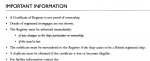
It says exactly the same thing on my Jersey Certificate and we dealt with this at #8 above. The Certificate document which they send to you is not proof of ownership and you need to apply to the Registrar for a current Transcript of Registry to prove ownership.Here's a scan of the back of my shiny new Part 1 registration - which came eight days after sending scans of the bills of sale and a declaration of nationality...
View attachment 69807
Please note the first line
Your entire proposition is, as I've said previously, firmly in the realms of fantasy and I've no wish to debate it further with you.
It says exactly the same thing on my Jersey Certificate and we dealt with this at #8 above. The Certificate document which they send to you is not proof of ownership and you need to apply to the Registrar for a current Transcript of Registry to prove ownership.