new Storm Jib

I will challenge that
My Stella had a storm sail hanked on the forestay( i still have it, plus the one that came with my second Stella, in my garage.) they are like handkerchiefs. But many a Stella has gone to windward, or spent hours hove too, with them. One of the 2 F9's in my life involved hoisting it & heaving too for some time then as it eased sailing up wind in horrendous seas. I have raced quite successfully in F7-8 with my first one & they will take a Stella up wind I can vouch for that. So can quite a few of the early Stella sailors, who would refuse to stop if it meant winning a race.

Well yeah, but the idea that sailing boats (all sailing boats) struggle to make progress to windward in proper gales isn't exactly controversial.

If that wasn't the case lee shores would hold little fear.
 
In an ideal world i would chose a second forestay with its own furler.

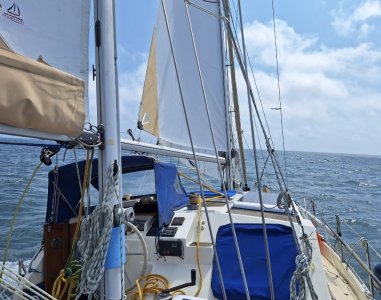
But that is a lot of clutter to add to the foredeck of smaller boats. I have a removeable Solent stay just behind the furling genoa. It gets well used as i go to windward much better in 20knts+ with the smaller jib than a part rolled genoa. Set flying it would need a scary amount of tension without the stay to hold it. As Wansworth says you need to check the sheeting angles. Picture is not very clear but shows the Solent stay just behind the rolled genoa.
Screenshot_20250618_115812_Gallery.jpg
Hank on sails are OK to raise and lower in a wind but factor in the plunging deck, spray and fatigue. Much easier with two people. I think the jib is critical to going to windward in strong winds - it needs to be flat, not too far forward and balanced with a deep reefed main. I carry a blade storm jib half the size of my Solent jib and about double my storm jib area. Not used yet - the Solent covers up to 35knts and allows a chunky motorsailor to sail to windward in 30kts (helped enormously by the mizzen!).

It's one thing to practise in a marina but quite another to rig it for real in 30knts+. The sheets flogging alone can concuss you. Often a scrap of unfurled genoa will be a much simpler solution.

One solution is a smaller, blade type jib to replace a larger furling genoa. But often the moment you decide the storm jib is needed is not the time to drop the genoa out its furler.

It's a relevant question - there has been a trend to very gusty conditions to and beyond forecast strength in recent years.
 
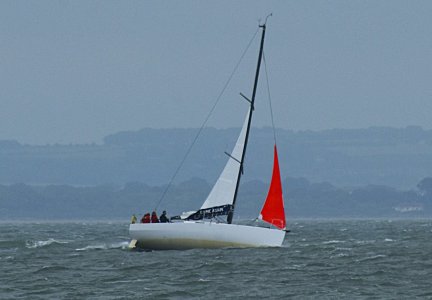
Used our storm jib cruising with the kids a few weeks back. Coupled with what is essentially a tripple reefed mainsail. That's not an optical illusion, that is the height of the hoist. Wind gusting well into the 30s when this pic was taken. Boat was a pussycat like this, going upwind at 6.5-7 knots, pic was taken just after we'd born away slightly round the brambles to head into Cowes. First time I've sailed the boat in any breeze in cruising mode, and honestly in this configuration I think I'd quit a long time before the boat did trying to go upwind.

Following day the wind had dropped to about 20 knots and we used the J4, which is circa 80% of the foretriangle area and "1.5" reefs in the main. (I have 2 reef points in the cruising main, but they are really 1.5 and 3 reefs compared to conventional reef points).

We went upwind with the kids driving from Cowes to Yarmouth, and were faster and pointing higher than every cruising boat we saw. Even the 45 footers. Proper jibs make an enormous difference to your ability to sail to windward in breeze. Yarmouth came up too quickly really!

For coastal cruising on more of a conventional cruising boat my preference would always be to swap out the genoa for a dedicated high wind sail before leaving if expecting a lengthy heavy airs upwind beat. The wrap around sails look like an ok solution but I doubt they'd be as good, or frankly as easy to use, as a dedicated storm jib / heavy working jib, designed to work with your furler and swapped out before leaving your berth.


cruising.jpg
 
I also said "But many a Stella has gone to windward," --What part of that did you not understand?
The fact that you confuse sailing at 80° off the wind in relatively flat coastal seas with moderately strong winds with sailing in 4M seas plus offshore in very strong winds when you will certainly not be going to windward which is what a storm sail is for.
 
The fact that you confuse sailing at 80° off the wind in relatively flat coastal seas with moderately strong winds with sailing in 4M seas plus offshore in very strong winds when you will certainly not be going to windward which is what a storm sail is for.

I wouldn't make quite such a blanket statement as that as the issue with going to windward with storm sails isn't the storm jib but the storm trisail, because it's pretty much impossible to get enough tension in a storm trisail to make any progress to windward. Wheras you can often still make decent progress to windward with a storm jib and a very reefed mainsail.
 
I wonder what the purpose of having such an item on a sailing school boat is and why would you demonstrate it to unwary novices? Hopefully you followed up your demonstration by discussing the ideal conditions and what it might be like in far more challenging conditions or even when the vessel was actually at sea.
Personally I think it's very poor and misleading at best. No criticism of Skylark as he is just doing what the course requires but it's not real world stuff.
It's a required part of the inventory. The wrap around ones are mostly crap. On my own school yacht we installed a separate forestay for a handed on storm jib. That can be set at sea 8ncluding a teach in on when it can be used and the correct sheeting, normally well aft and the importance of a suitable tack strop to lift the sail higher than people often assume.

Good excerc8se for Day Sipper trainees and excellent for exam prep courses.
 
Used our storm jib cruising with the kids a few weeks back. Coupled with what is essentially a tripple reefed mainsail. That's not an optical illusion, that is the height of the hoist. Wind gusting well into the 30s when this pic was taken. Boat was a pussycat like this, going upwind at 6.5-7 knots, pic was taken just after we'd born away slightly round the brambles to head into Cowes. First time I've sailed the boat in any breeze in cruising mode, and honestly in this configuration I think I'd quit a long time before the boat did trying to go upwind.

Following day the wind had dropped to about 20 knots and we used the J4, which is circa 80% of the foretriangle area and "1.5" reefs in the main. (I have 2 reef points in the cruising main, but they are really 1.5 and 3 reefs compared to conventional reef points).

We went upwind with the kids driving from Cowes to Yarmouth, and were faster and pointing higher than every cruising boat we saw. Even the 45 footers. Proper jibs make an enormous difference to your ability to sail to windward in breeze. Yarmouth came up too quickly really!

For coastal cruising on more of a conventional cruising boat my preference would always be to swap out the genoa for a dedicated high wind sail before leaving if expecting a lengthy heavy airs upwind beat. The wrap around sails look like an ok solution but I doubt they'd be as good, or frankly as easy to use, as a dedicated storm jib / heavy working jib, designed to work with your furler and swapped out before leaving your berth.


View attachment 194955
Good example of setting the sail too low. In any seaway waves can crash into the sail with potential for serious damage.
 
The fact that you confuse sailing at 80° off the wind in relatively flat coastal seas with moderately strong winds with sailing in 4M seas plus offshore in very strong winds when you will certainly not be going to windward which is what a storm sail is for.
Who said anything about sailing 80 degrees off wind in flat seas. I think that waves breaking over the entire boat & spume blowing off the waves reduciing visibility to a few yards denote something a bit more than flat seas..

What happened to post 17 in which you said "It is not and won't take you to windward in a small boat " Now you are saying it is what it is for
 
Did the furling jib come into being because of the massive Overlaping genoas used by racing boats .All my cruising boats had Hank in sails and offered a nice setting sail with quick reefing.The Albin Vega had a roller furler which as a 130% foresail was a pain to tack,Maybe cruising boats should return to banked on sails and we should get more used to going upon the foredeck.
 
Who said anything about sailing 80 degrees off wind in flat seas. I think that waves breaking over the entire boat & spume blowing off the waves reduciing visibility to a few yards denote something a bit more than flat seas..

What happened to post 17 in which you said "It is not and won't take you to windward in a small boat " Now you are saying it is what it is for
It won't do you dream about big seas and going to windward all the time;
 
Good example of setting the sail too low. In any seaway waves can crash into the sail with potential for serious damage.
I would tend to agree, however that sail, which was specifically made for the first owner of the boat, has a luff tape permanently attacted to the head of the sail made up of a very long dynema strop sewn inside about 3 inches of sail material with a luff tape on the front that goes all the way up the luff groove, meaning the halyard is at full hoist in that pic. Which does mean that was I to put a strop on, I wouldn't be able to hoist it as the top of the "sail" would hit the jib halyard sheave before the strop was taking the load. I assume that this is to stop the foil from vibrating itself to bits, but it does seem unnecessary to me,

Given the use case for the boat is 95% inshore racing, a little family cruising and no "offshore in waves that can crash over the boat", it's low on my list of things to be bothered about.
 
I would tend to agree, however that sail, which was specifically made for the first owner of the boat, has a luff tape permanently attacted to the head of the sail made up of a very long dynema strop sewn inside about 3 inches of sail material with a luff tape on the front that goes all the way up the luff groove, meaning the halyard is at full hoist in that pic. Which does mean that was I to put a strop on, I wouldn't be able to hoist it as the top of the "sail" would hit the jib halyard sheave before the strop was taking the load. I assume that this is to stop the foil from vibrating itself to bits, but it does seem unnecessary to me,

Given the use case for the boat is 95% inshore racing, a little family cruising and no "offshore in waves that can crash over the boat", it's low on my list of things to be bothered about.
Yeah I suppose for the use the boat gets it may be adequate. Perhaps though, a future owner may wish to revise the system.

The guy that taught me loads about storm canvas was John Goode. I've used a lot of that advice in vigorous offshore conditions....:)
 
I would tend to agree, however that sail, which was specifically made for the first owner of the boat, has a luff tape permanently attacted to the head of the sail made up of a very long dynema strop sewn inside about 3 inches of sail material with a luff tape on the front that goes all the way up the luff groove, meaning the halyard is at full hoist in that pic. Which does mean that was I to put a strop on, I wouldn't be able to hoist it as the top of the "sail" would hit the jib halyard sheave before the strop was taking the load. I assume that this is to stop the foil from vibrating itself to bits, but it does seem unnecessary to me,

Given the use case for the boat is 95% inshore racing, a little family cruising and no "offshore in waves that can crash over the boat", it's low on my list of things to be bothered about.
I think the main thing is that you have had a go and discovered what works for you and your boat. Sailing in big winds with sensible sized sails is enjoyable and efficient.

The state of the sea offshore after such winds have blown for 6 hours+ is another problem. My experience off Scotland and in the Irish Sea says the true offshore seas are less frightening than those in shallow water and off headlands with tide. I once crossed Malahide Bay near Dublin the afternoon after a F6-7 Easterly blow and discovered the waves were stating to break continuously from the 8-10m depth contour. Offshore in the height of the wind was OK and almost fun.
 
Yeah I suppose for the use the boat gets it may be adequate. Perhaps though, a future owner may wish to revise the system.

The guy that taught me loads about storm canvas was John Goode. I've used a lot of that advice in vigorous offshore conditions....:)
"Suppose it might be adequate...." Condescending much?

I got to know John quite well when I worked for the boat show. Worked together when we put on the cruising chute demos with the "yacht" on a turntable in front of big fans. Which I then hijacked to run racing spinnaker demos with Pip Hare.
He eventually admitted he had been wrong about the relative interest of the 2 demos. Pip got bigger crowds than he did, and this was about a decade before her 1st Vendee....
 
I think the main thing is that you have had a go and discovered what works for you and your boat. Sailing in big winds with sensible sized sails is enjoyable and efficient.
Wasn't exactly my first rodeo with the orange sails.

First one where someone took a picture though.
 
"Suppose it might be adequate...." Condescending much?

I got to know John quite well when I worked for the boat show. Worked together when we put on the cruising chute demos with the "yacht" on a turntable in front of big fans. Which I then hijacked to run racing spinnaker demos with Pip Hare.
He eventually admitted he had been wrong about the relative interest of the 2 demos. Pip got bigger crowds than he did, and this was about a decade before her 1st Vendee....
What was the sea state? :D

He was one of the most helpful and influential people I sailed with when I was climbing the slippery pole to be an Instructor. The whiskey drinking was.....awesome!
 
Top