New MPPT 100/20

Whilst I haven't used my load output I did consider using it as a low voltage cut off for none essential loads.
Load shedding is common in commercial aircraft system design. My thoughts were to put the Bilge pump and VHF on a "HOT Bus" connected directly to the battery and everything else on the load output. That way in the worst case the last systems available as the battery voltage drops are the ones most likely to save your life.

I may well still do it.

Edit to add:

I've remembered why I didn't do it now. The GPS feed to my VHF is via the NMEA network which would also need to be HOT wired and that is basically all my continuous load.
 
I must be missing a trick here. You mean my solar works at night too?

Yes, the load output will just draw power from the batteries if the solar output is inefficient.

So for example the load terminals can used to power a fridge and this will keep the fridge running day and night. The difference compared to connecting the fridge directly to the battery is that the load terminals add some intelligence.

For example, you can program load terminals so the fridge is disconnected if the battery voltage drops below a certain level, preventing damaging the battery.

Using a different setting the load terminals can be programmed to ignore the battery voltage but turn on at night. This can be used to create an automatic anchor light.

There are some restrictions. The maximum current is limited (check the specifications), so high draw appliances may need to be switched via a relay. Only one set of instructions is possible so you cannot use the load terminals to automate both the fridge and anchor light as these would require a different program. Some solar controllers have many sophisticated functions that are available via their load terminals, others only have a single option.

The popular Victron controllers have most of the load function options available. The terminals can also be manually switched on or off via Bluetooth. So you could turn on or off devices via your phone or tablet without getting out of bed! The app also keeps track of the watt hours used by the load terminals so you can separately monitor the power consumption of a device.

On many boats the above features are of little value, but in some situations it can be helpful. For example for a boat on a mooring having an automatic light at night, or even a cold fridge that would not excessively drain the batteries could be worthwhile. These features are available without purchasing any extra equipment if you already own (most) solar regulators.
 
Whilst I haven't used my load output I did consider using it as a low voltage cut off for none essential loads.
Load shedding is common in commercial aircraft system design. My thoughts were to put the Bilge pump and VHF on a "HOT Bus" connected directly to the battery and everything else on the load output. That way in the worst case the last systems available as the battery voltage drops are the ones most likely to save your life.

I may well still do it.

Edit to add:

I've remembered why I didn't do it now. The GPS feed to my VHF is via the NMEA network which would also need to be HOT wired and that is basically all my continuous load.
We have the electric heaters and water heating setup with load shedding but using the programmable relays on the multi plus.

have to say I tend to load shed With the battery monitor
 
Ignore the load.
Thanks Paul,
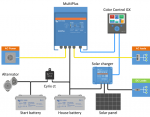
Shall I connect the Battery "+" to the starter battery or domestic bank, negative will be connected to negative bus bar after shunt? Starter and domestic bank are connected with Victron Cyrix combiner. If is connected only to the domestic bank, starter battery won't be charged by solar, and again does it need to be charged by solar or engine alternator will be sufficient enough? Thanks you
 
Thanks Paul,
Shall I connect the Battery "+" to the starter battery or domestic bank, negative will be connected to negative bus bar after shunt? Starter and domestic bank are connected with Victron Cyrix combiner. If is connected only to the domestic bank, starter battery won't be charged by solar, and again does it need to be charged by solar or engine alternator will be sufficient enough? Thanks you
Cyrix works both ways.
Best to connect to the domestic batteries as that’s where the power is needed and don’t forget the charge needs to flow through the shunt or you will get a false reading.
start batteries are rarely discharged more than a few amp hours
 
Thanks Paul,
Shall I connect the Battery "+" to the starter battery or domestic bank, negative will be connected to negative bus bar after shunt? Starter and domestic bank are connected with Victron Cyrix combiner. If is connected only to the domestic bank, starter battery won't be charged by solar, and again does it need to be charged by solar or engine alternator will be sufficient enough? Thanks you

As Jon says in post #26, the Cyrix is dual sensing, so doesn't really matter, i connect to the domestics.
 
Cyrix works both ways.
Best to connect to the domestic batteries as that’s where the power is needed and don’t forget the charge needs to flow through the shunt or you will get a false reading.
start batteries are rarely discharged more than a few amp hours
Thanks! I really tough its working one way, thank you!
 
qc

Our anchor light is switched on automatically by a Victron MPPT. It works great. The feature is there so why not use it?
It’s a personal thing isn’t it. I mean so much is,

my reasoning is I just like as few connections and layers in a system as possible especially on critical circuits. makes for less time problem solving and more time drinking beer!

you can do lots of smart things now if I was onboard all the time my system would be different, bigger inverters,lithium solar with load shedding and all sorts of other cleverness! But really I prefer to manually manage these kind of things and that gives me a little bit moreawareness of what’s going on with it. The only thing that cuts out on my boat is the fridge at 60% soc.

that said, I have a customer that keep
killing his batteries (well it was his grandson actually) so it now has solar and load shedding and a low battery cut off and thats sorted out the problem.

so in truth its Completely personal thing, but in a ‘normal’ simple system the load side is unlikely to be utilised.
 
It’s a personal thing isn’t it. I mean so much is,

my reasoning is I just like as few connections and layers in a system as possible especially on critical circuits. makes for less time problem solving and more time drinking beer!

you can do lots of smart things now if I was onboard all the time my system would be different, bigger inverters,lithium solar with load shedding and all sorts of other cleverness! But really I prefer to manually manage these kind of things and that gives me a little bit moreawareness of what’s going on with it. The only thing that cuts out on my boat is the fridge at 60% soc.

that said, I have a customer that keep
killing his batteries (well it was his grandson actually) so it now has solar and load shedding and a low battery cut off and thats sorted out the problem.

so in truth its Completely personal thing, but in a ‘normal’ simple system the load side is unlikely to be utilised.
I guess it depends where you sail. In a liveaboard environment, at anchor as opposed to a marina it is the norm to have an anchor light that turns its self on automatically. In a busy anchorage you might be back from the bar later than expected. Having the boat conform to collation regs without having to remember to turn the anchor light on manually several hours before you need it is handy. If you have to buy an automatic sensor to do this it will be an expense you can avoid by using the Victron feature of your MPPT to do it for you. Makes sense to me
 
I just thought, if Cyrix works both ways, how to protect starter battery and make sure it's always fully charged? Another gadget?
Well, I didn't read the manual carefully enough, so I went back to it, it says:

Prioritising the starter battery
In a typical setup the alternator is directly connected to the starter battery. The accessory battery, and possibly also a bow thruster and other batteries are each connected to the starter battery with Cyrix battery combiners. When a Cyrix senses that the starter battery has reached the connect voltage it will engage, to allow for parallel charging of the other batteries.

So prioritising starer battery and work both ways! Right?
 
Well, I didn't read the manual carefully enough, so I went back to it, it says:

Prioritising the starter battery
In a typical setup the alternator is directly connected to the starter battery. The accessory battery, and possibly also a bow thruster and other batteries are each connected to the starter battery with Cyrix battery combiners. When a Cyrix senses that the starter battery has reached the connect voltage it will engage, to allow for parallel charging of the other batteries.

So prioritising starer battery and work both ways! Right?

Dual sensing means that whichever battery is being charged it will close the relay. So when you start the engine, the VSR senses the charging voltage and closes the relay, same thing when the solar controller voltage goes above the VSR set point.

Prioritising the engine battery is somewhat a load of old cobblers though. Within a few seconds to a minute, depending on battery state of charge, the relay will close. Don't over think it though, the Cyrix will close when a battery is on charge and open when the charging stops and the voltage drops back down.
 
Top