Chiara’s slave
Well-Known Member
I replaced a wire/rope halyard with a rope. A dyneema one of course, with the cover stripped from where it needs to run over the wire width sheave.

 - at least for some of us.

I’d caution strongly against that sort of thinking. Halyards die from lots of causes, like UV damage, heating, tight bending fatigue,etc and to get decades requires an extraordinary amount of TLC. Having had broken sheets and halyards way too early with forces of less than a tenth of their rated strength I’d be very, very cautious and I replace early now.….The halyard will last for decades, if it must….
UV damage to Dyneema is a phurphy, possibly inherited, incorrectly from Kevlar. No textile should suffer from tight bending - there is something wrong if its there. Heat is an issue, sheets have failed with friction on other ropes - but again this can be planned out if you are observant.I’d caution strongly against that sort of thinking. Halyards die from lots of causes, like UV damage, heating, tight bending fatigue,etc and to get decades requires an extraordinary amount of TLC. Having had broken sheets and halyards way too early with forces of less than a tenth of their rated strength I’d be very, very cautious and I replace early now.
No. That is incorrect. I know from my own experience it is untrue, but Dyneema has been reported to be degraded by UV by the maker DSM and others.UV damage to Dyneema is a phurphy, possibly inherited, incorrectly from Kevlar. No textile should suffer from tight bending - there is something wrong if its there. Heat is an issue, sheets have failed with friction on other ropes - but again this can be planned out if you are observant.
A tight bend, the classic would be a spliced eye - how many people have reported their splices in dyneema have failed. It is now common place for many to attach their sheets to a sail using a syneema soft shackle - how many soft shackles have failed, subject to UV and tight bends.
This is how UV degradation was a major issue with dyneema - people simply extrapolated from Kevlar (which is very susceptible to UV). No-one conducted any tests on dyneema and its UV susceptibility is incorrect and still quoted. Now we use uncovered dyneema without a second thought for UV damage. Dyneema does need a cover - to make it manageable in clutches and on winches and to make it simply comfortable to work with.
We even have 'yellow' covers on dyneema to make it look like hemp for traditional yachts.
AND - its now 40 years old and we are still finding new uses for dyneema.
Jonathan
Semantics.No. That is incorrect. I know from my own experience it is untrue, but Dyneema has been reported to be degraded by UV by the maker DSM and others.
I found a useful article for you by I think Thinwater of this parish:
When Should We Retire Dyneema Stays and Running Rigging? - Practical Sailor
The problem I found in trying to do wire to rope splice is that you must open up the strands of wire to get the ends of polyester through. With what seemed like 1/8 diameter wire it was impossible for me to open up the strands. Yes obviously it had been done previously but I could not do it. Replaced the wire with dyneema easily spliced. to 10mm polyester.'ANY'
How many would admit to be capable of a wire to rope splice?
Jonathan
Jonathan
The problem I found in trying to do wire to rope splice is that you must open up the strands of wire to get the ends of polyester through. With what seemed like 1/8 diameter wire it was impossible for me to open up the strands. Yes obviously it had been done previously but I could not do it. Replaced the wire with dyneema easily spliced. to 10mm polyester.
Just re lack of head room between sail top and sheave. I had a steel thimble on the eye splice on the wire. I was short of room . I moved the thimble to the side of the head board and used a bolt through thimble and headboard. Now this gives an unbalanced pull on sail. I made up a ss plate with a key hole type slot that the thimble and swage went thriough then pulled own to a tight fit around the wire. (upstream of swage) this plate then had a hole in it to match the bolt through from thimble so puting pull on both sides of the headboard. Worked well and saved me some distance previously lost with a shackle. (I did later get the sail head cut down a little so not needed) ol'will
)I would not be so certain about those ropes for situations where the cover would move against the core. Some owners of large yachts remove the outer covers, because they can slip & bunch preventing the line from going out of the clutch. Just whipping the end is not so clever because one can just look at how short a length of rope a rigger uses & locks off for making a splice & milking the rope. I only need 8ft & if the cover cn slip 8ft down the line thenjust whipping the end is pointless.Here’s some I prepared earlier today
View attachment 198604
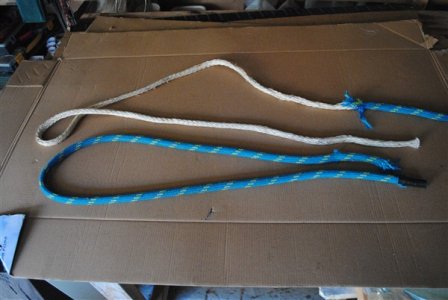
I bet if you got a new rope & stretched it out with the ends fixed you could grip the cover in the middle & slide it back & forthI'm confident in that. Been doing it for years. It is stitched and whipped, the cover is sewn through the eye of the splice, they don’t move when done like that. Anchoring the end makes the rest of the cover tighten and grip the core under tension
A bit cheap and nasty if so. And the stretching of the cover tightens it up in any caseI bet if you got a new rope & stretched it out with the ends fixed you could grip the cover in the middle & slide it back & forth