New halyard - seems core?

As an ancient mountaineer and sailor I am fully aware of the properties of dyneema and am still not convinced that there is any advantage in a vessel less than 20 meters.
You really do not know do you. When I changed my sail to laminate the sail would look ok then when a gust came a huge crease would appear across the middle as the halyard stretched. I changed to a cruising dynema and that only partially solved the problem . I only sorted it when I went to a good lyros dynema cored rope with a very tight outer covering so there is zero slip between cover and core. Or at least none once the rope has bedded in.
I am sorry to have to say this to you but To suggest that it is only needed on a boat of nearly 70 feet is talking rubbish.
 
You really do not know do you. When I changed my sail to laminate the sail would look ok then when a gust came a huge crease would appear across the middle as the halyard stretched. I changed to a cruising dynema and that only partially solved the problem . I only sorted it when I went to a good lyros dynema cored rope with a very tight outer covering so there is zero slip between cover and core. Or at least none once the rope has bedded in.
I am sorry to have to say this to you but To suggest that it is only needed on a boat of nearly 70 feet is talking rubbish.
Completely agree. The only doubters of the advantages of dyneema are those that have not tried it. You don’t have to have laminate sails, its just as useful with dacron. We have boats to compare that on.
 
You really do not know do you. When I changed my sail to laminate the sail would look ok then when a gust came a huge crease would appear across the middle as the halyard stretched. I changed to a cruising dynema and that only partially solved the problem . I only sorted it when I went to a good lyros dynema cored rope with a very tight outer covering so there is zero slip between cover and core. Or at least none once the rope has bedded in.
I am sorry to have to say this to you but To suggest that it is only needed on a boat of nearly 70 feet is talking rubbish.
I don't have laminated sails.
 
Completely agree. The only doubters of the advantages of dyneema are those that have not tried it. You don’t have to have laminate sails, its just as useful with dacron. We have boats to compare that on.
I've sailed on boats with dyneema and not seen any advantage.
 
I've sailed on boats with dyneema and not seen any advantage.
Presumably you don’t mind if your sail turns into a saggy mess when the wind blows. Halyard stretch is ruinous for performance. Racing, we’ll adjust ours possibly 10 times in a race to keep the shape. Clearly that’s obsessional when cruising, but being able to maintain the max draught position is vital to going to windward. Tensioning it as the wind rises is how it’s done. If this lackadaisical approach is widespread, our Dragonfly isn’t as fast as we think it is. It’s just that most others are sandbagging.
 
I've sailed on boats with dyneema and not seen any advantage.
To an “ancient mountaineerer” I suppose the simplest analogy is that polyester braid on braid is like a dynamic rope and dyneema is like a static rope. There’s quite a bit a stretch in 20 or 30 metres of braid on braid. To be fair, if you make like Geoff Capes on your halyard winch you’ll probably remove the stretch eventually, but it’s a hassle. For me, the big advantage is going down a size (or two) in halyard width. Lovely free running lines make sailing less of a chore.
 
To an “ancient mountaineerer” I suppose the simplest analogy is that polyester braid on braid is like a dynamic rope and dyneema is like a static rope. There’s quite a bit a stretch in 20 or 30 metres of braid on braid. To be fair, if you make like Geoff Capes on your halyard winch you’ll probably remove the stretch eventually, but it’s a hassle. For me, the big advantage is going down a size (or two) in halyard width. Lovely free running lines make sailing less of a chore.
I've happily down sized from 12 to 10 mm. I am no Geoff Capes, but have seen some significant, and expensive, damage done to bits of metal at the top of a mast by people with that sort of strength.
 
Thanks for all your advice. Fitted the new halyard yesterday and had a chance to try it today.
The difference is as amazing, much easier to hoist the sail as it runs better.
Had a little luff sag, but nothing like before. I’ll check the clutch inner jaws.
 
It is nothing to do with overloading the sail by Geoff capes. It is about precise sail adjustment. Like Charia I have 2 boats. The other is a squib and that does not have laminate sails. However the mainsail has to be adjusted carefully during a race. A halyard that allows the sail to change shape on its own is of no use. Like Charia suggests many do not understand the effect of sail trim. It is a fine art and so they believe that their baggy tarpaulins are the bees knees where in fact they are not and they are rarely set right in the first place.
But it is all down to the art of sailing.
Some are happy to drift
 
Thanks for all your advice. Fitted the new halyard yesterday and had a chance to try it today.
The difference is as amazing, much easier to hoist the sail as it runs better.
Had a little luff sag, but nothing like before. I’ll check the clutch inner jaws.
So what did you buy- sisal, hemp or blue polypropylene ———after Sandy’s advice?
 
Think on this one.

If you start to climb a nylon or polyester halyard, it will stretch when you weight it. Pretty annoying. But if you pre-tension the rope to more than the dynamic load (say 250 pounds) it will climb like a steel cable, because there is zero stretch when you weight it. This is how rope ladders, like the MastMate, are properly rigged for easy climbing. Pretension.

A cruiser that tensions the halyard to the maximum tension he will need will not see any change in stretch. The load will never exceed the pretension. Something like torquing bolts. Yes, he will have more than optimum tension when off the wind, and I'm guessing he neither knows nor cares.

Re. Cunninghams, I have one on my F-24, and the need stems from friction in the sail track (the luff tape is in the mast). The halyard does a good job of tensioning the top 2/3 of the sail, but it is nearly impossible to get proper tension on the bottom 1/3 with just the halyard. This is less true with lower friction systems, but even then, once the outhaul is on, increasing halyard tension will often do little for the bottom 1/3 of the sail. Too much friction.

(I've had both types. Dyneema is nicer, much nicer with laminate sails. But with polyester sails, you pay your money, you make your choice, and either works for a cruiser, IMO. Judging from the over sheeted, under sheeted, wrongly twisted, and other sail faults I see every day, I doubt many check the draft position.)
 
…A cruiser that tensions the halyard to the maximum tension he will need will not see any change in stretch. The load will never exceed the pretension…
Yep, that’s what I said in post 26 - if you winch up braid-on-braid really tight it’ll not be able to stretch any more, but your clutch will then be putting a great deal of pressure on your halyard outer layer and you will get fluffy halyard syndrome.
 
Yep, that’s what I said in post 26 - if you winch up braid-on-braid really tight it’ll not be able to stretch any more, but your clutch will then be putting a great deal of pressure on your halyard outer layer and you will get fluffy halyard syndrome.
The old school practice was to cut about 2 feet off the end every other year. No problem. The halyard will last for decades, if it must.

In fact, it is still smart practice to get halyards about 4-6 feet too long for this reason, whatever the material. Same with jib sheets and rodes (more like an extra 30 feet in this case, because you trim 10').
 
If Sandy is using, and has been on a yacht using, a wire halyard with a textile tail and he is using the halyard properly to engender sail trim he will see no advantage of a dyneema halyard over a wire halyard. Wire halyards run freely, like Dyneema, they are inextensible, like dyneema and he might also have gone to supersavers.

One major advantage of dyneema is that you can make your own halyard - so you save money as you don't need to pay someone to splice the textile tail onto the wire

He will notice the difference when the wire halyards starts to fail, at the splice, as the crew will complain of cut hands from the unravelling wire.

Sandy is simply illustrating, maybe, the inability of a sailor to accept innovation. We started using dyneema for halyards and sheets about 40 years ago - and have never once considered moving back. I do consider that Sandy is actually not serious and is simply winding up the assorted members - no-one can deny 40 years of usage of dynneema and he seems to claim, or imply, he has never heard of it.


A word of warning - if you crank up a dyneema halyard and start to develop fuzziness at the clutch on the outer braided cover you really need to change the halyard, turn it into sheets or end for end it. If the fuzziness fails the cover will split and the halyard is virtually impossible to control - as the cover slips. I was taught to not use a clutch on a halyard under constant tension but leave the halyard on the winch - to minimise the development of fuzziness. This does mean you need a 'spare' winch - or some imaginative cross sheeting.

Jonathan
 
If Sandy is using, and has been on a yacht using, a wire halyard with a textile tail and he is using the halyard properly to engender sail trim he will see no advantage of a dyneema halyard over a wire halyard. Wire halyards run freely, like Dyneema, they are inextensible, like dyneema and he might also have gone to supersavers.
My last boat came with a wire halyard. Very quickly replaced with rope. Reason: Rust and a few of the wires had broken causing damage to the sheeve.
One major advantage of dyneema is that you can make your own halyard - so you save money as you don't need to pay someone to splice the textile tail onto the wire
I think that most people will be able to make up any rope halyards.
Sandy is simply illustrating, maybe, the inability of a sailor to accept innovation. We started using dyneema for halyards and sheets about 40 years ago - and have never once considered moving back. I do consider that Sandy is actually not serious and is simply winding up the assorted members - no-one can deny 40 years of usage of dynneema and he seems to claim, or imply, he has never heard of it.
You misread me. I am more than happy to accept innovation, my view is that I do not consider dyneema is needed on smaller cruising boats, what people fit on their own boat is up to them. If the OP said he was a racer this would be different.

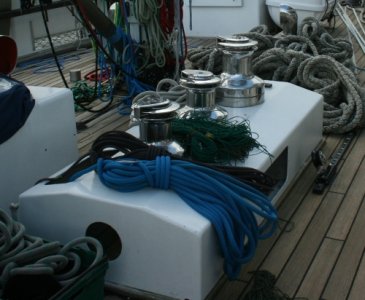
I've sailed on several boats between 10 metres to 30 metres that use dyneema. I have only seen an advantage in the 30 metre boat, even then we had to change brand as one set of new halyards got so stiff that it took two or three people some time to coil the rope up.

Forgive the mess in the photo below, it was taken as we were decommissioning the 30 metre boat at the end of the season. You will see from the size of the winches that the forces are much, much greater than on your AWB and dyneema is used extensively.

winch.JPG

The wonderful thing about forums is people can share their views. I happen to have a different one to the followers of dyneema. We will all get from A to B and enjoy our time on the water.
 
Is this an anchor thread in disguise?

I think that most people will be able to make up any rope halyards.


'ANY'

How many would admit to be capable of a wire to rope splice?

My last boat came with a wire halyard. Very quickly replaced with rope. Reason: Rust and a few of the wires had broken causing damage to the sheeve.
You replaced wire with rope and did not notice the difference - not even the fact the sheave was the wrong size and 'type'

Specsavers is the least of your needs.

Jonathan

Jonathan
 
Top