New engine electrical panel?

sgr143

Well-Known Member
Joined
26 Jul 2016
Messages
493
Location
Oxford & WicorMarine
Visit site
What's currently installed in the cockpit of my Westerly Merlin as the motor control panel for the Bukh DV20 is pretty manky, both outside and in. The ignition key-switch is on its way out (a burnt-out stop solenoid a couple of years back due to the "off" spring being duff necessitating the fitting of a stop button in series with it) and most of the indicator/warning lights are dud. There's no rev counter and no temperature gauge; neither is a big deal but might be nice to have. I'm anyway going to have the alternator seen to (thanks for advice received elsewhere on this forum).

I was wondering if while the boat is out of the water, it might be worthwhile doing a proper job, and replacing the panel with something like this:
https://www.vetus.com/en/boat-instr...type-mp34-12-volt-with-black-instruments.html
or one of these (type "B"?)
https://betamarine.co.uk/seagoing-control-panels/

Question - how difficult would it be to wire this (or something like this) in without totally rewiring everything (especially the boat's existing HDD VSR for charge-splitting, and the associated Westerly switch and charge-indicating panel) ? I'm reasonably handy (I did a whole new loom for my Triumph 650 for example). but I've not tackled anything quite like this before. Any useful reading material? (I have Calder's big book, but I find it over-complicates things for a basic boat like mine).

Ta - Steve
 
Last edited:
What's currently installed in the cockpit of my Westerly Merlin as the motor control panel for the Bukh DV20 is pretty manky, both outside and in. The ignition key-switch is on its way out (a burnt-out stop solenoid a couple of years back due to the "off" spring being duff necessitating the fitting of a stop button in series with it) and most of the indicator/warning lights are dud. There's no rev counter and no temperature gauge; neither is a big deal but might be nice to have. I'm anyway going to have the alternator seen to (thanks for advice received elsewhere on this forum).

I was wondering if while the boat is out of the water, it might be worthwhile doing a proper job, and replacing the panel with something like this:
https://www.vetus.com/en/boat-instr...type-mp34-12-volt-with-black-instruments.html
or one of these (type "B"?)
https://betamarine.co.uk/seagoing-control-panels/

Question - how difficult would it be to wire this (or something like this) in without totally rewiring everything (especially the boat's existing HDD VSR for charge-splitting, and the associated Westerly switch and charge-indicating panel) ? I'm reasonably handy (I did a whole new loom for my Triumph 650 for example). but I've not tackled anything quite like this before. Any useful reading material? (I have Calder's big book, but I find it over-complicates things for a basic boat like mine).

Ta - Steve

No problem, the panels are separate items.

Do you have a Powercentre panel ?

Brian
 
Thanks Brian, for the quick response.

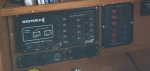
Yes, the Powercentre panel (in the picture below) is in place and is used. The KDD charge splitting device is behind the panel. The additional panels are for some newly added circuits - stereo, 12V sockets, masthead nav lights.
chart table panelsf.jpg

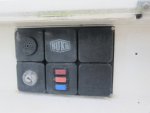
The engine control panel itself is I think an original-issue Bukh one, as shown here:
engine control panel .jpg
- though now with an added engine stop button in the top-right position due to the stop-position on the keyswitch having a duff return spring.

Thanks by the way for the help you gave a couple of years back by phone and email when I was trying to sort out the strange wiring-up of the charge splitter - at least , I assume it was you!

Steve
 
Last edited:
I made my own from plywood. A simple on/off switch for the "ignition", a press switch for the starter, three warning lights, a couple of buzzers and an angled bit set in for the stop cable so it doesn't get kicked, all mounted in the cockpit, near the throttle control. Security is provided by a 1-2-both switch in the locked cabin. The old arrangement had everything in the saloon, the engine stop/cold start almost inaccessible and the panel not much better, so having it outside is a big improvement when I want the engine in a bit of a hurry. The rev counter is a tiny tach mounted with the nav instruments on the companionway hatch.
 
Thanks both Muddy and Stemar; both look like good solutions. In this case though, exceptionally for me, I'm OK to spend actual money (within limits!) on a shiny new panel, as part of Osprey's gradual enshinyness improvement programme (aka "tarting up"). It's the wiring up I'm looking for advice on!
Steve
 
We make quite a few replacement panels in house for customers. They can be prewired so all you have to do is "plug and play" in that you'd wire your old feeds into a new supply and hey presto.

They are also a nice DIY project and you can get good results with a piece of aluminium composite and a good quality switch available from RS, eBay or equivalents. Your local sign writer can produce good labels to ident all the equipment or you can get reasonable results from a dymo printer.
 
Thanks Brian, for the quick response.

Yes, the Powercentre panel (in the picture below) is in place and is used. The KDD charge splitting device is behind the panel. The additional panels are for some newly added circuits - stereo, 12V sockets, masthead nav lights.
View attachment 73859

The engine control panel itself is I think an original-issue Bukh one, as shown here:
View attachment 73860
- though now with an added engine stop button in the top-right position due to the stop-position on the keyswitch having a duff return spring.

Thanks by the way for the help you gave a couple of years back by phone and email when I was trying to sort out the strange wiring-up of the charge splitter - at least , I assume it was you!

Steve

Yes that would have been me, still going if you need more help, spares or a new panel. That is a old panel, one of the first we supplied Westerly, around 1984.

Brian
 
Top