New Electrics

sparerooms

Active Member
Joined
12 Jan 2014
Messages
68
Location
cornwall, UK
Visit site
Hi all, i'm new to this forum and a new owner of a VIVACITY 20 sailboat.

The boat is not fitted with any electrics at the moment.

I want to fit navigation lights, bilge pump, vhf, fish finder and maybe a few other bits.

I have not got a clue how to rig the electrics, I am looking for someone to give me an idiots guide diagram if possible?

I guess I will have to run it all from a leisure battery, but how do I keep it charged up? The boat has a 5hp outboard engine, would that be enough to keep it topped up?

Sorry so many questions:confused:

Any advice would be much appreciated
 
You probably want to buy Nigal Calder's book. Costs about £25 on amazon and tells you everything you could possibly want to know to design, build and commission your electrical system. It won't tell you which make of sonar is better but will tell you how to wire them all up. (And it's got loads of other useful stuff in it.)
 
You need a leisure battery, box, straps, a master switch, a fused switch panel with about 6 switches, busbar for grounds, thick cable between battery and switch panel/bus bar, crimp pliers and crimps and some multi-stranded ideally tinned cable.

Whether your engine will provide enough power depends on its model. Check with the manufacturer. A solar panel would help. That might need a voltage regulator. Ask again with another post if you go that route.


http://www.ebay.co.uk/itm/LEISURE-B...tEquipment_Accessories_SM&hash=item4175e5be92

http://www.ebay.co.uk/itm/Battery-M...tEquipment_Accessories_SM&hash=item2a1a89f0c1

http://www.ebay.co.uk/itm/Marine-6-...ervan_Caravan_Accessories&hash=item231d3930a3

http://www.ebay.co.uk/itm/9-RATCHET...t=UK_Hand_Tools_Equipment&hash=item35cfbe6c54

http://www.ebay.co.uk/itm/Marine-Au...tEquipment_Accessories_SM&hash=item19cae7a97e
 
Keep it simple, use the thickest wire you can afford.

The outboard charging is a myth! Trust me, I tried.

Solar panel and the mains battery charger coming up in Lidl soon - £14.00 and will more than deal with your 110Ah battery.

Oh and get the biggest battery you can afford - nothing fancy, just basic leisure lead acid. Look on caravan sites or just google 110Ah [or more] battery and see what comes up. About £80 average.
 
... mains battery charger coming up in Lidl soon - £14.00 and will more than deal with your 110Ah battery.
I would strongly advise against getting a cheap battery charger, a proper multi-stage charger will charge faster and prolong the life of your battery. Ideally you should aim for a charge current of 20% of your battery capacity in Ah, but around 10% is OK; it just takes longer.

CTEK make a huge range, these ones are excellent:
http://www.amazon.co.uk/exec/obidos/ASIN/B002Q5D6JO/dolcetto-21
http://www.amazon.co.uk/exec/obidos/ASIN/B002Q54CFG/dolcetto-21
 
Last edited:
The outboard charging is a myth! Trust me, I tried.

Without getting into another argument about this, no it isn't, but it does depend on the output of the engine you have. A 5hp engine as the OP has is likely to have a small output which may well be insufficient. My 9.9 has significantly more output (12 Amps), and is enough to run my 10m boat, including compressor coolbox, all the instruments, autopilot, chartplotter, radios etc. Still not as much as an inboard's alternator of course, but enough not to be at mythical levels.
 
All good advice so far.

Best place to secure (and that means attach that battery box so it doesn't slide around) is under the cockpit deck.

So as soon as you step below, the battery is just behind you in the little gap between cabin sole and cockpit sole. Just near where the cockpit drainage seacocks are.As you step below, the port side cabin bulkhead usually has a flip down hatch _ driest spot on a Vivacity 20 and great place to place the distribution panel and also not far away from the battery and all wires can be fed through the shelving on the port side and even to starboard side by going through cubby hole above battery.

As well as the book mentioned, PBO published a really easy to follow beginners' book on electrical things. Your library should have one. Great illustrations and diagrams.

Hi all, i'm new to this forum and a new owner of a VIVACITY 20 sailboat.

The boat is not fitted with any electrics at the moment.

I want to fit navigation lights, bilge pump, vhf, fish finder and maybe a few other bits.

I have not got a clue how to rig the electrics, I am looking for someone to give me an idiots guide diagram if possible?

I guess I will have to run it all from a leisure battery, but how do I keep it charged up? The boat has a 5hp outboard engine, would that be enough to keep it topped up?

Sorry so many questions:confused:

Any advice would be much appreciated
 
All good advice so far.

Best place to secure (and that means attach that battery box so it doesn't slide around) is under the cockpit deck.

So as soon as you step below, the battery is just behind you in the little gap between cabin sole and cockpit sole. Just near where the cockpit drainage seacocks are.As you step below, the port side cabin bulkhead usually has a flip down hatch _ driest spot on a Vivacity 20 and great place to place the distribution panel and also not far away from the battery and all wires can be fed through the shelving on the port side and even to starboard side by going through cubby hole above battery.

As well as the book mentioned, PBO published a really easy to follow beginners' book on electrical things. Your library should have one. Great illustrations and diagrams.

That's were I was thinking of putting the distribution panel, would you fit it to the back of the hatch?

I will pop in the library tomorrow to have a look for that book. many thanks
 
That's were I was thinking of putting the distribution panel, would you fit it to the back of the hatch?

I will pop in the library tomorrow to have a look for that book. many thanks

The PBO book is this one by Garrod http://www.amazon.co.uk/Practical-B...ie=UTF8&qid=1389649379&sr=1-4&keywords=garrod

Not seen it personally but I have the PBO articles on which it is based. It is probably nearer to what you need than Calder's book.

My comments,( as a longstanding owner of a similar sized boat.

Battery .... 60 or70 Ah probably sensible minimum size unless you plan on fitting a load of power hungry equipment then get bigger, but the bigger they are the heavier they are. Mine new last year is this 60Ah one http://www.tayna.co.uk/LFD60-Varta-Professional-DC-Leisure-Battery-930060056-P3635.html

Decide what you what to fit. What you need in the way of lights etc and other equipment. I'd not bother with an electric bilge pump!

Make or buy a switch panel with enough spare switches and fuses to accommodate extra stuff which you will fit in time.

Wire every thing with twin flex .. tinned is best and probably worth while for wires that go outside eg to light fittings even if you dont bother else where.

Use a minimum size of wire for the low current stuff that is robust. For other stuff ensure you use a wire that is heavy enough ( surprising how heavy that can be on long runs ) to keep volts drop to an acceptable level.

Charging .. small outboards usually are inadequate unless you run them for long periods at highish revs. I tried but now have a small solar panel. Mine is 5 Watts but 10 w would be better if the space is available to fit one.

LEDs for lights are expensive but keep the current drain down, then you can keep the battery size down Only my tricolour is LED but if I were refitting the interior again I fit LED lights inside even if not the deck level Nav lights

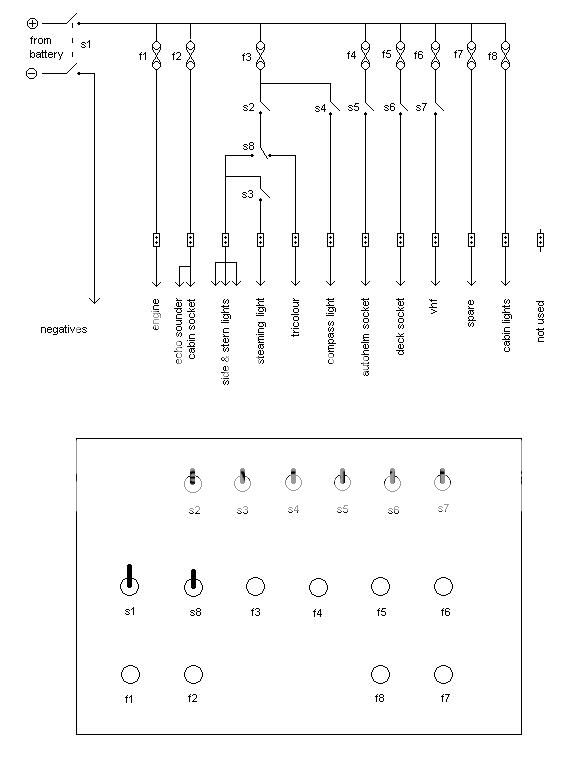
FWIW the wiring diagram of my switch panel below. Not suggesting you follow it just posting it for ideas ..... It would be a bit different if I made a new one anyway

97a15036.jpg
 
Last edited:
Yes I would fit it to the wood that hinges downwards _ that way you have access to the switches when hatch is closed and access to the back of panel when hatch is open.

That's were I was thinking of putting the distribution panel, would you fit it to the back of the hatch?

I will pop in the library tomorrow to have a look for that book. many thanks
 
Use a minimum size of wire for the low current stuff that is robust. For other stuff ensure you use a wire that is heavy enough ( surprising how heavy that can be on long runs ) to keep volts drop to an acceptable level.

As an idea, when I rewired our first boat I carefully worked out the current in each and every wire - and found that everything apart from the fridge and the fairly large electric bilge pump were more than happy with 1.5mm². That seemed like a good minimum size for robustness, so I bought a big reel of 1.5mm² for general wiring and a couple of cut lengths for the heavier things.

That was with LED lights - if you insist on using Victorian white-hot coils of wire then you may well need bigger, especially if they're at the top of the mast. So don't do that - fitting new filament lamps on a power-constrained small boat in 2014 is madness.

Pete
 
... when I rewired our first boat I carefully worked out the current in each and every wire - and found that everything apart from the fridge and the fairly large electric bilge pump were more than happy with 1.5mm²....
Same on my boat, except the lighting was originally on two circuits. I'm happy to say I gained a spare switch by fitting LEDs.
 
As an idea, when I rewired our first boat I carefully worked out the current in each and every wire - and found that everything apart from the fridge and the fairly large electric bilge pump were more than happy with 1.5mm². That seemed like a good minimum size for robustness, so I bought a big reel of 1.5mm² for general wiring and a couple of cut lengths for the heavier things.

That was with LED lights - if you insist on using Victorian white-hot coils of wire then you may well need bigger, especially if they're at the top of the mast. So don't do that - fitting new filament lamps on a power-constrained small boat in 2014 is madness.

Pete

IMO 1.5mm² is bit on the heavy side in a small boat except where needed. I freely admit though that most of my boat is wired with cable thats a bit too small but its not caused any problems in 30 years plus
 
IMO 1.5mm² is bit on the heavy side in a small boat except where needed.

It's certainly bigger than electrically necessary for many of the circuits in an all-LED boat. But it was cheaper and simpler to buy a full reel of one size than mess about with multiple orders of just the right amount of just the right size. I set the reel up on a taut line lashed across the boat out of the way, so that while working I could just reel off a length as needed for each run. The bigger cable is physically tougher too.

If someone wanted to use 1mm² as their basic standard, going up as necessary, I certainly wouldn't say that they were wrong.

Pete
 
Sparerooms

Twelve months ago I didn't have a clue how to wire up a boat either. I bought a book and I downloaded articles of the Internet. I probably learned the basics but that's all. I got the local auto sparky in for 1/2 an hour to show me and away I went!

I've now wired a 43ft yacht with 12/24/240V power. You'll need a small switchboard for navigation lights, steaming light, anchor light, cabin light(s), cockpit light?, 12V outlets (GPS, depth-sounder, radio, TV?, computer etc).
All my larger items (bilge pumps, macerator pumps, fresh water pump etc) each have their separate fuses as well as the light circuits. Common sense will tell you to have at least two light circuits on separate fuses as you don't want to be in the dark trying to replace a fuse should one blow. Using the same logic you don't want both bilge pumps on the same fuse/circuit.

You will need (probably) two fuse boards (each X6 fuses). Those fuse boards will have switches so that (for example) you can switch the masthead light on from the cabin without having to climb up to the mast head. These fuse boards also have bus bars which save a lot of wiring. That's a bit like your motor car - the metal body/chassis is used as the negative wire so they only have to run a positive wire to the component and "ëarth" the component to the chassis. A voltmeter will help maintain a fully charged battery and a battery isolator switch could switch off all power when you leave the boat.

As far as wire size is concerned don't go undersize as you could have "voltage drop" and (say) your radio may not work too well. Worse still you could cause a fire with the wires overheating. It won't be a big deal on a craft your size but it would be silly to go oversize, I suppose a bit like using a fire hydrant hose to water your lawn

Cheers
 
Top