
New electrical system part 2, any good?

steve yates

Well-Known Member
Joined
16 Oct 2014
Messages
4,151
Location
Benfleet, Essex at mo/Scottish West coast soon
Visit site
Right I’ve made my choice, I’m going lithium for the house bank & normal for the engine, as per Pail’s suggestion.
Trying to get it all straight in my head before I start shopping for bits, I have drawn out what I am planning.
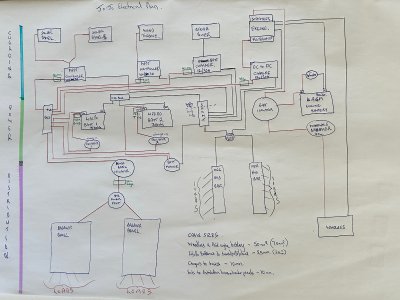
IMG_2026-03-02-142452.jpeg
Looking for critique, what I have missed, anything I have got wrong, any better ideas etc.
I’m already wondering about keeping the two systems entirely seperate, or should I have a means of combing them in an emergency for a short time?
And I’m wondering about charging the engine battery when left on a mooring for months, can I tie the agm i to the mppt controllers, or should I have a small panel seperately just for that job, which seems a bit of a waste of solar space.
I haven’t worked out or specced my solar requirements yet, basically I will put on as much as I can fit, and the wind generator will be a future add on.
Its not going to be a massively power hungry boat, electronics are another job to be planned for and sourced after I have power, but I’m not bothered about loading her up with all singing all dancing toys, I want power to last without having to worry much about it.
I’m particularly looking for critique on the wiring, fusing & cable choices.
Thanks.
 
At first glance it looks good.
A small panel just for the engine battery would be the simplest solution, it could just be a 10w thing that you chuck down in the cockpit while you're not using the boat.
I don't have any way of charging my engine battery other than the engine itself, but I'm generally using the engine every few weeks.

There's a school of thought that the MPPT should be wired directly the battery side of your main fuse, because if you don't, the boat's systems can keep on running directly from the solar even after the fuse has blown. I'd be interested to see what others make of that view.
 
My scribble is not to scale, so the lifepo cables from the terminal to buses will all be equal length.
I'm just ordering the bits for my install, I have a lot less of a power requirement than your goodself so to keep life simple I'll be having independent 100aH engine SLA start / windlass and 300aH Lithium service battery setups.
A single house 300aH Lithium will be connected to 200W solar and a Sterling 12V / 50A mains charger, the engine start / alternator / windlass physically separate and largely fending for itself with maybe a small 'tickover' solar panel.
There will be an emergency changeover switch to disconnect the Lithium / connect the house circuit to the SLA side but with our relatively limited cruising range and generally one or two nights anchored 300aH will more than cover any 'between shorepower' time
I've found an interesting thing to be the fuses and isolators, I'm planning the same size cabling as you on the Lithium side, the engine / windless side is already in place
 
Right I’ve made my choice, I’m going lithium for the house bank & normal for the engine, as per Pail’s suggestion.
Trying to get it all straight in my head before I start shopping for bits, I have drawn out what I am planning.
View attachment 207203
Looking for critique, what I have missed, anything I have got wrong, any better ideas etc.
I’m already wondering about keeping the two systems entirely seperate, or should I have a means of combing them in an emergency for a short time?
And I’m wondering about charging the engine battery when left on a mooring for months, can I tie the agm i to the mppt controllers, or should I have a small panel seperately just for that job, which seems a bit of a waste of solar space.
I haven’t worked out or specced my solar requirements yet, basically I will put on as much as I can fit, and the wind generator will be a future add on.
Its not going to be a massively power hungry boat, electronics are another job to be planned for and sourced after I have power, but I’m not bothered about loading her up with all singing all dancing toys, I want power to last without having to worry much about it.
I’m particularly looking for critique on the wiring, fusing & cable choices.
Thanks.
If there is a short between the master isolator and the busbar both battery fuses will blow and you lose both batteries. So connect isolators 1 and 2 straight to the main isolator. Still connect the +VE bus here too. Depending on the likelihood of this cable to possibility short you might want to fuse it close to the isolator.

If there is a short between a MPPT controller or the mains charger, between the fuse and the busbar, the 150A fuse might not blow, the wiring might melt/catch fire instead. Fit the fuses close to the busbars.

The DC-DC charger wants to be connected to the load terminals of the main isolator and the engine isolator, fused close to the isolators. This way the fuses protect the wiring and when the isolators are off the charger is totally isolated.

Skip the 200A fuse at the main isolator. Connect the two panels independently to the isolator, each with their own fuse. If you blow a fuse you only lose one panel.

An emergency switch makes sense, connect it between the main isolator and engine isolator load terminals. The Lithiums should start the engine.

EVE cells have 2 M6 bolts, using big fat cable here doesn't feel right, so i use a pair of 25mm cables, in which case you can use 200A battery fuses.

The following cables must be the same length, you want both battery circuits to be the same length to keep the batteries in balance as much as possible.:

All negative cables from each battery to the BMS
All negative cables from the BMS to the -VE busbar.

The positive cables from each battery to its isolator.
The positive cables from each isolator to the master isolator.
 
Thanks Paul, all of that makes sense. Seachange, I don’t know enough about it,I’ll leave it to those more knowledgeable to comment. I think I can see what you mean, a bit like having a usb charging point on a controller, anything plugged into it would get power unless the panels themselves were disconnected? Would it matter if you were there? If unattended the main isolator would be off anyway so there would be nothing for them to draw?
 
Top