New electrical system from scratch- Part 1- lifepo4 , engine starting and the 1-2-1 switch :)

steve yates

Well-Known Member
Joined
16 Oct 2014
Messages
4,136
Location
Benfleet, Essex at mo/Scottish West coast soon
Visit site
I have stripped all electrics from my longbow and almost ready to start again from scratch, so there may be a few questions and requests for advice.
Firstly, it seems a good idea since starting afresh to go with life4po, but am I likely to end up with an uninsurable boat! After a full refit is finished I don’t want to be stuck with third party only! Thats quite a big consideration.

Next, I previously had 2 agm’s and a 121 switch, for the house bank & engine and I would swap them around by starting on bat 1 one week and bat 2 the next etc. Are life4po batteries fine to start the engine with this way or not or would I need a seperate engine start battery.

Now bear with me, I know the 121 switch is pretty frowned upon these days, but I do want 2 seperate house batteries, so if the bms shuts one down I can use the other. For the same reason I want them selectebale independantly, and I would run them the same way I used to, ie battery 1 for a week, then battery 2 for a week, or on alternative days or whatever. But for me, the ability to do this is a necessity. The 121 switch is just a means to select them, it doesn’t need to be used in the both position.
Is there a btter way to achieve this nowadays?

I am considering 2 480ahr life4po’s in place of my previous 2 120ahr agm’s, this would cost a lot more but would be a game changing amount of power. I know I would need to install a dc to dc charger for the life4po, anything else that I should be thinking off adding? Would that dc to dc also charge a third engine battery if I decided on one?

And lastly for now, I there was a third battery for engine starting, would it be a good idea to use that for the anchor winch also? I am currently thinking the house bank should power the anchor winch.

Ta.
 
I have stripped all electrics from my longbow and almost ready to start again from scratch, so there may be a few questions and requests for advice.
Firstly, it seems a good idea since starting afresh to go with life4po, but am I likely to end up with an uninsurable boat! After a full refit is finished I don’t want to be stuck with third party only! Thats quite a big consideration.

Next, I previously had 2 agm’s and a 121 switch, for the house bank & engine and I would swap them around by starting on bat 1 one week and bat 2 the next etc. Are life4po batteries fine to start the engine with this way or not or would I need a seperate engine start battery.

Now bear with me, I know the 121 switch is pretty frowned upon these days, but I do want 2 seperate house batteries, so if the bms shuts one down I can use the other. For the same reason I want them selectebale independantly, and I would run them the same way I used to, ie battery 1 for a week, then battery 2 for a week, or on alternative days or whatever. But for me, the ability to do this is a necessity. The 121 switch is just a means to select them, it doesn’t need to be used in the both position.
Is there a btter way to achieve this nowadays?

I am considering 2 480ahr life4po’s in place of my previous 2 120ahr agm’s, this would cost a lot more but would be a game changing amount of power. I know I would need to install a dc to dc charger for the life4po, anything else that I should be thinking off adding? Would that dc to dc also charge a third engine battery if I decided on one?

And lastly for now, I there was a third battery for engine starting, would it be a good idea to use that for the anchor winch also? I am currently thinking the house bank should power the anchor winch.

Ta.
You are making it all too complicated. Why do you need nearly 1000Ah of house capacity? what are you going to run that consumes that amount? how are you going to charge it? If you are sailing single handed or short handed in a 31' boat you do not need that amount. Do the sums properly to work out average daily consumption and average daily charging from engine and solar times the number of days away from mains charging. I would be surprised if, provided you have decent amount of solar that you need more than 25-300Ah storage. As for switching - why would you want to complicate things by switching between batteries? Keep it simple. Engine start battery, LA or AGM with its own isolator, B2B charge, probably 30A to you House battery again with its own isolator. Possibly emergency switch to use the house bank to start the engine - but bet you never need to use it.

If you ask Paul Rainbow nicely he will let you have copy of a schematic for such a system.
 
In my experience a BMS only takes a battery offline if it's being asked to draw too much power, or if it's been allowed to get to too low a SOC.
These are predictable and avoidable situations. In the first case, you just reduce the loads and then wait a few seconds for the battery to start up again. In the second, you turn on a charging source, e.g. engine with DC-DC.
So I don't think you really need a separate bank as such, especially if the engine start battery is already separate (which is a good idea. And can be done cheaply and easily with a lead acid).
 
You are making it all too complicated. Why do you need nearly 1000Ah of house capacity? what are you going to run that consumes that amount? how are you going to charge it? If you are sailing single handed or short handed in a 31' boat you do not need that amount. Do the sums properly to work out average daily consumption and average daily charging from engine and solar times the number of days away from mains charging. I would be surprised if, provided you have decent amount of solar that you need more than 25-300Ah storage. As for switching - why would you want to complicate things by switching between batteries? Keep it simple. Engine start battery, LA or AGM with its own isolator, B2B charge, probably 30A to you House battery again with its own isolator. Possibly emergency switch to use the house bank to start the engine - but bet you never need to use it.

If you ask Paul Rainbow nicely he will let you have copy of a schematic for such a system.
Yeah I’m sure your right about the power amount, I know its excessive and I was in wee boat mode still and just didn't compute that I have a dirty big engine to charge them with. I do like the idea of never having to think about the consumption though :) The boat is also going to be in scotland and will be afloat through the winter.
Regardless of power output though, I have the space for two house batteries, so would definitely want two, that can be used independently of each other for the house bank, should one go down for any reason. And if they were agm that could be as simple as three or four years are up and the thing is just on its last legs. They don’t last very long.
There is no way I would rely on one battery when I have the option to have two.
This installation is for the long term and for spending months aboard out of marinas.
 
I have stripped all electrics from my longbow and almost ready to start again from scratch, so there may be a few questions and requests for advice.
Firstly, it seems a good idea since starting afresh to go with life4po, but am I likely to end up with an uninsurable boat! After a full refit is finished I don’t want to be stuck with third party only! Thats quite a big consideration.

Next, I previously had 2 agm’s and a 121 switch, for the house bank & engine and I would swap them around by starting on bat 1 one week and bat 2 the next etc. Are life4po batteries fine to start the engine with this way or not or would I need a seperate engine start battery.

Now bear with me, I know the 121 switch is pretty frowned upon these days, but I do want 2 seperate house batteries, so if the bms shuts one down I can use the other. For the same reason I want them selectebale independantly, and I would run them the same way I used to, ie battery 1 for a week, then battery 2 for a week, or on alternative days or whatever. But for me, the ability to do this is a necessity. The 121 switch is just a means to select them, it doesn’t need to be used in the both position.
Is there a btter way to achieve this nowadays?

I am considering 2 480ahr life4po’s in place of my previous 2 120ahr agm’s, this would cost a lot more but would be a game changing amount of power. I know I would need to install a dc to dc charger for the life4po, anything else that I should be thinking off adding? Would that dc to dc also charge a third engine battery if I decided on one?

And lastly for now, I there was a third battery for engine starting, would it be a good idea to use that for the anchor winch also? I am currently thinking the house bank should power the anchor winch.

Ta.
Lead acid battery for the engine, with it's own isolator.

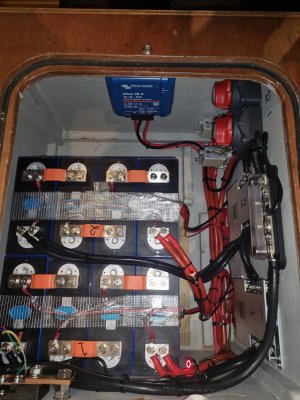
If you want 2xLFP batteries, fine, i just finished such an installation. Each battery has it's own BMS, fuse and isolator. The two isolators are linked on the load terminals and then to a master isolator. In normal use the two primary switches stay on and the batteries are isolated using the master switch. All positive cables from the batteries to the isolators are exactly the same length. The negatives are also the same length, but not necessarily the same length as the positives. This keeps the batteries balanced. If there is an issue with one battery/BMS the other stays working. A faulty batter/BMS can be isolated using a primary switch.

A 3rd switch is fitted between the load terminals of the engine switch and LFP master switch. This will usually allow the engine to be started from the LFP bank, unless the engine is unusually big (mobo for example) or you have fitted a crap battery or BMS.

A 1-2-B switch for a LFP install is a terrible idea, sorry Steve.

A DC-DC charger should be fitted between the engine battery isolator switch load terminal and the LFP master isolator load terminal, this way the charger is isolated when you leave the boat.

The original charger, which has no LFP ability was left in place to charge the engine battery and a nee Victron on fitted just for the LFP bank.

This gives a very robust system with good redundancy.

The batteries are 314Ah each, which is a lot for a modest sail boat.

All in the space of 2 LA batteries !

Oceanquest after.jpg
 
Yeah I’m sure your right about the power amount, I know its excessive and I was in wee boat mode still and just didn't compute that I have a dirty big engine to charge them with.
Engine size isn't important, it's alternator output, of which you are limited to 50% or it will overheat and die with a LFP installation.
I do like the idea of never having to think about the consumption though :) The boat is also going to be in scotland and will be afloat through the winter.

Regardless of power output though, I have the space for two house batteries, so would definitely want two, that can be used independently of each other for the house bank, should one go down for any reason. And if they were agm that could be as simple as three or four years are up and the thing is just on its last legs. They don’t last very long.
There is no way I would rely on one battery when I have the option to have two.
This installation is for the long term and for spending months aboard out of marinas.
You still need to charge them, no matter how big the batteries. Run a pair of 460Ah LFPs down to 10 % and it will take about 28 hours to charge them up with your engine, unless you have a very big alternator, then you might halve that.
 
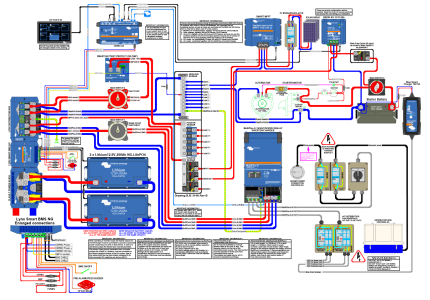
Something like this without the generator ...

You are overthinking the Li batteries, just stack them in parallel and let the BMS take care of them.

https://www.victronenergy.com/uploa...50-SBP-220-generator-MPPT-100-50-Orion-XS.pdf

View attachment 206899T

here are loads of Victron schematics for all sorts of systems here ... Victron Energy | Independent energy systems engineered to outlast
Several single points of failure between the batteries and the isolator though ?
 
Engine size isn't important, it's alternator output, of which you are limited to 50% or it will overheat and die with a LFP installation.

You still need to charge them, no matter how big the batteries. Run a pair of 460Ah LFPs down to 10 % and it will take about 28 hours to charge them up with your engine, unless you have a very big alternator, then you might halve that.
Aye, but It is an engine, with an alternator, (120a I think?) unlike on the wee boat which has no engine charging :)

The description of your installation sounds pretty much exactly what I am looking for Paul, thank you.
 
Aye, but It is an engine, with an alternator, (120a I think?) unlike on the wee boat which has no engine charging :)

The description of your installation sounds pretty much exactly what I am looking for Paul, thank you.
Yes, but you cannot use the 120A because you will be controlling the charge to the house bank with your DC-DC charger which will likely be 60A (the one in Paul's installation looks like 50A)
 
Looking at it the other way around, if you had 100Ah battery that 50A DC DC charger becomes useless after just two hours on the motor while your planned install will keep taking charge because it has more capacity (assuming you can run it down after a week or so, which you will!).
Aside from cost and space there’s very little downside to overspeccing, it’ll still be lighter than the lead it replaces I imagine. Ours takes 11 hours to charge, but that doesn’t affect me at all, I just have to do it less often. No need to charge lithium before leaving the boat other than saving time when you get back to the boat the next time.
 
Top