New Cowes breakwater

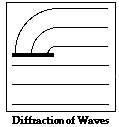
Refraction causes waves to change direction as they pass an obstruction to one side of the wave train - to swing inwards, if you like. It's what lets swell get into anchorages that look as if they should be as smooth as silk.

You may have a point but the effect you are talking about is diffraction not refraction. - And you a wordsmith too! :o

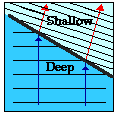
Refraction:-
u10l3b7.gif


Diffraction:-
u10l3b8.gif


In practice I think both will come into play with the proposed breakwater. I would hope that they have done some modelling to check this.
 
Refraction causes waves to change direction as they pass an obstruction to one side of the wave train - to swing inwards, if you like. It's what lets swell get into anchorages that look as if they should be as smooth as silk.

I'm afraid it doesn't. You're thinking of diffraction.

Refraction is what happens when a wave moves into an area with a different propagation velocity, like light moving from air to glass, or surfaces waves moving into shallower water.
 
Refraction causes waves to change direction as they pass an obstruction to one side of the wave train - to swing inwards, if you like. It's what lets swell get into anchorages that look as if they should be as smooth as silk
<pedant mode> What you're describing is diffraction, not refraction. </pedant mode>
 
Which one was that?

I think it was Shepherds, just N of the Cowes Harbour Master Pontoon by the chain ferry.

However I've sailed a few miles since then, but I've had a look at the chartlet and that one seems to be in about the place we were. And my apologies; the boat was only 67 feet long. I was confusing that trip with another one.
 
Poor TK! Actually the technical report does consider REfraction (but not in the context to which TK was referring):

"Due to the considerations above, the very minimum length of breakwater would be in
line with the end of the Shrape Breakwater in a N direction. These considerations,
however, do not take account of the waves that approach from the NE. These waves
approach at an acute angle to the shelving bank up to the shallow water over the
Shrape Mud. As the waves ‘feel the bottom’, they refract with a tendency to align
perpendicular to the bed contours."
 
I think it was Shepherds, just N of the Cowes Harbour Master Pontoon by the chain ferry.

However I've sailed a few miles since then, but I've had a look at the chartlet and that one seems to be in about the place we were. And my apologies; the boat was only 67 feet long. I was confusing that trip with another one.


There is a long pontoon, a few yards north of the chains, where the yard was, before you get to the marina pontoons, used for the small passenger catamarans IIRC.

One of the Challenge boats?
 
Cowes is still sheltered from the prevailing gales, if you want to see a sometimes dangerous entrance try Chichester; I once met an American chap in Braye, Alderney ( a place which puts the willies up me ) who had singlehanded across the N Atlantic; on finding we were from Chichester he remarked " that's the most dangerous place I've ever seen, don't people get killed there ?! "

Please don't think I'm saying how tough I am sailing from there, I know when to run and hide !

Dayboats on exposed moorings will always be at risk, but that's largely due to the owners not being sensible and wanting quick access to the Solent; I have sailed to Cowes from Chichester in a F7 with prolonged 55 knot squalls in winter, but the harbour entrance was the easy bit, we had spray all over the boat in East Cowes Marina but getting in was fine - as one would expect in a blow, the wind was from the SW.

As for wave refraction / defraction / distraction / general bemusement, the book Heavy Weather Sailing has clear descriptions and diagrams as to why seeking shelter to leeward of an island ( or breakwater ) is not a spiffing idea.
 
Cowes is still sheltered from the prevailing gales, if you want to see a sometimes dangerous entrance try Chichester; I once met an American chap in Braye, Alderney ( a place which puts the willies up me ) who had singlehanded across the N Atlantic; on finding we were from Chichester he remarked " that's the most dangerous place I've ever seen, don't people get killed there ?! "

Please don't think I'm saying how tough I am sailing from there, I know when to run and hide !

Dayboats on exposed moorings will always be at risk, but that's largely due to the owners not being sensible and wanting quick access to the Solent; I have sailed to Cowes from Chichester in a F7 with prolonged 55 knot squalls in winter, but the harbour entrance was the easy bit, we had spray all over the boat in East Cowes Marina but getting in was fine - as one would expect in a blow, the wind was from the SW.

As for wave refraction / defraction / distraction / general bemusement, the book Heavy Weather Sailing has clear descriptions and diagrams as to why seeking shelter to leeward of an island ( or breakwater ) is not a spiffing idea.

Hang on seajet, don't tell us yet, let us have a guess.


Would that have been in one of those urban myth bullet proof flying machines, called an Anderson 22, we keep hearing about?;)
 
Cowes is still sheltered from the prevailing gales, if you want to see a sometimes dangerous entrance try Chichester; I once met an American chap in Braye, Alderney ( a place which puts the willies up me ) who had singlehanded across the N Atlantic; on finding we were from Chichester he remarked " that's the most dangerous place I've ever seen, don't people get killed there ?! "

Please don't think I'm saying how tough I am sailing from there, I know when to run and hide !

Dayboats on exposed moorings will always be at risk, but that's largely due to the owners not being sensible and wanting quick access to the Solent; I have sailed to Cowes from Chichester in a F7 with prolonged 55 knot squalls in winter, but the harbour entrance was the easy bit, we had spray all over the boat in East Cowes Marina but getting in was fine - as one would expect in a blow, the wind was from the SW.

As for wave refraction / defraction / distraction / general bemusement, the book Heavy Weather Sailing has clear descriptions and diagrams as to why seeking shelter to leeward of an island ( or breakwater ) is not a spiffing idea.

You aren't comparing like for like - the breakwater isn't about improving conditions in the entrance, it is about improving conditions in the harbour, which happens in Chichester because of naturally occurring narrow entrance. None of the marinas in Chichester Harbour are as exposed to wave action as the ones in Cowes which even though called a harbour is in fact an estuary.
 
Last edited:
Solent Protection Society have tried to get behind the facade, and discover the facts. The Cowes Breakwater is one of their feature Issues. Go to this link for an overview
http://www.solentprotection.org/issues/cowes-outer-harbour/

And go to this link for a 15 min video about the design considerations. It addresses directly many of the doubts and queries expressed in this discussion thread.
http://www.cowesharbourcommission.co.uk/pages/outerharbourplan?id=781

It is better to debate on the basis of fact.
 
Cowes is still sheltered from the prevailing gales, if you want to see a sometimes dangerous entrance try Chichester;

You're missing the point. Cowes isn't a dangerous entrance, it's an exposed "harbour". Except that if you look at a chart or satellite view you can see it isn't really a harbour at all, as an increasing amount of development has been pushed seaward to where it's simply "on the shoreline".

Pete
 
You're missing the point. Cowes isn't a dangerous entrance, it's an exposed "harbour". Except that if you look at a chart or satellite view you can see it isn't really a harbour at all, as an increasing amount of development has been pushed seaward to where it's simply "on the shoreline".

Pete

I beg to differ. In a northerly/Northeasterly 7 against an outgoing tide in a small boat Cowes can be very dangerous and is the only place I've ever been close to worried on Live Magic. The rocky shore becomes your only likely destination under sail and with an outboard the motor doesn't help much because it's nowhere near the water! Thanks to the very fast flow out of the Medina at springs the waves become very large indeed at the entrance and almost vertical. That having been said, by the time I reached where the new small boat channel joins the main channel it was almost flat calm, allowing me to prepare sufficient rope to make myself very secure to the land when I reached the marina!
It doesn't happen often, but on this occasion it was rough enough for the East Cowes marina staff to question my sanity at sailing to Cowes that day (it was F2 when I left Southampton!)
 
Refraction causes waves to change direction as they pass an obstruction to one side of the wave train - to swing inwards, if you like. It's what lets swell get into anchorages that look as if they should be as smooth as silk.

It occurred to me that the breakwater might well bend waves passing either end of the breakwater inwards, acting like a lens and focussing them at some point to the South, in amongst the small boat moorings, with a resulting rather unpleasant cross sea there.

Still I suppose the experts have worked out that it's not going to happen. Unless it does.
If you want a serious answer. Diffraction may cause a bending of the wave around the breakwater - but it should not cause an issue. Firstly if I remember my A Level physics from several decades ago, the amount of diffraction will only be significant if the wavelength of the incident wave is a significant proportion of the gap through which it is moving - which is unlikely to be the case here. Also the diffraction will cause a convex curved wavefront that won't be focussed at any point. (Now if you had two you might get some interesting interference patterns). Over all the amount of wave energy reaching the moorings will be much less so they will certainly benefit.
 
I beg to differ. In a northerly/Northeasterly 7 against an outgoing tide in a small boat Cowes can be very dangerous and is the only place I've ever been close to worried on Live Magic. The rocky shore becomes your only likely destination under sail and with an outboard the motor doesn't help much because it's nowhere near the water! Thanks to the very fast flow out of the Medina at springs the waves become very large indeed at the entrance and almost vertical. That having been said, by the time I reached where the new small boat channel joins the main channel it was almost flat calm, allowing me to prepare sufficient rope to make myself very secure to the land when I reached the marina!
It doesn't happen often, but on this occasion it was rough enough for the East Cowes marina staff to question my sanity at sailing to Cowes that day (it was F2 when I left Southampton!)


So I have to ask, why were you motoring in with a following gale and a transom mounted engine ?!
 
I beg to differ. In a northerly/Northeasterly 7 against an outgoing tide in a small boat Cowes can be very dangerous

My point wasn't so much about the degree of danger, but the distinction between an entrance (which the mouth of Chichester certainly is) and the body of a harbour. At Chichester, the harbour mouth and bar would certainly be dangerous in an onshore gale - but a yacht already inside the harbour and tied up would not be unduly troubled. Whereas when the wind blows into Cowes, more or less everywhere north of the chain ferry is getting bounced around, which covers a lot of pontoons and moorings and so on that in a proper harbour would be sheltered. I was saying that they're different situations, so claiming that one is worse than the other doesn't make sense. Chichester bar must be much nastier than Cowes, but you don't try to leave a boat alongside a pontoon on Chichester bar.

Last time I went into the Medina with a strong northerly and an outgoing tide (perhaps not springs though) I had no intention whatsoever of stopping anywhere north of the chain ferry. Maybe your northerly had enough east in it for some parts to be sheltered; nowhere I saw looked remotely tenable until south of the ferry. We ran right up the river under mizzen and staysail, including through some standing waves just before the ferry, and dropped sail just off the Folly.

Pete
 
Top