New anchor chain and Kong swivel size?

Hi Johnathan the chain is stamped every metre or so with a traceable batch number. The chain also came with a manufacturer's declaration of conformity and manufacturer's Certificate. Stating product code, Batch number, Serial number, DIN number, ISO Galvanising Standard and Minimum Breaking Load.
William Hackett was a very well respected UK In chain manufacturer but now supplies chain as an importer. Viv did a chain and connector destruction test and W/Hackett and Chinese chain results were very good and far outside of the standard required for their loadings.
My original unknown supplied chain has faired well over the last ten years, but now has odd rusty links at regular intervals, so needs changing. As I only wanted to do this once, I went for a bells and whistles chain probably not required, but for piece of mind. My windlass position is between the anchor locker and stemhead so not much room on deck in front of windlass. I have found the windlass invaluable when retrieving 45mtrs of chain with ageing arms.

Philip
 
Hi Johnathan the chain is stamped every metre or so with a traceable batch number. The chain also came with a manufacturer's declaration of conformity and manufacturer's Certificate. Stating product code, Batch number, Serial number, DIN number, ISO Galvanising Standard and Minimum Breaking Load.
William Hackett was a very well respected UK In chain manufacturer but now supplies chain as an importer. Viv did a chain and connector destruction test and W/Hackett and Chinese chain results were very good and far outside of the standard required for their loadings.
My original unknown supplied chain has faired well over the last ten years, but now has odd rusty links at regular intervals, so needs changing. As I only wanted to do this once, I went for a bells and whistles chain probably not required, but for piece of mind. My windlass position is between the anchor locker and stemhead so not much room on deck in front of windlass. I have found the windlass invaluable when retrieving 45mtrs of chain with ageing arms.

Philip


I really cannot fault what you have done in receiving certification, I do wonder why others do not do the same.

I don't recommend G40 chain because historically G30 has been adequate, it is a long time since people complained of anchor chain quality and as most use G30 then G30 seems to have been sound (and as you note - well overstrength). There is a fear that the reasons supporting the production of over strength G30 would 'disappear' but if this has happened - there are still no reports of questionable quality.

The exception is galvanising quality - but the finger was pointed, not with much substance, at one specific manufacturer and I'm suspicious of the condemnation.

But if G30 has no negative reports then why buy G40 at a higher price. You are confirming you bought G40 at a price lower than some G30 in the market place - well done - you undermine my ideas - I need to update (and be more forthright in mentioning W Hackett).

Might I ask if you have the manufacturers certificate - who is the manufacturer (I'd like to add them to my short list of approved suppliers).


As you may know I 'arrange' manufacturer of galvanised G80 and G100 chain (here in Oz), of a size smaller than recommended - so saving weight). I made our own rode and have managed another 3 and having another source of raw chain would be useful. All I do is arranging verification of quality etc using a galvaniser and testing facilities I use.. The 'owners' of the chain pay for everything - my interest is in getting the test data (and I drop a few pieces into the batch for galvanising of items I want to test.

If you don't want to be open - maybe send me a PM.

Take care, stay safe,

Jonathan
 
Continuing my education - what is the need for the larger shackle. If you want more strength why not buy a 'better' shackle. Again continuing the education process - what is the need for the larger link on the end of the chain?

Jonathan

Because I have what I have. The chain with the extra long link (both ends) and large shackle (again both ends) was fitted at the factory (Bavaria). I have indeed bought the correct size shackle to go with the 10mm link , but my problem now is that the 8mm Kong does not fit the long link, so I have to cut it off to get back to the 8mm link.
 
I find, in common with others, that with time you need to cut the first few links off from you chain, they corrode preferentially. They may in fact be perfectly sound but if you have 100m of chain (we have 75m) the chopping off 3 links is neither here nor there. You would not notice but the new first (or last link) is no longer corroded. You can of course end for end, but that's a bit of a hassle (with 100m of 8mm (or larger) chain.

Surely Bavaria know all of this and must also know people will want to fit swivels so I wonder why they fit the enlarged link in the first place. The only case I know of attaching an enlarged link is for G70 chain and the enlarged link is to allow use of a shackle whose strength is compatible with the chain (and fits the anchor)

I understand you might not be able to clarify - but you are an example of the problem you have 8mm chain, a 8mm swivel and a big link that is incompatible with the chain and your swivel. You have bought the bigger shackle ..... now do you need to buy a smaller shackle to match the 8mm chain (not the 10mm extra link)

Bavaria must do this for a very good reason, because its an extra process (that someone has to pay for) and I wonder if they certificate the extra link.....??

So much easier:

How to boomerang your anchor right back at you | Mysailing News

:)

Take care, stay safe

Jonathan
 
I understand you might not be able to clarify - but you are an example of the problem you have 8mm chain, a 8mm swivel and a big link that is incompatible with the chain and your swivel. You have bought the bigger shackle ..... now do you need to buy a smaller shackle to match the 8mm chain (not the 10mm extra link)

Bavaria must do this for a very good reason, because its an extra process (that someone has to pay for) and I wonder if they certificate the extra link.....??


Jonathan
The shackle is from the 10mm to the anchor, not the 8mm as that goes directly to the Kong.

Yes, Bavaria always have an explanation, although it is often of the "we know what we are doing" variety! The extra long thicker link goes to a huge tested (not sure to what level) D shackle on the Delta and a slightly smaller one on the bitter end to a U bolt in the anchor locker - very accessible.
 
I really cannot fault what you have done in receiving certification, I do wonder why others do not do the same.

I don't recommend G40 chain because historically G30 has been adequate, it is a long time since people complained of anchor chain quality and as most use G30 then G30 seems to have been sound (and as you note - well overstrength). There is a fear that the reasons supporting the production of over strength G30 would 'disappear' but if this has happened - there are still no reports of questionable quality.

The exception is galvanising quality - but the finger was pointed, not with much substance, at one specific manufacturer and I'm suspicious of the condemnation.

But if G30 has no negative reports then why buy G40 at a higher price. You are confirming you bought G40 at a price lower than some G30 in the market place - well done - you undermine my ideas - I need to update (and be more forthright in mentioning W Hackett).

Might I ask if you have the manufacturers certificate - who is the manufacturer (I'd like to add them to my short list of approved suppliers).


As you may know I 'arrange' manufacturer of galvanised G80 and G100 chain (here in Oz), of a size smaller than recommended - so saving weight). I made our own rode and have managed another 3 and having another source of raw chain would be useful. All I do is arranging verification of quality etc using a galvaniser and testing facilities I use.. The 'owners' of the chain pay for everything - my interest is in getting the test data (and I drop a few pieces into the batch for galvanising of items I want to test.

If you don't want to be open - maybe send me a PM.

Take care, stay safe,

Jonathan


Hi Johnathan, I did say that the chain was cheaper than G30 but what I should have said was, I costed the different chains including carriage. The chain from different suppliers are probably in the same retail price brackets but depending on where they are supplied from depends on carriage costs. I found for me, W Hackett's G40 delivered price was cheaper than some G30 suppliers and some even without tested certificates.
Re test certificates, The W Hackett company headed printed certificate shows the retail outlet they supplied and the certificate is described as a 'Dual Purpose Document' EC Declaration of Conformity certificate A' it
states : I declare that the items described on this document comply with the requirements of the machinery Directive 2006/42/EC.
The manufacture's Certificate 'B' Certified on behalf of the company and has a signature and dated 04/05/21.
It does not name the actual chain manufacturer.(Probably a closely guarded secret.)?
 
Hi Johnathan, I did say that the chain was cheaper than G30 but what I should have said was, I costed the different chains including carriage. The chain from different suppliers are probably in the same retail price brackets but depending on where they are supplied from depends on carriage costs. I found for me, W Hackett's G40 delivered price was cheaper than some G30 suppliers and some even without tested certificates.
Re test certificates, The W Hackett company headed printed certificate shows the retail outlet they supplied and the certificate is described as a 'Dual Purpose Document' EC Declaration of Conformity certificate A' it
states : I declare that the items described on this document comply with the requirements of the machinery Directive 2006/42/EC.
The manufacture's Certificate 'B' Certified on behalf of the company and has a signature and dated 04/05/21.
It does not name the actual chain manufacturer.(Probably a closely guarded secret.)?

Thanks

Hackett having had a history of chain making presumably would still have all the testing kit. The testing of chain is surprisingly lax, one length of chain quite short for every batch (and batch could be 3t).

Finding a reliable source is difficult and expensive (as most sources are now in China). But you need to obtain samples, hopefully random, over a period of time and test them - looking for conformity. You would start off looking at a number of sources and then whittle it down. You are not only looking for strength but the quality of the galvanising. So establishing a source and having them do what you want takes time (and time is money). So - I think you will be right - they will protect their source.

Fortunately Vyv's testing, then, showed that Chinese chain was of good quality, over a variety of suppliers, and the strength was much better than expected (for reasons unknown). I've done the same as Vyv and found the same results - the industry (or us) really needs those tests repeated on a regular schedule, say every 2 years - just to keep on top of trends - but its expensive and readers eyes would glaze over very quickly if there were repetitive articles. The answer is what you have done buy from someone who is reliable. Plastimo, Lewmar et al (Lofrans?) all import but whether they test?? There are a few manufacturers left in Europe but environmental laws make it increasingly difficult.

The big problem is that people don't do what you have done and simply buy from their local chandler and don't ask for a certificate. It really should be automatically offered with your invoice, you should not need to ask.

Whinge over :)

Thanks again Phil?

Take care, stay safe

Jonathan
 
The shackle is from the 10mm to the anchor, not the 8mm as that goes directly to the Kong.

Yes, Bavaria always have an explanation, although it is often of the "we know what we are doing" variety! The extra long thicker link goes to a huge tested (not sure to what level) D shackle on the Delta and a slightly smaller one on the bitter end to a U bolt in the anchor locker - very accessible.

Also thanks, for the detail

Something to ponder.

Anchor makers have gone to great lengths to manufacture anchors with thin shanks that are also strong, a good example is Rocna and they have then made that shank much more sophisticated with the Vulcan. The reasoning is that there is a wealth of work that shows that shank thickness, or increased shank thickness detracts from anchor performance. There is another body of work showing that the tension angle on the anchor is not scope but the shackle angle.......and that's another area with lots of work invested.

You rely on 8mm chain, that's the bulk of your rode but at the anchor you have 10mm links, a big shackle and a swivel all of which are bigger in width (so offer increased resistance to anchor performance). I am sure you will tell me 'so what - its never been an issue' and it would be rewarding to know - just something to ponder.

The oil rig industry and the US and UK navies are sufficiently interested in shackle angle that it has been much researched and they can calculate exactly what the tension angle on the anchor actually is. The 'bigger' the rode - the higher the angle (forget scope)

If it was not an issue Rocna would not have made such a song and dance about BIS80 nor would they have that expensively machined shank on the Volcan. It would be cheaper for them to use a less strong but thicker metal and dispense with the machined shank. Now you may think Rocna's or Peter Smith's ideas are wrong.....

Again thanks for the background, much appreciated

Take care, stay safe,

Jonathan
 
Thanks

Hackett having had a history of chain making presumably would still have all the testing kit. The testing of chain is surprisingly lax, one length of chain quite short for every batch (and batch could be 3t).

Finding a reliable source is difficult and expensive (as most sources are now in China). But you need to obtain samples, hopefully random, over a period of time and test them - looking for conformity. You would start off looking at a number of sources and then whittle it down. You are not only looking for strength but the quality of the galvanising. So establishing a source and having them do what you want takes time (and time is money). So - I think you will be right - they will protect their source.

Fortunately Vyv's testing, then, showed that Chinese chain was of good quality, over a variety of suppliers, and the strength was much better than expected (for reasons unknown). I've done the same as Vyv and found the same results - the industry (or us) really needs those tests repeated on a regular schedule, say every 2 years - just to keep on top of trends - but its expensive and readers eyes would glaze over very quickly if there were repetitive articles. The answer is what you have done buy from someone who is reliable. Plastimo, Lewmar et al (Lofrans?) all import but whether they test?? There are a few manufacturers left in Europe but environmental laws make it increasingly difficult.

The big problem is that people don't do what you have done and simply buy from their local chandler and don't ask for a certificate. It really should be automatically offered with your invoice, you should not need to ask.

Whinge over :)

Thanks again Phil?

Take care, stay safe

Jonathan
Bainbridge is a big importer of chain, who, at the time of my tests, also conducted batch testing of Chinese chain and could supply certificates. Many chandleries are supplied chain by Bainbridge in steel drums, with the name stencilled on. Worth looking out for these when buying chain as a sort of quality indication.
 
Also thanks, for the detail

Something to ponder.

Anchor makers have gone to great lengths to manufacture anchors with thin shanks that are also strong, a good example is Rocna and they have then made that shank much more sophisticated with the Vulcan. The reasoning is that there is a wealth of work that shows that shank thickness, or increased shank thickness detracts from anchor performance. There is another body of work showing that the tension angle on the anchor is not scope but the shackle angle.......and that's another area with lots of work invested.

You rely on 8mm chain, that's the bulk of your rode but at the anchor you have 10mm links, a big shackle and a swivel all of which are bigger in width (so offer increased resistance to anchor performance). I am sure you will tell me 'so what - its never been an issue' and it would be rewarding to know - just something to ponder.

Again thanks for the background, much appreciated

Take care, stay safe,

Jonathan
It is peeing with rain here, after 10 days of Aussie type weather! When it dries up I will go down to the boat and take some photos of the standard Bavaria arrangement and the swivel/link/shackle I shall be fitting.

As I walk down the pontoon (or any of the pontoons in the club with around 400 boats) I will see that an estimated 70% will have CQRs, and the rest split over Bruce, Delta (on newer boats) a few Danforth type and the odd new generation. This is fairly typical of UK boat population, most of whom never visit these forums nor indeed read the sponsoring mags. If they did then I expect they would wonder what all this fuss was about with anchors.

Why? Main reason they never have any problem with their existing anchor, second reason, they rarely or even never, anchor at all. For example with my old wooden 26' classic I went over 30 years cruising up and down the channel, including the Channel Islands with its 8m tidal range and never had any anchoring issues with the 25lb CQR, 6mm chain rode and manual windlass. Why? simple, mostly anchor in 3-8m in sheltered locations with mud or sand bottoms and being a wimp, avoid bad weather! Actually, often the biggest problem is unsticking the anchor from the glue like mud, particularly in Poole Harbour. Before our friends from the north start complaining I appreciate it is not the same up there - which proves my point!

Of course when I started boating in Greece, anchors became a hot topic. Why? you anchor often twice a day, most berths are stern to a town quay with anchor holding the bow and crucially the bottom is often poor holding - hard shale, thin sand on rock or thick weed. Add katabatick type winds and you can see why mooring watching is a local sport! The CQR I had first was poor, Delta better, but new gen were only just coming in (15 years ago) and I like many who post here but boat in the Med would have gone new gen if I had stayed out there.

The point I am trying to make is that anchoring and anchor design is an issue that only really affects those for whom anchoring , particularly in difficult situations (location, weather etc) is important. Even then, if you look at bluewater type boats from pre 1990s for sale you will find many still using their CQRs. so owners presumably do not feel the need to change.

Now being old and sailing singled handed on a boat that is really too big for my needs I concentrate on removing the barriers to safe and enjoyable sailing. Hence the bow thruster for ease of getting in and out of my berth, furling sails, autopilot and so on. The anchoring set up with a wireless remote for the windlass, a fairly good chain locker and a self stowing Delta is OK except that sometimes the anchor flips backwards as it comes to the roller and is a PITA to get straight. Near vertical stem does not help as if it starts to swing it can bash the hull. Hence the proposed change to swivel connector.
 
Thanks Tranona - an erudite reply the contents of which contain many truths.

We used a genuine CQR with success, bought before the new fangled Delta became well distributed, Fortress was but a dream in the developers mind and Bruce was too much of a novelty to be accepted. The CQR served us well in Hong Kong and the very occasional Philippine waters. Work then intervened and by the time we were ready to replace the CQR, it was too small for the 38' cat, we had the new batch of anchors, so post 2006, from which to choose. And what a choice - decisions, decisions. I was invited to review a Classification Society test of anchors - and I never looked back. The difference between the triumvirate of CQR, Delta, Bruce and the Spade, Rocna, Supreme, Excel was so large - there was no question.

Since then I took on the weight fetish and down sized (by weight) to aluminium anchors and then 6mm rather than 8mm chain - and have not looked back.

My point on the contents at the end of your rode is all part of the learning curve I went through. An illustration of the point might be - if you were offered a Rocna, or Excel 'as is' or one with a shank twice as thick - what would you choose (assuming both shanks were equally strong)? Then why might you choose the thinner shank?

But moving on - don't expect the swivel to remove the twists that result in your anchor arriving at the bow roller, back to front. There is simply too much friction in a swivel. As a bearing goes - they are as crude as they come (and get worse when full of sand). To right the anchor you will need to stop the windlass and prod the anchor with a boat hook (or broom handle) so as to encourage the anchor to turn on the swivel (the boomerang will do it for you :) )

I have sometimes thought - if you have a slotted bow roller then unless the chain jumps on the bow roller and assuming your chain contains no twists between bow roller and windlass then the chain should deploy untwisted. When you retrieve torque and free hanging anchor should remove any twists imparted when you were at anchor and any twist left should be removed by the slotted roller. What you need is not a swivel, nor boomerang, but patience (which seems to have become scarce).

But you have the swivel - so it would be very unlikely you will retire it - so get a decent pole, clip it to the bow, somewhere/how - and you are good to go. Finally I know you have a decent swivel and the owner of the same device from the same manufacturer mentions he too uses a broom handle - I don't make these things up! It just does seem perverse to buy the best swivel money can buy - and need to rely on a wooden stick to have it perform its role.

Stay safe, take care

Jonathan

I'm searching for an article on the effectiveness of swivels I found this one first. Its the old story - don't buy cheap

Anchor Swivels: Caution Required | Practical Sailor

Here we go, this one looks at swivels slightly differently and were part of the motivation for the Boomerang.

How Well Do Swivels Reduce Twist? | Practical Sailor

and putting them all in one post

How to boomerang your anchor right back at you | Mysailing News

And yes manufacturers have copied the Boomerang, Anchor Right and Viking (and no I don't receive any money from either. The original article was to allow you to make your own and being open source was available for anyone to copy. Here a consortium from a Cruising Club got together, 20 of them, had them cut professionally and galvanised as a batch - so the original intent did work.


.
 
Last edited:
Thanks Tranona - an erudite reply the contents of which contain many truths.

We used a genuine CQR with success, bought before the new fangled Delta became well distributed, Fortress was but a dream in the developers mind and Bruce was too much of a novelty to be accepted. The CQR served us well in Hong Kong and the very occasional Philippine waters. Work then intervened and by the time we were ready to replace the CQR, it was too small for the 38' cat, we had the new batch of anchors, so post 2006, from which to choose. And what a choice - decisions, decisions. I was invited to review a Classification Society test of anchors - and I never looked back. The difference between the triumvirate of CQR, Delta, Bruce and the Spade, Rocna, Supreme, Excel was so large - there was no question.

Since then I took on the weight fetish and down sized (by weight) to aluminium anchors and then 6mm rather than 8mm chain - and have not looked back.

My point on the contents at the end of your rode is all part of the learning curve I went through. An illustration of the point might be - if you were offered a Rocna, or Excel 'as is' or one with a shank twice as thick - what would you choose (assuming both shanks were equally strong)? Then why might you choose the thinner shank?

But moving on - don't expect the swivel to remove the twists that result in your anchor arriving at the bow roller, back to front. There is simply too much friction in a swivel. As a bearing goes - they are as crude as they come (and get worse when full of sand). To right the anchor you will need to stop the windlass and prod the anchor with a boat hook (or broom handle) so as to encourage the anchor to turn on the swivel (the boomerang will do it for you :) )

I have sometimes thought - if you have a slotted bow roller then unless the chain jumps on the bow roller and assuming your chain contains no twists between bow roller and windlass then the chain should deploy untwisted. When you retrieve torque and free hanging anchor should remove any twists imparted when you were at anchor and any twist left should be removed by the slotted roller. What you need is not a swivel, nor boomerang, but patience (which seems to have become scarce).

But you have the swivel - so it would be very unlikely you will retire it - so get a decent pole, clip it to the bow, somewhere/how - and you are good to go. Finally I know you have a decent swivel and the owner of the same device from the same manufacturer mentions he too uses a broom handle - I don't make these things up! It just does seem perverse to buy the best swivel money can buy - and need to rely on a wooden stick to have it perform its role.

Stay safe, take care

Jonathan

I'm searching for an article on the effectiveness of swivels I found this one first. Its the old story - don't buy cheap

Anchor Swivels: Caution Required | Practical Sailor

Here we go, this one looks at swivels slightly differently and were part of the motivation for the Boomerang.

How Well Do Swivels Reduce Twist? | Practical Sailor

and putting them all in one post

How to boomerang your anchor right back at you | Mysailing News

And yes manufacturers have copied the Boomerang, Anchor Right and Viking (and no I don't receive any money from either. The original article was to allow you to make your own and being open source was available for anyone to copy. Here a consortium from a Cruising Club got together, 20 of them, had them cut professionally and galvanised as a batch - so the original intent did work.


.

I went from Kong swivel (plus 3 links, of course) to boomerang having discovered that the shape of my Spade with the boat moving forwards ALWAYS turned the anchor tip forwards facilitated by the swivel. I now stare in amazement every time as the anchor comes up the correct way round. Someone should get a Nobel Prize for it.
 
I’ve read the boomerang article but struggling to find drawings to make one, can someone point me in the right direction?
 
I’ve read the boomerang article but struggling to find drawings to make one, can someone point me in the right direction?

The drawing is at the head of the article. There is a picture at the introduction with an arrow button - click the button and there is a string of images, one of which is the drawing. The other pictures are of installations.

The string of pictures with the arrow possibly has a fancy name - I don't know what it is.

If in doubt or need some help - re-post or send me a PM.

I have lots of room between windlass and anchor roller (the roller itself) and many yachts have the windlass so far forward that there is no room for a Boomerang, of the size of the drawing. I made a little one - works well but quickly.

You need an angle grinder and decent drill, to drill out the shackle holes. Rasps and hand files will neaten it up. I prefer it made from Duplex stainless or a highish MPa steel (I used 800MPa). If you go the HT steel route - you need to galvanise. Its over engineered, but I'm for belt and braces when its my design. the 8mm version made with 800 MPa steel has a UTS of 9t (which I think is unquestionably strong enough).

You can buy one mail order from Viking Anchor who make to the original design - but I don't know how much they charge. I'm biased and think it simple and neat (and it works) and it is gratifying or is it satisfying? to see people making and using it.

Jonathan
 
Last edited:
Thanks Tranona - an erudite reply the contents of which contain many truths.


But moving on - don't expect the swivel to remove the twists that result in your anchor arriving at the bow roller, back to front. There is simply too much friction in a swivel. As a bearing goes - they are as crude as they come (and get worse when full of sand). To right the anchor you will need to stop the windlass and prod the anchor with a boat hook (or broom handle) so as to encourage the anchor to turn on the swivel (the boomerang will do it for you :) )

I have sometimes thought - if you have a slotted bow roller then unless the chain jumps on the bow roller and assuming your chain contains no twists between bow roller and windlass then the chain should deploy untwisted. When you retrieve torque and free hanging anchor should remove any twists imparted when you were at anchor and any twist left should be removed by the slotted roller. What you need is not a swivel, nor boomerang, but patience (which seems to have become scarce).

But you have the swivel - so it would be very unlikely you will retire it - so get a decent pole, clip it to the bow, somewhere/how - and you are good to go. Finally I know you have a decent swivel and the owner of the same device from the same manufacturer mentions he too uses a broom handle - I don't make these things up! It just does seem perverse to buy the best swivel money can buy - and need to rely on a wooden stick to have it perform its role..
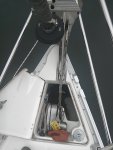
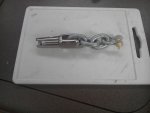
As promised photos of standard Bavaria setup and the new swivel - yet to be fitted.

As you can see it is all very congested around the bow roller so getting through to the anchor hanging off the front is a bit of a pain. The thing with the anchor coming up backwards is that it is unpredictable. Mostly it is fine, sometimes it starts off backwards but as it gets near to the roller and flips right side up (as it did last Tuesday). I have tried your suggestions and learned the key thing is to make sure I stop the windlass before the shank hits the roller as this is the critical point at which there is a danger the anchor will jump off. Fortunately happened only once. You can probably just make out a bit of light line tied to the crown and running up the chain. Added this after the jumping off episode so that I can lift the crown rather than struggling over the bow. Not used in anger yet. Because I am on my own I always try to anchor where there is plenty of space so that I can sort things out without the fear of drifting onto other boats, but if I am in a crowded anchorage I usually lift most of the chain from the foredeck then go back to the helm and lift the rest from there and leave the anchor dangling. Go somewhere with room and sort it out at leisure. What would be nice though, would be to have the anchor reliably self stowing. Not terribly convinced the swivel set up will do this but worth a try.
 

Attachments

  • IMG_20210619_131130.jpg
    IMG_20210619_131130.jpg
    728.3 KB · Views: 15
  • IMG_20210619_130827.jpg
    IMG_20210619_130827.jpg
    518.1 KB · Views: 11
Sorry Jonathan, I must be having a bad day, can see the article but nothing to click for pictures etc.
 
The anchoring set up with a wireless remote for the windlass, a fairly good chain locker and a self stowing Delta is OK except that sometimes the anchor flips backwards as it comes to the roller and is a PITA to get straight. Near vertical stem does not help as if it starts to swing it can bash the hull. Hence the proposed change to swivel connector.


Hi Tranona, have you seen the Osculati anchor swivel link?

Just fitted one to our new Rocna and it does exactly what it is supposed to, ensures the anchor comes over the roller right way up.

Our previous Delta was a lottery - I have a few gelcoat chips to prove it.

I got ours from Force 4 at Chichester. I wasn there yesterday, they have two in stock.

It is a thick S/S round bar with an integral swivel one end and a cunning bend the other.

Simple, but effective.
 
Thanks for that. I had seen it, but I had already decided that the Kong setup was suitable based on various reports from users. However I might revisit my decision. You are right about the lottery with the Delta - that is what I want to avoid.
 
Hi Tranona, have you seen the Osculati anchor swivel link?

Just fitted one to our new Rocna and it does exactly what it is supposed to, ensures the anchor comes over the roller right way up.

Our previous Delta was a lottery - I have a few gelcoat chips to prove it.

I got ours from Force 4 at Chichester. I wasn there yesterday, they have two in stock.

It is a thick S/S round bar with an integral swivel one end and a cunning bend the other.

Simple, but effective.

If you send Vyv a PM he has a rather scary picture of where his Oscaluti link locked vertically on the shank of his anchor. I'm not sure if adding a few links of chain might not solve the problem. But a bent link with a swivel is a contradiction. The bent link negates the need entirely for a swivel - adding a swivel simply adds a point of failure you cannot inspect. says a man showing no bias at all :).

Jonathan
 
Top