New anchor chain and Kong swivel size?

Sorry Jonathan, I must be having a bad day, can see the article but nothing to click for pictures etc.

Don't apologise. My fault.

I have just checked and find that MySailing that is the link I have given for the Boomerang have changed the format - and for reasons known only to them - have removed all the pictures. (There is a long story about MySailing and change of ownership etc etc)

However Thinwater has a blog and on the blog he has a short article on the Boomerang and, maybe more important, the drawing with all the dimensions. So.....no need to send me your email address.

Boomerang Your Anchor

However ..... I have a number of photographs of Boomerang installations (they are not exciting and have not a single bikini - so you know I'm not a marketing man) and if you would like some installation photos - I can send you some (but now I need your email address :(. ). The reason I have the cross section of images (apart from hoping to enhance my status) - when a batch were made some of the new owners who were local to me asked me to look at their installation, maybe they cannot count links :) and I took the opportunity to increase my Boomerang album.

I have a number of variants to the original boomerang, one of which we have permanently attached which makes it more convenient to incorporate the concept with high tensile chain. Instead of shackles we use Omega links from the lifting industry and I had to modify the slot design to have the links fit.

It is critical that you ensure that you instal correctly and that your chain is not twisted, but its not difficult - just follow the instructions.

Again, any queries - just post on YBW in either PBO or YM sections and/or send me a PM and I'll help.

Sorry that I have led you an unnecessary song and dance.

Viking Anchors make the Boomerang with my approval, they asked if I would mind (a move showing integrity) and I am more than happy to have someone spread the word - as I think the device useful, it works and it is over engineered - so safe. I'm not in the business, despite what people might think, of promoting - I just like my ideas to be assessed by my peers, you, and if accepted then those ideas I'd like disseminated to as many as possible - altruism, not money is the motivation.

Now I have not seen, in the flesh, a Viking Boomerang - but have been promised one. I like Viking because I think they have moved anchor 'knowledge' forward by use of HT steel through the whole anchor and thus saving weight. I'm one who thinks anchors work by design, not weight. They are open minded and adopt ideas from outside and are happy to give a source to ideas they adopt. Their use of HT steel in the fluke is all theirs. Interestingly their steel supplier a specialist Nordic company have been adopted by Volvo to supply them 'green' steel made using hydrogen, not coal. Its the first time I have heard of green steel being accepted commercially and possibly Viking use the same steel - as the steel Viking uses is used in the Automotive industry. So those of you with environmental credentials - take note - watch Volvo and Viking.

I am quite happy to admit that the Boomerang is hardly original. NormanS, a member of YBW, made one from stainless rod with rings welded on each end. Oscaluti make one and I have seen them in the Med (some bent) referenced above, and I have seen a cast version. I believe there is one in America called a banana (I've not seen it). Now who made the original - no idea - I simply copied the concept - my input was to make it a very different way (which I think is simple). It requires no great skill, but you really do need an angle grinder and a decent drill, but no welding, no ability to bend anything. You could make it in your kitchen (though angle grinders are incredibly noisy - so an understanding wife is a real asset :) ). I don't have the problem with noise as my workshop is mostly underground and is built to what seems the same specification as a bomb shelter - reinforced concrete, roof, walls and floor.

I'll get off my soap box :)

Take care, stay safe

Jonathan

Apologies to the OP for commandeering his thread for selfish reasons - I've wrapped my knuckles.
 
Last edited:
I don't know about the Nobel Prize, but the developer of the Boomerang is Jonathan Neeves AKA N in this place. and it is manufactured by Viking anchors with his approval.
As said, good and simple solution, easy to make by almost anyone.

Mine's a Viking and, if anyone is in doubt, it works. I suppose I could have made one but for the galvanising.
 
Last edited:
If you send Vyv a PM he has a rather scary picture of where his Oscaluti link locked vertically on the shank of his anchor. I'm not sure if adding a few links of chain might not solve the problem. But a bent link with a swivel is a contradiction. The bent link negates the need entirely for a swivel - adding a swivel simply adds a point of failure you cannot inspect. says a man showing no bias at all :).

Jonathan


The Osculati kit that does what the boomerang does is fitted with several links of chain, then the swivel,bend and link towards the main chain.

That is the fitting instruction, which I followed exactly.

Boy, are those 12mm Witchard shackles expensive!

Used it four times, practiced on the mooring to see it in action about the same. Comes over the roller right way up every time.
 
The Osculati kit that does what the boomerang does is fitted with several links of chain, then the swivel,bend and link towards the main chain.

That is the fitting instruction, which I followed exactly.

Boy, are those 12mm Witchard shackles expensive!

Used it four times, practiced on the mooring to see it in action about the same. Comes over the roller right way up every time.

I recall that the Oscaluti link has a fork and I suspect Vyv had the fork attached directly to the shank of the anchor (otherwise it would not stand vertically). The links supplied seem to overcome that issue.

If in the fullness of time if you find any of the gal links corroding remember to cut of 2 or 4 (even number) or when you re-assemble the chain it will have a twist in it.

I confess the Boomerang does need 2 extra shackles - but they simply can be rated, conventional gal shackles as they are never side loaded, so for a 3/8th" shackle they would have a WLL of 1t. A CMP Titan yellow pin shackle would be fine (cheap as chips). You still need a decent shackle for connection at the anchor shank itself and again for a 3/8th" shackle I'd strongly recommend a Crosby G209a with a WLL of 2t, which are hardly expensive but more expensive than a Titan Yellow Pin shackle. A 3/8th" shackle would be good for a 8mm G30 chain (or a G70 6mm chain :) ).

Shackles lock up in anchor slots, believe me - if loaded at 90 degrees their WLL is reduced by 50% (believe me - I've tested it) and this is on the website of most manufacturers. I was giving a lecture in Queensland and one of the audience approached me and slightly sheepishly told me he had just lost his new Excel anchor. He gave me the shackle - it had been side loaded, the pin had pulled out of the thread - and released the chain - it was a 3/8th" rated shackle WLL 1t.

For anyone reading this post - I am looking at some alternatives to Crosby shackles, same specification, which might be easier to source and maybe cheaper.

Jonathan
 
Last edited:
I recall that the Oscaluti link has a fork and I suspect Vyv had the fork attached directly to the shank of the anchor (otherwise it would not stand vertically). The links supplied seem to overcome that issue.

If in the fullness of time if you find any of the gal links corroding remember to cut of 2 or 4 (even number) or when you re-assemble the chain it will have a twist in it.

I confess the Boomerang does need 2 extra shackles - but they simply can be rated, conventional gal shackles as they are never side loaded, so for a 3/8th" shackle they would have a WLL of 1t. A CMP Titan yellow pin shackle would be fine (cheap as chips). You still need a decent shackle for connection at the anchor shank itself and again for a 3/8th" shackle I'd strongly recommend a Crosby G209a with a WLL of 2t, which are hardly expensive but more expensive than a Titan Yellow Pin shackle. A 3/8th" shackle would be good for a 8mm G30 chain (or a G70 6mm chain :) ).

Shackles lock up in anchor slots, believe me - if loaded at 90 degrees their WLL is reduced by 50% (believe me - I've tested it) and this is on the website of most manufacturers. I was giving a lecture in Queensland and one of the audience approached me and slightly sheepishly told me he had just lost his new Excel anchor. He gave me the shackle - it had been side loaded, the pin had pulled out of the thread - and released the chain - it was a 3/8th" rated shackle WLL 1t.

For anyone reading this post - I am looking at some alternatives to Crosby shackles, same specification, which might be easier to source and maybe cheaper.

Jonathan


I believe what I am talking about is different to what Vyv had trouble with. The swivel end has a pin for the chain or shackle, the rear end, for the main chain, a fork for the shackle.

I would not connect a fork direct to an anchor shank.

Surprised Vyv did.
 
I believe what I am talking about is different to what Vyv had trouble with. The swivel end has a pin for the chain or shackle, the rear end, for the main chain, a fork for the shackle.

I would not connect a fork direct to an anchor shank.

Surprised Vyv did.
I didn't. I used the same three links. The Osculati did what is expected on recovery. What was not expected was that it disrupted the anchoring process. No idea why but the Osculati finished up sticking vertically out of the seabed. It did this several times and we stopped using it after about a week.
 
I didn't. I used the same three links. The Osculati did what is expected on recovery. What was not expected was that it disrupted the anchoring process. No idea why but the Osculati finished up sticking vertically out of the seabed. It did this several times and we stopped using it after about a week.
The danger of anchor straighteners is that they can disrupt the performance of the anchor, as this example shows.

KISS has a lot of merit when considering how to attach the chain to the anchor.
 
The danger of anchor straighteners is that they can disrupt the performance of the anchor, as this example shows.

KISS has a lot of merit when considering how to attach the chain to the anchor.
The problem of rode burial is a major area of research for Naval engineers and the oil industry. The shackle and boomerang (or old fashioned swivels) are necessary - we do not yet have a way of attaching rode to anchor without a shackle, some need a 'straightener' - there is little point in ignoring the issue and hope it goes away - it will not. Too many buy a swivel thinking it will solve their problems - it does not. Too many buy a Boomerang and swear by them to suggest they don't work or are complicated.

What disrupts the performance of an anchor is the rode itself! The ideal rode is made from infinity thin wire of infinite strength. The rode has volume, or surface area and that surface area tempers anchor performance, except for Fortress and Mantus M1. The M1 sets shallow and does not bury the shank (nor rode) the Fortress buries all of its fluke before it begins to bury the rode. This latter is an unsung advantage of a Fortress, you bury all the fluke before the shank and rode influences performance.

Ignoring these 2 examples.

Most anchor bury the shackle end of the shank and toe simultaneously. As the anchor fluke buries it must drag chain down with it. As more and more chain is buried it provides an increase resistance to the shackle end of the shank burying. The other factor is that as the rode buries it describes a reverse catenary and the shackle develops an increased angle to the seabed. Its the shackle angle that determines the tension angle so as the shackle buries the tension angle increases completely independent of the scope. You can have a zero degree scope angle, chain on the seabed but the tension angle could be 30 degrees. The larger your chain, relative to the anchor, the big swivel, 2 big shackles will all detract from the performance of the anchor. Anchor makers now are going to great lengths to make the shank as thin as possible - having a beefy rode negates that effort.

If you were offered two identical Rocna, one with the existing shank and one with a shank twice as thick (but both shanks of the same strength) - which would you buy. If you opt for the thin shank why - now extrapolate to your rode. Simple stuff.

If you buy a Boomerang of the right size it is thinner than the rode. The Boomerang if attached correctly also provides some resistance to lateral loading, reduces the impact of veering, because it is buried vertically and provides a vertical fluke.

Look at the Vryhof or Bruce website - every drawing shows a rode with a reverse catenary. Bury anchors and dig them out you can measure the angles..

Most anchors set with a fluke seabed angle of 30 degrees, except Mantus M1 at 16 degrees. When they drag, reach ultimate hold, they do so with the fluke at 10 degrees. The angle slowly reduces from 30 degrees (or 16 degrees) as the anchor sets more and more deeply. The angle reduces as the increasing length of buried chain introduces a lifting element to the anchor tension. Its a long way from 30 to 10 degrees (in fact 20 degrees) it is 6 degrees from 16 to 10 degrees. Shear strength of the seabed increases with the square of depth, double depth and you increase hold by 4 times. The steeper your fluke angle the more quickly you will increase hold. The shallower the set the further, distance, the fluke has to travel to develop hold - during which time the fluke may hit a contaminant in the seabed and drag prematurely. A thin rode, however you achieve that thinness, will allow your anchor to dive more deeply and more quickly.

This is an advantage of using smaller high tensile chain (it has less resistance to burial). It is not only the leisure marine industry but oil rigs also use smaller HT chain - for the same reason, you get better burial (and lighter chain and you can carry more of it.)

There will be an article on all of this in Yachting Monthly within the next few months. It will be supported with data and pictures. It has been well researched, its not some airy fairly nonsense from those whose knowledge is superficial.

So as well as focussing on scope look at the size of your swivel, compared to the size of the chain, look at the size of a Boomerang cutting through the seabed vertically - and ponder.

Take care, stay safe,

Jonathan
 
Last edited:
So have I ...it’s just arrived this morning and have been a little surprised as to how small some load bearing parts (lugs, etc) are !

I have fitted my Kong fro the 6-8mm chain and followed the advice and Jimmy Green recommendation and have 3 links of 10mm chain into a bow shackle (galvanised)

it’s all within spec for my 8mm anchor chain, Spade 80 and 37 foot boat, but I am more nervous than I expected about how the Kong goes together and how small the parts are that give it its integrity.

i know there are some gurus on here...i am pondering swapping the Kong for the next size up 8-12mm chain. I guess it will be bulkier going over the bow roller

so ...can I trust the smaller Kong ?

I dont envisage riding out a big storm at anchor
 
I have fitted my Kong fro the 6-8mm chain and followed the advice and Jimmy Green recommendation and have 3 links of 10mm chain into a bow shackle (galvanised)

it’s all within spec for my 8mm anchor chain, Spade 80 and 37 foot boat, but I am more nervous than I expected about how the Kong goes together and how small the parts are that give it its integrity.

i know there are some gurus on here...i am pondering swapping the Kong for the next size up 8-12mm chain. I guess it will be bulkier going over the bow roller

so ...can I trust the smaller Kong ?

I dont envisage riding out a big storm at anchor
How much of a storm are you envisaging? With the same size Kong attached to my Sadler 34 I have sat out countless nights with wind in the 40 knot range and the odd one at 50 knots.

The way the Kong goes together is its big plus point. No loads on screws, only on forged parts of the fitting. As you can see from my test results the 6-8 mm Kong has a similar break load to grade 40 chain, which is vastly greater than any wind will generate blowing on your boat.
 
How much of a storm are you envisaging? With the same size Kong attached to my Sadler 34 I have sat out countless nights with wind in the 40 knot range and the odd one at 50 knots.

The way the Kong goes together is its big plus point. No loads on screws, only on forged parts of the fitting. As you can see from my test results the 6-8 mm Kong has a similar break load to grade 40 chain, which is vastly greater than any wind will generate blowing on your boat.
Thanks Vyv

not planning to be at anchor in 40k !

youve put my mind at rest
 
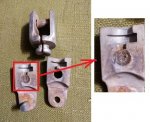
Better be sure to regularly inspect and possibly replace the pairing bolt :)
This one came up with the anchor still miraculously attached as the two halves were kept together by the tiny amount of friction between them
View attachment 118369
That's a good one! A bonus obtained by stowing my anchor below and leaving the chain hanging beneath the cradle is that I disconnect the swivel every winter.
 
Better be sure to regularly inspect and possibly replace the pairing bolt :)
This one came up with the anchor still miraculously attached as the two halves were kept together by the tiny amount of friction between them
View attachment 118369

Last time I undid my securing bolt it was a fair old struggle and I had to use a longer Allen key which I thought was a fair testament to the underwater holding properties of blue Loctite.
 
Top