New alternator temperature way higher than the old one

Boater On Thames

Well-Known Member
Joined
5 Oct 2018
Messages
534
Visit site
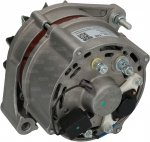
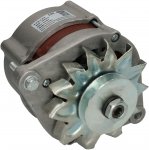
I have replaced the starboard side engine alternator in my Volvo Penta TAMD61A yesterday. The new alternator is Cargo 110127. The cooling fan and the pulley using the old one from the original alternator. Now I found the new alternator temperature way higher compared to the other existing old one on the port side engine. The port size old alternator is just a little warm like I can barely feel the warm temperature by my finger when it's loaded and run for half an hour. But the new one on starboard, I can't hold my finger on the middle deep red part longer than a few seconds no matter when it's no load or loaded after it running for just a few minutes. So yes, the temperature seems the same high doesn't matter loaded or not.

I have kept it running for half an hour, the new alternator still working even temperature quite high.

Any idea why is that? Or, is it just normal for that new alternator?

Thanks.
110127_a.jpg
 
Last edited:
Sometimes the wiring can be confusing. Have you wired it up correctly? (note you may have 2 positive and two negative wires on each terminal depending on engine. If it's correct and still heating up check the amp draw on it. It could be a battery fault or something upline that was the demise of the previous alternator. Also you have changed fan. Is it blowing through the back of the alternator?

Untitled.jpg
 
Hi BruceK, yes, the contentions are correct. Everything working perfectly except the alternator temperature higher than the old one. The batteries are all in good condition. The alternator temperature no obvious difference when no loaded or loaded.

The old fan blowing normally. I can feel the wind. The reason I use the old fan is that the new fan that comes with the new alternator is in opposite direction, so the new fan won't blow air.

The new alternator no load voltage around 54V, then around 14V when loaded. As a comparison, the old alternator no load voltage around 36V, then around 14V when loaded. Is it possible this voltage difference causes the temperature?
 
Last edited:
i.e. unless there is something wrong with the alternator the only thing that will make it hot is the amperage draw on it. i.e. something is drawing amps from it. Try running it with the D+ exciter wire detatched. Hopefully it wont excite and charge. Validate with a multimeter V doesnt increase. See if it still gets hot
 
Hi BruceK, when I say no load mean I disconnected the +VE and -VE terminals on the alternator. Also, even I disconnected all terminals +V, -V, D+, W. So the alternator no any output, no connection or any load. The temperature still not much different, still quite high. Funny!

I thought the alternator has problems. But turns out it kept running about one and a half hour all working good. The temperature remain the same high. So that makes me think is it possible this is a normal temperature for this new alternator?
 
Last edited:
I am amazed how many people fit unsuitable products , I’m also amazed how companies sell products to people who don’t understand what they are buying which are not compatible.

The Volvo spec alternators will only work on battery sensing either from the battery that starts the deduce engine or sense from the domestics via a split charge diode .
I am guessing that this alternator is sensing incorrectly as it has no provision to sense separately that’s why it’s getting hot because the regulator has not input feed therefore it will charge constantly.

The 61 A also spins the opposite way so requires a left hand fan .
 
It has an IR regulator does it need a sensing wire? In as much without a split charge the yellow wire just defaults to B+
 
How hot is too hot ? I had a 200a water cooled on a car. Since the cooling is around 87c then the alternator must get very hot for 87c to cool it ?
 
How hot is too hot ? I had a 200a water cooled on a car. Since the cooling is around 87c then the alternator must get very hot for 87c to cool it ?


I think you may find that actually worked the other way, rather then the coolant cooling the alt, the alt helped get the coolant up to temperature for emissions, if that makes sense?
 
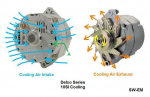
I am not sure about that as I did a bit of googling today and a lot of the information says that they suck air not blow


Tbh I am not 100 percent, just working on the principle in vehicles most alts have the fan end the same end as the direction of travel, so any air coming into the compartment via the engine cooling rad would also need to travel the same way?
Being an industrial engine it may work differently?

Edit, well I never knew that, well what I really mean is I have never had cause to give it any thought before.
Screen Shot 2021-06-29 at 13.29.15.png
 
Last edited:
Top