Navigation marks

Mark26

Well-Known Member
Joined
17 Nov 2017
Messages
377
Location
Penton Hook
Visit site
Following on from the post regarding the Princess stuck on the incorrectly marked sunken wide-beam...

Is it a legal requirement for the environment agency to use maritime navigational marks and aids on non-tidal rivers?

I ask because I don’t know.

On Inland Waterways, ie canals, I don't think there’s any requirement to use maritime navigational marks?

On Tidal rivers yes.

Is a non-tidal the river the same thing as an inland waterway?
I tend to think of them as three things..
Canals - inland waterways
Non tidal rivers
Tidal rivers which encompasses estuaries.

interestingly, on the non tidal river, speed limits are posted in KPH, not Knots which may indicate maritime navigational protocols are not legally required? we do use them but there’s a difference between that and there being a legal requirement for their use.

Thanks in advance, I’d be interested to know.
Mark
 
Following on from the post regarding the Princess stuck on the incorrectly marked sunken wide-beam...

Is it a legal requirement for the environment agency to use maritime navigational marks and aids on non-tidal rivers?

I ask because I don’t know.

On Inland Waterways, ie canals, I don't think there’s any requirement to use maritime navigational marks?

On Tidal rivers yes.

Is a non-tidal the river the same thing as an inland waterway?
I tend to think of them as three things..
Canals - inland waterways
Non tidal rivers
Tidal rivers which encompasses estuaries.

interestingly, on the non tidal river, speed limits are posted in KPH, not Knots which may indicate maritime navigational protocols are not legally required? we do use them but there’s a difference between that and there being a legal requirement for their use.

Thanks in advance, I’d be interested to know.
Mark
There's an useful guide here:-
River Thames and connecting waterways: cruising guide
- with loads of information plus a note on how EA uses marker bouys which may help. Ordinarily there are very few of them in use. More above Oxford where the river is shallower.
Because the EA doesn't have any money, occasionally the correct colour or indeed no colour at all may be used - but it should be clear (with a bit of thought) what the meaningis...
 
The shortish answer is this:

The EA is not constrained by international maritime regulations and navigational marks as it is an independent navigation authority.

All inland waterways must comply with international regulations where no local navigation authority regulations apply - so in the case of the non-tidal Thames, the Thames Conservancy Acts trump any other maritime law.

On the canals, the British Waterways bye laws apply.

The inland waterways are all rivers and canals that are just that, inland, that is, not coastal even though they may be tidal.

The EA posts speed signs in KPH as the UK follows the metric system except for pints of beer (thankfully).
 
Thank you old Crusty.

I shall have to look at the Thames Conservancy Act - just out of interest. Heard of it, but never looked at it. I thought it had been relegated to the dim and distant past.

What a strange mixed-up world we live in.

I shan't mention the roads...
...Oh, all right then...Strangely, the distance markers (those little white posts on the hard shoulder, if you can find a hard shoulder that is) on our motorways, are in KM although we still play with that other old fangled measurement system.

But that’s food for another post. ?
 
Thames Conservancy - Wikipedia

"In 1858 a toll of 15 shillings was imposed on every steam vessel passing Teddington Lock, and a speed limit set to five miles per hour. This was amended to 5 mph with the stream and 4 mph against it. Netting from Richmond to Staines was prohibited for ever. The new authority reaffirmed the rights of anglers against interference from landowners and received a notice from the water-bailiff drawing attention to the " improper practice of letting boats for hire to inexperienced persons".[8] At this time the management of the bulk of the upstream river was the responsibility of the Thames Navigation Commissioners, but this changed in 1866. "
 
The EA looked at adopting CEVNI - so perhaps they should be marking in accordance with that. Hence the KPH, not knots. Its a shame that tradition is not respected but there you go.

The trouble is the EA are no longer a navigation authority - they are park wardens with a boat or two. Whilst they keep putting pen-pushers in as Harbour Master; being the correct title; this will not change. The EA should have marked that narrow boat properly, in MHO. But I get their argument will be that the river is shut, so they don't need to. One of the new temporary wreak marks (blue and yellow vertical stripes) at each end of the wreak would have been ideal.

@Old Crusty - You evidently have been senior in the EA in the past, and I respect your position; indeed I often read your posts with interest, but not marking wreaks and shallows in accordance with the international regs is not clever IMHO. Oh, and you are wrong about the metric system - seen those roads signs with yards and statute miles on them??
 
The EA looked at adopting CEVNI - so perhaps they should be marking in accordance with that. Hence the KPH, not knots. Its a shame that tradition is not respected but there you go.

The trouble is the EA are no longer a navigation authority - they are park wardens with a boat or two. Whilst they keep putting pen-pushers in as Harbour Master; being the correct title; this will not change. The EA should have marked that narrow boat properly, in MHO. But I get their argument will be that the river is shut, so they don't need to. One of the new temporary wreak marks (blue and yellow vertical stripes) at each end of the wreak would have been ideal.

@Old Crusty - You evidently have been senior in the EA in the past, and I respect your position; indeed I often read your posts with interest, but not marking wreaks and shallows in accordance with the international regs is not clever IMHO. Oh, and you are wrong about the metric system - seen those roads signs with yards and statute miles on them??

Pump-Out - I disagree that the EA is not a navigation authority, it is but just isn't doing a great job, merely reactive, constrained by under funding, a lack of talent, poor direction and no will to change. Maintaining the status quo is just easier for the EA.

The last HM on the Thames to have proper nautical experience was me though I did see myself as HM of a bloody big ditch! My framed letter of appointment under the Harbours Docks & Piers Clauses Act 1847 hangs in my downstairs heads, where all such marks of achievement belong. Before that, it was the late Phil Green who had 35 years in the MN (the others like Andrew Graham and Matt Carter have been career, public sector apparatchiks with no boating experience).

I agree that adopting the international CEVNI standard is the right thing to do. Not marking wrecks is unacceptable and they would have been done in my day - we embraced strong stream conditions so we could maintain our boat handling skills in case we needed to pull a boat off a weir structure in high flows.

Re the metric system, I gave the pint of beer as one of the few examples that don't use the metric system for weights & measures - having spent a lifetime in the brewing industry, I know that with very few exceptions, life is metric now. For what it's worth, most boat skippers misinterpret the 8KPH signs as knots which explains partly why I have commanded so many to slow down, especially between Molesey and Teddington (are you reading this Colliers/Cockney Sparrow?)

The EA's part time PR manager monitors this forum so I hope he gets to understand the concerns and frustrations shared by those who contribute half the Waterways Department's budget that includes my £500 this year - and I know also that he won't give a monkey's.
 
I does seem odd that the sunken widebeam canal boat above Sunbury was not marked at both ends. I really thought that would have been done.

It's not exactly complicated to get it sorted out. In fact with a bit of lateral thinking and suitable equipment you could quite easily attach several buoys to the vessel using strong magnets.

It's an all steel boat at the end of the day and after a few weeks on the bottom it seems improbable that a little paintwork scratching caused by the magnets would be a problem.

Decent sized neo pot magnets will stick very very securely to it.
 
@Old Crusty
We are in violent agreement, rest assured. Your post expresses my feelings entirely.

My comment about park wardens was more directed as they way the EA behave, rather than what they are supposed to achieve. The lock staff, who for most of us are the customer facing body of the EA, achieve much more than we, or their masters, perhaps give them credit for.

The back-room facilities are appalling. Don't get me started on putting in assistance call to the EA "The River Thames, sir? - and in what region would that be?" But I get off topic.

Following six months of high waters, and now weeks of shut down, all the navigation marks will need reviewing. Perhaps this should be contracted-out? By area? Going forward a decent boating company could keep a few special marks in a dusty corner of the boathouse, and deploy them fairly rapidly, and possibly cheaper, to an obstruction. The EA tug staff could then attend in slower time to remove the problem.
 
Do the EA still own the tugs?

I think they might still have Ver but not sure about the others. Possibly Churn? The big Falconbrook has been sold as I understand it.

Plus a couple of low profile tugs further up river.
 
Do the EA still own the tugs?

I think they might still have Ver but not sure about the others. Possibly Churn? The big Falconbrook has been sold as I understand it.

Plus a couple of low profile tugs further up river.
[/QUOTE

Hmm, not sure, been retired 4 years now so a bit blind sided. Shame about Falconbrook, powerful beast, 350 hp if I recall correctly. Churn used to tow the poo barge for lock house pump outs and Ver was a regular work horse betweenTeddytown & Caversham.

Please don't be mean about the small tugs based out of Osney. The former finest tug skipper on the non tidal river, Daggy, would chew you off a strip! I thought I was a decent boat skipper till I met Daggy. The man is a legend, taught me so much about handling craft in tricky conditions. Also stopped me from telling La Chemme's skipper to eff off out the way at HRR!
 
I wasn't attempting to imply a negative about the low air draft tugs at all.

They are nice boats and well handled when I have seen them on the River.

I was just doing a comment about vessel ownership.

One thing I did notice about the Falconbrook, which is indeed a powerful beast, was that it is now blue not green so I think the ownership change may be a true story.

I think this was one of the tugs which had a Gardner unit hauled out in favour of a Scania. Ok so Gardner's were the holy grail and the best thing since bread never mind the sliced stuff but the scanias which replaced them were somewhat more powerful.

I remember when Cannonbrook was one of the Thames fleet under the NRA. Lovely old boat that one not sure where it went but it was nice to see. Then there was the Wey with the high up wheelhouse. Postcard material.
 
Given the line of questioning in this post has the OP any connection with the Princess concerned?

No, not at all.

As per the original post, I was purely curious about the legal navigational mark requirements on inland waterways.
I do have a boat, and have for many years, It is because of the differences seen on tidal waterways, and non-tidal where things seem a little more relaxed (being polite) along with the use of KPH instead of Knots that led me to ask.
 
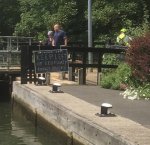
We were amused by this notice in Abingdon Lock, which suggests many Thames users are unaware of the significance of buoyage. :)
 

Attachments

  • IMG_6748.jpg
    IMG_6748.jpg
    70.1 KB · Views: 65
A trip through Abingdon Lock always puts a smile on my face. I hope Frank's doing okay and keeping well during this current situation.
Amen to that.
One of our favourite spots as well.

Ran aground when mooring upstream of Abingdon main road bridge in July last year, got proper stuck, only escaped with the kind help of two other boat crews. Normally moor downstream of the bridge.
 
I like the bacon sandwiches to be passed to the lock keeper sign.

I was taken to task for nicking Richard's Colvic a couple of years ago when I arrived at Culham lock as I had an almost identical vessel at the time. It was not his boat but the keeper there did seem to think it might be.
 
Just as an addenda to my earlier comments re buoyage, the EA does not use top marks on nav buoys. Were that the case, the sunken widebeam orange mark would have had a pole & two black balls atop it. The reason for no top marks is that rowing clubs were in the habit of removing them to prevent damage to expensive rowing blades as they whizzed by.
 
Top