Nav Lights and Regs

Solar garden lights

One thing I've started to see on liveaboards is the use of solar garden lights as anchor lights, either strung up in the foretriangle or mounted permanantly on a short pole on the pushpit (and covered when not anchored). One skipper I spoke to about it said that she preferred a light in people's eyeline when going into a dark anchorage, not something way above it.

That way the anchor light can be used every night even if the engine hasn't been used to charge the batteries. One downside that it probably won't last all night, but the experienced anchorers seem to think that there isn't much movement in an anchorage between 2am and dawn, so it shouldn't matter.
 
One thing I've started to see on liveaboards is the use of solar garden lights as anchor lights, either strung up in the foretriangle or mounted permanantly on a short pole on the pushpit (and covered when not anchored). One skipper I spoke to about it said that she preferred a light in people's eyeline when going into a dark anchorage, not something way above it.

That way the anchor light can be used every night even if the engine hasn't been used to charge the batteries. One downside that it probably won't last all night, but the experienced anchorers seem to think that there isn't much movement in an anchorage between 2am and dawn, so it shouldn't matter.


Some are better than others.
One cheapy from Lidl would burn all night during the summer months. There was enough daylight to charge it fully and not dark for long enough to fully exhaust it.
A modified conical reflector below its single downward facing LED gave it a pretty good visible range too.
The winter weather got under the solar cell eventually and that was the end of it!

A three LED one from Homebase only burns for about 2 - 3 hours even from fully charged. Also has a very uneven spread of light (3 narrow beams basically) Solar cell is protected by a domed cover.


Trouble with them anyway is that if you stow them away during the day they aren't charged when you get them out to use them. Got to have a mounting on deck to ensure they are charged. They also need a switch to switch them off when not required. My Homebase one has but it switches off the charging as well!
 
Last edited:
And if you're a tightwad like me, you can do it all with 3 bulbs and 2 switches.


you are going to have to illuminate me as to how you manage this

I'm normally quite good at working through such challenges but this one has me stumped - unless you aren't a yacht of course........like me, where it's the norm. However this leaves me unable to correctly show the lights for a boat under sail.

You may get round this by having your engine on all the time and correctly acting as a powered craft underway :)

I look forward to being enlightened further!

Failing a response from Angus, I imagine that the answer lies in Rule 23(c)(i), which allows a power-driven vessel of less than 12 metres to combine the steaming and stern lights into a single all-round white. Thus when sailing he exhibits combined red/green sidelights and a sternlight and when motoring he switches off the sternlight and switches on an all-round white (which could also be used on its own as an anchor light).
 
One of the things that really, really annoys me is people who have their sternlight on the pushpit and then have an ensign that obscures it through a big angle half the time.
Some people deserve to be rammed up the arse by the Bilbao.
Either take the flag down when you want lights, or fly it off the backstay.
Or move the light I suppose.

Likewise anchor lights will be obscured by the mast through a significant angle unless you either use a masthead one or keep it well away from the mast.
If you are worried about people seeing your boat from close to, a low power light low down at the stern/cockpit in addition to the masthead light works well. A bunch of white LEDs totalling under 1W lights the deck and is visible from hundreds of metres.
 
It seems to have become custom and practice for some people to use an all round white light at the masthead. I have never found the authority for this view.

I think that the authority is from the statement itself....where else can a white light be seen all round on a sailing boat?

Any lower than the masthead and the mast would, at some point, block the light therefore not providing an all round white light.
 
Any lower than the masthead and the mast would, at some point, block the light therefore not providing an all round white light.
I have two inexpensive Aldi battery powered LED lanterns ( thanks to another forumite)

I can hang one as high as I can reach in the fore triangle ( or even hoist it higher if I feel the need) and the other from the boom or one of the backstays.

With that arrangement ( esp as the boom stows off centre) at least one is visible from any angle and from most angles both are visible , complying with part (a) of Rule 30.

Also provides a bit of usefull illumination in the cockpit ... it ensures that I am visible to anyone else up and about if I get up "to admire the view" during the night. :eek:
 
Failing a response from Angus, I imagine that the answer lies in Rule 23(c)(i), which allows a power-driven vessel of less than 12 metres to combine the steaming and stern lights into a single all-round white. Thus when sailing he exhibits combined red/green sidelights and a sternlight and when motoring he switches off the sternlight and switches on an all-round white (which could also be used on its own as an anchor light).

Sorry everyone, lost track of this thread.

alan_d is correct. You need an all round white at the masthead, a bicolour somewhere forward and a sternlight.

Sailing - bicolour and sternlight
Motoring - all round white and bicolour
Anchoring - all round white
None of the above - all off

So that's the light. For the switches...there are 4 combinations above, so with 2 switches each which can be in 2 positions, you have 4 switch combinations. Wiring them up to do this requires some head scratching, and I can't remember how to do it. I know that you need 2-way and double gang switches rather than ordinary single gang on/off, but it can be done.

The above situation if 3 lights and 2 switches is standard factory fit out on Dragonflies. The reason for it is one less hole in the carbon mast in the normal steaming light position.
 
Lights

I am amazed at the number of sailing boats leaving Portsmouth at night displaying the incorrect lights, also why do boats in Osborne Bay and other similar areas seem to think an Anchor ball isn't worth the expense in daylight but will use an anchor light at night. Surely other sea farers would like to be warned, whatever the time of day. As for motoring cones............................
 
why do boats in Osborne Bay and other similar areas seem to think an Anchor ball isn't worth the expense in daylight but will use an anchor light at night.

Because without a light at night they will be invisible. Without a ball in daylight they're still just as visible, so nobody should be crashing into them. In theory someone sailing or approaching from their starboard side could expect them to give way, but in practice that person is an idiot if they don't realise that a small boat stationary in Osborne Bay is probably anchored.

Seems pretty straightforward and practical to me.

Pete
 
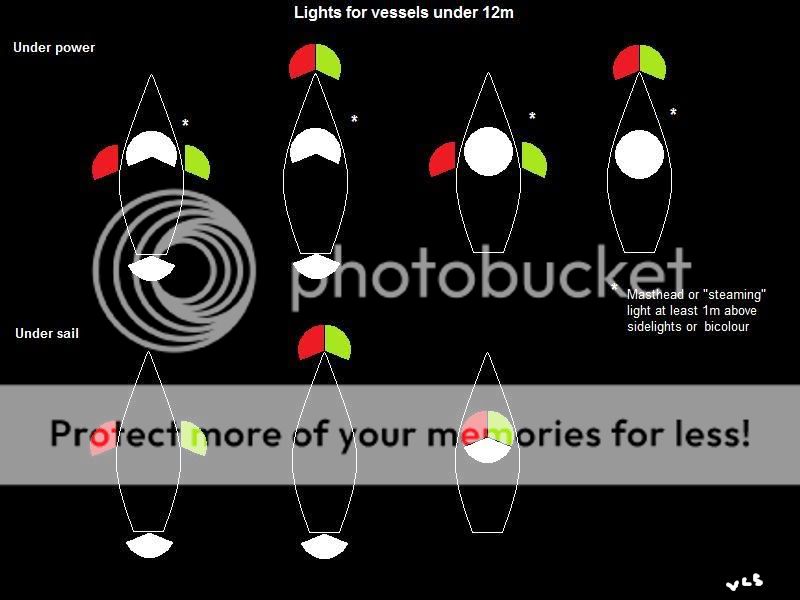
...The diagram below shows the various combinations of lights that may be used on a vessel under 12m while underway..

Very helpful, but {pedant point} it does leave out the possibility of red over green at the masthead used in conjuction with sidelights - "Red over green, sailing machine"
 
if they don't realise that a small boat stationary in Osborne Bay is probably anchored.

Seems pretty straightforward and practical to me.

Pete


The anchor cable gives another clue.

Or is there a special light/cone for "under way but still struggling to break anchor out"?
 
Very helpful, but {pedant point} it does leave out the possibility of red over green at the masthead used in conjuction with sidelights

Since Vic created the diagram specifically so that novices could easily understand how to "be legal" with the minimum required lights, I'm not at all surprised that he missed out optional lights never seen on anything smaller than a square-rigger or a superyacht.

:-)

Pete
 
specifically so that novices could easily understand how to "be legal" with the minimum required lights
Thats it.
Originally drawn to help explain the various alternatives to someone on the Owners Association message board who was having difficulty with written explanations.

Various additions and qualifications could be made.
The concession for certain vessels under 7m is mentioned in the post.
The all round red and green lights now mentioned.
The fact that bicolours and tricolors are allowed on vessels up to 20m and not limited to vessels under 12m, although the all round white in lieu of stern and steaming lights is not.
One could add anchor lights, lights for vessels aground or not under command, vessels fishing etc etc

Eventually the whole object, namely a simple set of diagrams to show the normal lights used by small vessels and their legal combinations, is lost!
 
Sorry everyone, lost track of this thread.

alan_d is correct. You need an all round white at the masthead, a bicolour somewhere forward and a sternlight.

Sailing - bicolour and sternlight
Motoring - all round white and bicolour
Anchoring - all round white
None of the above - all off

So that's the light. For the switches...there are 4 combinations above, so with 2 switches each which can be in 2 positions, you have 4 switch combinations. Wiring them up to do this requires some head scratching, and I can't remember how to do it. I know that you need 2-way and double gang switches rather than ordinary single gang on/off, but it can be done.

The above situation if 3 lights and 2 switches is standard factory fit out on Dragonflies. The reason for it is one less hole in the carbon mast in the normal steaming light position.

thanks Angus (Alan) - I had got as far as the 3 bulbs in this arrangement but my simple brain was thinking in binary terms for the 2 switches with only on/off options!
 
thanks Angus (Alan) - I had got as far as the 3 bulbs in this arrangement but my simple brain was thinking in binary terms for the 2 switches with only on/off options!

You need 1 ordinary single gang on/off switch (S1), and 1 two gang 2-way switch (S2)

Lights are Masthead (M), Bicolour (B) and stern (S)

Logic table...

S1 S2 Lights required
0 0 none
0 1 M anchoring
1 0 BS sailing
1 1 BM motoring

Circuit diagram (without earths) attached.
 
Last edited:
attachment.php
For this to work you need an "allround white" not a masthead light

!
 
The diagram below shows the various combinations of lights that may be used on a vessel under 12m while underway.

Navigationlights.jpg


.

AngusMcDoon adds:
And if you're a tightwad like me, you can do it all with 3 bulbs and 2 switches.

My Beneteau came with just two switches, as you suggest. One turns on lights as shown by the middle boat "under sail" on the diagram above, the other turns on a masthead white all-round light. Thus when running the motor, I have the lights as shown by the second boat from the left of the top row, but the masthead light is all-round !!!!

Will probably confuse someone someday!!!!
 
Angus made it clear in his previous post that he has an all round white at his masthead...

That was 0850 this morning .... still in bed then ....cant be expected to know what people say at that ungodly hour. ;)
Anyway a masthead light is defined in the colregs and it isn't visible through 360
 
Last edited:
Top