
Nav Lights and Regs

johnjfrake

Well-Known Member
Joined
16 Oct 2010
Messages
97
Location
Reading
Visit site
I am a little puzzled by the above and would like some clever and helpful person to confirm or otherwise my understanding. Have a Sailing yacht under 12M. As I understand the regs the following applies:-
When proceeding under sail only under conditions of limited visibility I am obliged to display the following lights: RED to be viewed from Port, GREEN to be viewed from Starboard and WHITE to be viewed fromAstern. I understand about angles of visibility. These light may be mounted at Deck (Push/Pull pit) level or at the masthead in the form of a Tricolour but must not use them simultaneously!!

If I then decide to switch on the engine, regardless of whether I keep the sails up or not I then display a WHITE light centred on the boats centre line and visible from an angle of 112.5 degrees either side of the front of the boat. This white light must be at least 1 meter above the lights described in the above paragraph!

If I then decide to anchor I put on a WHITE light at the masthead that has all round visibility and all other Nav lights must be off.

Will someone confirm this is correct please?
 
That's it.

Couple of things to mention, which you've probably already got.

At under 12m you're allowed to have the red & green in a single bicolour at the bow.

When you turn on the steaming light you've no option but to use the lower nav lights (you can't use the tricolour with the steaming light)

Should also mention that lights should be displayed sunset to sunrise, but you can also choose to display them in limited visibility.
 
Last edited:
Just a few points.

You say "limited visibility". These lights are required between sunset and sunrise... regardless of visibility ... and between sunrise and sunset in restricted visibility.

An anchor light should visible through 360 degrees where it can best be seen

Full details of lights, the alternatives and their minimum visible ranges are in the "colregs" See http://www.mcga.gov.uk/c4mca/msn_1781-2.pdf

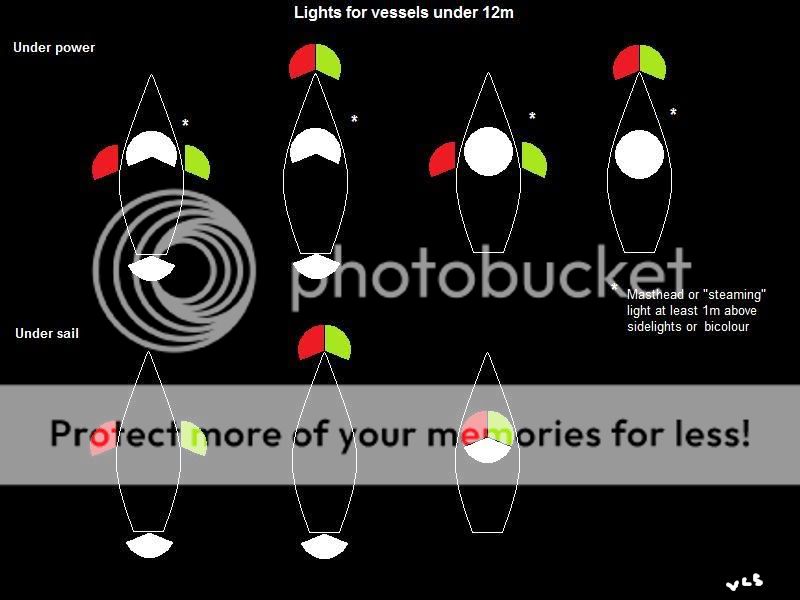
The diagram below shows the various combinations of lights that may be used on a vessel under 12m while underway.
(There is a concession for vessels under 7m with a top speed of less than 7 knots ... for which see the colregs)**

Navigationlights.jpg


** I have to add that or some pedantic school mistress will!

.
 
Last edited:
The other slightly contentious point is about the anchor light.

It seems to have become custom and practice for some people to use an all round white light at the masthead. I have never found the authority for this view.

As far as I know, the only official place for an anchor light is in the fore rigging, eg some 6ft or so off the deck so it can be seen all round. In practical terms this is far preferable IMO to mast head as it is more easily seen and partially lightd the deck to show the boat to others.

Otherwise - Yes!

Mike
 
It seems to have become custom and practice for some people to use an all round white light at the masthead. I have never found the authority for this view.

To be fair, 'some people' in your statement equates to something like 99% or more of yachts. All the major manufacturers mount the anchor light there and they pass the RCD so there would seem to be some implied authority for it.

It's a bit like the custom & practice of commercial shipping leaving their nav lights on when tied up. Saves the bulbs apparently.
 
To be fair, 'some people' in your statement equates to something like 99% or more of yachts. All the major manufacturers mount the anchor light there and they pass the RCD so there would seem to be some implied authority for it.

Rule 30 of the colregs simply says:

Rule 30
Anchored vessels and vessels aground
(a) A vessel at anchor shall exhibit where it can best be seen:
(i) in the fore part, an all-round white light or one ball;
(ii) at or near the stern and at a lower level than the light prescribed in sub-paragraph (i), an all-round white light.​
(b) A vessel of less than 50 metres in length may exhibit an all-round white light where it can best be seen instead of the lights prescribed in paragraph (a) of this Rule.​
 
As far as I know, the only official place for an anchor light is in the fore rigging, eg some 6ft or so off the deck so it can be seen all round.

Nope - as Vic posted, paragraph B of the relevant rule merely says "where it can best be seen". Unless you're the master of a ship, this is all you need to do. I suppose if you're a volume boatbuilder wanting to make something that your punters can turn on at the flick of a switch, the top of the mast is an easy way to do it.

I agree that the middle of the foretriangle is more practical in many ways, and it's what I do.

Pete
 
I came to this post late - but the correct and expert opinions are there.

There have been a large number of debates about what's the best place to exhibit an anchor light on a small boat.

I think it's a majority view that having it lower than the masthead - somewhere approaching eye height on another small boat is optimum.

But a large number of people are perfectly happy with the masthead!

I always put mine lower than the masthead.

We've had one exemption for small boats, here's another:


A vessel under 7m in length need not exhibit the (anchor) lights and shape unless:

in or
near a:​

narrow channel or
fairway or
anchorage or​
where other vessels normally navigate
 
Its night for crying out loud!

The other slightly contentious point is about the anchor light.

It seems to have become custom and practice for some people to use an all round white light at the masthead. I have never found the authority for this view.

As far as I know, the only official place for an anchor light is in the fore rigging, eg some 6ft or so off the deck so it can be seen all round. In practical terms this is far preferable IMO to mast head as it is more easily seen and partially lightd the deck to show the boat to others.

Otherwise - Yes!

Mike

From a practical viewpoint, the important bit is that you have identified it as an all round white (even that is speculative, since all you actually see is a white light, not a 360 view), so chances are it may be a vessel at anchor.

Its going to be used at night, before anyone else points out the obvious, so it will not be possible to identify where on a vessel the light is, unless perhaps when very close, since you will have no other point of reference.

Its only when there may be another light, that you can identify which is the fore rigging/mast.

At night, you have little distance/height perspective. Even on a clear night, all you see are lights on a 'black' background, with little likelhood of judging how close/how far/ how bright/etc. Little chance of being able to pick out fore rigging.

You cannot see things, which is why ensigns are lowered at night - you can't see them, so superfluous to requirements.

Common sense, with rules developed by practical people.
 
Last edited:
best place for lights?

It's not just the anchor light where one gets a choice of high up or low down.

It's perfectly in order to use conventional, ie the deck or coachroof level, nav lights when under sail, they do not have to be (and should not be wired to be) reserved for use in combination with the 'steaming' light. Afterall for years, probably centuaries, this was where they were on sailing ships when oil lamps were used.

This isn't just an accademic or historical point; there are circumstances when you might choose to use them in preference to a masthead tricolour despite the extra power consumption. I have a fairly old (1990s) almanak which says on the subject "when in busy shipping [areas / lanes, if you want to stay alive, use deck level lights not the tricolour" (or words v. close).

I have discussed this with watch officers on ships on a couple of occasions, and they say that while a single high up light, like a tri at masthead, is easier to spot when way offshore, it's hard to judge its distance: it could be a low-down light near the horizon or a masthead light that's close (bear in mind that the bridge of a ship is around the height of a sailing boat's mast). If it's below the horizon it's unequivocally close!

Another aspect is whether lights at the masthead or low down are more likley to be about the same elevation as shore lights: this may differ when seen from a bridge or when seen from the cockpit of other yachts or fishing vessels, and presumably also with how high the shore lights are. How rough it is and whether the deck level lights will be obscured by swell is a factor also (although this is a factor in yachts seeing other yachts more than ships seeing yachts).

There's no hard and fast rule I think, we each have to use our own judgement in the circumstances, but typically I use the tricolour when well offshore and/or the density of other vessels - ships or yachts - is low, but use the nav lights when near a busy port, for instance in the approaches to Felixtowe or in the Solent. Doubtless some do the converse!
 
I am a little puzzled by the above and would like some clever and helpful person to confirm or otherwise my understanding. Have a Sailing yacht under 12M. As I understand the regs the following applies:-
When proceeding under sail only under conditions of limited visibility I am obliged to display the following lights: RED to be viewed from Port, GREEN to be viewed from Starboard and WHITE to be viewed fromAstern. I understand about angles of visibility. These light may be mounted at Deck (Push/Pull pit) level or at the masthead in the form of a Tricolour but must not use them simultaneously!!

If I then decide to switch on the engine, regardless of whether I keep the sails up or not I then display a WHITE light centred on the boats centre line and visible from an angle of 112.5 degrees either side of the front of the boat. This white light must be at least 1 meter above the lights described in the above paragraph!

If I then decide to anchor I put on a WHITE light at the masthead that has all round visibility and all other Nav lights must be off.

Will someone confirm this is correct please?
correct
[If I then decide to anchor I put on a WHITE light at the masthead that has all round visibility and all other Nav lights must be off.]
Anchor Light in the fore triangle unless you want it seen as a Star ;)
Others will disagree :D:D
 
Bear in mind that if you go with RGW on the pulpit/pushpit in any decent sea you will spend most of the time invisible, except for the steaming light. I'd go with a full set of lights including masthead tricolor and use that when sailing.
 
Thanks to you all for all the info! Most interesting. I will carry a bright deck level light for crowded poor visibility situations. I tend to avoid sailing in really bad visibility conditions, being retired I can play a little fast and loose with my diary if I need to.
 
And if you're a tightwad like me, you can do it all with 3 bulbs and 2 switches.
Angus, I am I tightwad also so would you share you secret of how you can comply with Colregs while expending so little.
Also I would like to raise the thorny issue of 'balls and cones' which was briefly referred to ealier in this thread. Does anyone actually use them - I don't and have never been on a yatch that does or even seen another yatch using them.
 
Angus, I am I tightwad also so would you share you secret of how you can comply with Colregs while expending so little.
Also I would like to raise the thorny issue of 'balls and cones' which was briefly referred to ealier in this thread. Does anyone actually use them - I don't and have never been on a yatch that does or even seen another yatch using them.
Well my yacht has balls and cones - and they are used (most of the time!) An old saying is that the only boat with a motor sailing cone up is either a sea school boat or a boat taking a yachting exam. I don't think that is very fair, as lots of people I know use an anchor ball and a few less people use a cone when motor sailing. I admit I see a lot who don't bother with the cone...

I don't own a yatch.
 
I pretty much always use an anchor ball. Last time I didn't was during my YM exam. Examiner said nothing for a while then pointed at another boat and said 'nice anchor ball he's got there'.

I'm less likely to use the motoring cone. I mainly just put it up when I expect to be in crowded waters or to go somewhere where they're fussy about it (Chichester).
 
If I then decide to switch on the engine, regardless of whether I keep the sails up or not I then display a WHITE light centred on the boats centre line and visible from an angle of 112.5 degrees either side of the front of the boat. This white light must be at least 1 meter above the lights described in the above paragraph!

My pet whinge is that modern yachts tend to have the steaming light half way up the front of the mast so you cannot motorsail with the genoa set and have the light properly visible :mad: (Not that the situation has arisen with the yacht though I did sometimes motorsail the lugger at night ... but I would rather not admit to her lighting arrangements before all the critics here!)
 
M
I use the tricolour when well offshore and/or the density of other vessels - ships or yachts - is low, but use the nav lights when near a busy port, for instance in the approaches to Felixtowe or in the Solent. Doubtless some do the converse!

I don't have the choice - my nav lights are provided by a bicolour on the front of the mast, just above where the gaff jaws sit. So not at the masthead, but not low down either. There's no pulpit to mount low-level ones on, although I suppose I could make up light boards for the shrouds if I really cared, which I don't. They'd probably foul the staysail anyway.

My steaming light is just below the masthead, so I don't have Mike's problem.

I always hoist an anchor ball overnight, because it goes up on the same halyard as the anchor light. I always hoist the light since it's an LED one taking miniscule power, and it gives a bit of illumination on deck should I wake up in the night and want to have a look round. I rarely anchor during the day, and wouldn't necessarily hoist a ball then if I did. Depends where I am.

I used the cone once this summer, but that's more because I rarely motorsail.

Pete
 
And if you're a tightwad like me, you can do it all with 3 bulbs and 2 switches.

you are going to have to illuminate me as to how you manage this

I'm normally quite good at working through such challenges but this one has me stumped - unless you aren't a yacht of course........like me, where it's the norm. However this leaves me unable to correctly show the lights for a boat under sail.

You may get round this by having your engine on all the time and correctly acting as a powered craft underway :)

I look forward to being enlightened further!
 
Top