Narrow Channels

What do you think

  • He had paid his fees and was entitled to block the channel for hours

  • The lock keeper should have denied his use of the lock until he had adequate water plus spare

  • Is 2 cm spare acceptable

  • Mobos should be banned from marinas, locks and the Solent area in general

  • Other - please post your detailed response

  • Nervous skipper should have kept his self inflicted nerves to himself and kept to his side


Results are only viewable after voting.
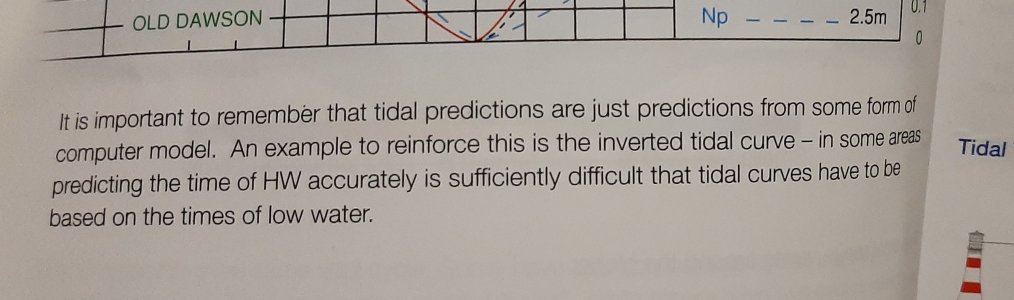
Lots of people don’t realise there’s only a bit less chaos in a tidal prediction than a weather prediction. Nobody is that surprised when a weather forecast is a bit off.

No, it is the reverse of that.

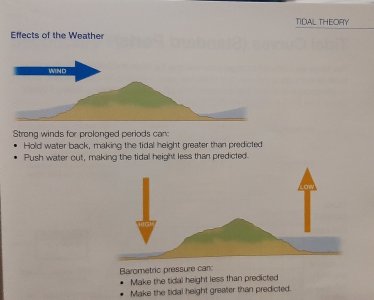
The tide tables are predicting, with impressive accuracy, the astronomical tides (only). What they do not include, and do not purport to include, are the direct and indirect weather-related phenomena that also affect water depth, the times of high/low water, and the timing of changes in 'tidal' current direction/speed - e.g. pressure higher or lower than average, wind-driven water ('tidal surges'), higher or lower than average rainfall and hence run-off and river flows, particularly high or low temperatures, etc.
 
No, it is the reverse of that.

The tide tables are predicting, with impressive accuracy, the astronomical tides (only). What they do not include, and do not purport to include, are the direct and indirect weather-related phenomena that also affect water depth, the times of high/low water, and the timing of changes in 'tidal' current direction/speed - e.g. pressure higher or lower than average, wind-driven water ('tidal surges'), higher or lower than average rainfall and hence run-off and river flows, particularly high or low temperatures, etc.
Well yes, the prediction is just the astronomical bit. The moon and the sun don’t muck around, but the effect of other factors is surprisingly large and much less predictable. Still, I can’t complain. I love being the pedant.
 
Well yes, the prediction is just the astronomical bit. The moon and the sun don’t muck around, but the effect of other factors is surprisingly large and much less predictable. Still, I can’t complain. I love being the pedant.
The predictions are surprisingly accurate given standard conditions.

Your job is to artistically interpret the conditions and apply your best 'guesstimate' of the correction. That's what makes it interesting, pressure is easy, wind effects are challenging and in many cases local knowledge is beneficial.
 
In your (un) humble opinion. See pist #7 - if you think asking people to calculate tides to 10mm, even in theory, is setting a good example of training then we shall neec to disagree.
How inaccurate do you expect people to be when training them in anything? The theory courses provided by the RYA allow for accuracy down to that small margin. They are designed that way and every student I've coached has managed it with practice.

Obviously, as practical sailors, instructors then, once the technique is learnt and practiced, introduce the real world variations.

There is nothing magic about it and is totally normal good educational procedure. Simple, really.
 
In your (un) humble opinion. See pist #7 - if you think asking people to calculate tides to 10mm, even in theory, is setting a good example of training then we shall neec to disagree.

They are not calculating tidal heights down to 10mm, they are calculating astronomical tidal predictions, to which they are also taught to apply an allowance for the variations from those predictions (or did you miss/forget that bit of your training?) according to conditions and circumstances.

Requiring accuracy in calculating the astronomical tidal predictions on training courses ensures that they (a) understand the procedure, and (b) can do the arithmetic.

Once they have got those under their belt, along with the understanding that the actual tide height will often vary from that and why, they may well, as many of us do, not worry about the last decimal point.

When I calculate a course to steer, for example, I know that I can't steer the boat that accurately and other factors will also result in variations from what I have calculated. but that doesn't mean that I shouldn't (or at least be able to) plot that course accurately the first place.

Why introduce more uncertainty and unpredictability? Any sloppiness in the calculation of tidal predictions only adds to the uncertainty and means you might e.g. either be not making best use of a tidal window to get in or out of somewhere because you'd assumed that sloppiness in your calculation was a substitute for an allowance of weather related effects, when they in fact cancelled out, or going aground because you'd assumed that the sloppiness cancelled it out when that and the weather effects were in the same direction and additional.
 
There was a yacht heading out of the very narrow channel wafting his arms up and down (simulating a flightless bird trying to fly).
:rolleyes:

That is actually a distress signal.

In Spain they teach tidal calcs by a mathematical method presuming a sine curve (or a table that basically does the same). One is supposed to make appropriate allowances for the approximation of the method which are obviously quite large in some places.

As I recall from my YM course there was almost always a a safety gap of typically 30cm to be included in the calcs? Maybe I remember badly?
I guess they probably still expected the result within a cm or so, because if everybody starts with the same numbers and uses the same technique you should all get the same answer.
 
In your (un) humble opinion. See pist #7 - if you think asking people to calculate tides to 10mm, even in theory, is setting a good example of training then we shall neec to disagree.
I happen to be on the boat, so here's the YM Shorebased notes explanation of this10mm accuracy. I think tides are more DS stuff, and I seem to have mislaid my books..

YMBook2.jpgYMBook.jpg
 
The DS course includes learning how to use the tidal curve. Also a basic introduction to secondary ports. The questions are for springs, nears or mid way. The Coastal course develops this so that any tide height can be interpolated. Secondary ports are covered in more detail learning techniques to accurately predict times and heights.

For tide streams, interpolation of rates are taught as well as direction.

Other effects on tidal heights as above are discussed.

Of course, you can always look at your mobile phone, but where's the skill in that??
 
Mobile phone tells me 'surge' of -0.39m at Harwich yesterday at low tide - and +0.6m at high tide this morning - so a useful resource that we didn't have when I did the yachtmaster - wouldn't like to have to rely on an electronic chart though - what happens when the battery runs out?
 
You’ll have to forgive me…I’m a bit short on free time and enjoy actual sailing a lot more than navigation and poncing about working out theoretical tidal heights!
If you really were short of time you wouldn't go sailing.....

Why is understanding tides 'poncing about'?

How do you know where you are going without some kind of navigation?

Lots of folk like to understand the environment around them.
 
If you really were short of time you wouldn't go sailing.....

Why is understanding tides 'poncing about'?

How do you know where you are going without some kind of navigation?

Lots of folk like to understand the environment around them.
I can do all the tidal calcs, but I don't go sailing because I love navigating. I navigate because I love sailing. Anything that means less time doing secondary port calcs and more time sailing, or in the pub, is good by me.
I regard the amount of navigation that I do on passage as "the amount necessary to be confident that the box of tricks isn't lying to me". In nice weather that generally involves "looking around". In snottier stuff it will involve simple stuff like "is the depth roughly what it should be?" Is the heading what I expected? etc. I used to jot down lat/long every hour or so to have something to work back from in the event of a power failure. Now I just periodically take a picture of the chartplotter's lat/long on my phone. Which also geotags it with the phone's position for doublechecking You might call that lazy, I call it efficient.
 
I can do all the tidal calcs, but I don't go sailing because I love navigating. I navigate because I love sailing. Anything that means less time doing secondary port calcs and more time sailing, or in the pub, is good by me.
I regard the amount of navigation that I do on passage as "the amount necessary to be confident that the box of tricks isn't lying to me". In nice weather that generally involves "looking around". In snottier stuff it will involve simple stuff like "is the depth roughly what it should be?" Is the heading what I expected? etc. I used to jot down lat/long every hour or so to have something to work back from in the event of a power failure. Now I just periodically take a picture of the chartplotter's lat/long on my phone. Which also geotags it with the phone's position for doublechecking You might call that lazy, I call it efficient.
Don't get me wrong, I rarely need to do basic navigation unless I'm coaching someone. But I do believe that those who understand how to use traditional navigation are more aware and can use modern...ish....tools more efficiently.

On longer passages I like to pass the time putting hourly fixes on the chart, mebbe a handbearing compass fix, yadda yada.

I also like sailing.
 
Don't get me wrong, I rarely need to do basic navigation unless I'm coaching someone. But I do believe that those who understand how to use traditional navigation are more aware and can use modern...ish....tools more efficiently.

On longer passages I like to pass the time putting hourly fixes on the chart, mebbe a handbearing compass fix, yadda yada.

I also like sailing.
If you’re on passage, you’ve generally got a bit of time on your hands, unless there’s something going on to make the sailing hard, like wind or se state. It’s shorter coastal hops done mostly on pilotage that leave you less time for mucking around with the tide tables. Tidal clearance for us generally isn’t the first consideration anyway. If the mud is wet, chances are we’ll get in🤣
 
I used to jot down lat/long every hour or so to have something to work back from in the event of a power failure. Now I just periodically take a picture of the chartplotter's lat/long on my phone. Which also geotags it with the phone's position for doublechecking You might call that lazy, I call it efficient.
I also do similar and I like the idea of phone photos but I'm not at adequate ?

On long passages I set a timer every 30 mins for lat long , speed over the ground , heading and log , it isn't always easy bouncing @ 22 knots .

I'm not sure a phone photo would be much use if all electrics are lost , my prime concern has always been lightning strike knocking out the nav gear but wouldn't an iphone suffer similar ?

I keep a VHF and hand held plotter in the oven (as a Faraday cage) but I'm not confident that the engines would still run after a lightning strike but at least you still have sail , perhaps keep your phone in the oven between photos ?
 
Top