Narrow Bow Roller

smithy

Well-Known Member
Joined
17 Apr 2011
Messages
367
Location
Glasgow
Visit site
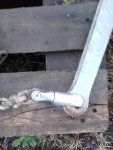
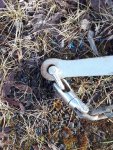
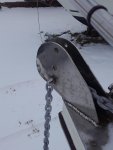
I have a CQR anchor with a swivel on it which just goes through the bow roller. I know the recommendation is to put a couple of links between the anchor and swivel. Unfortunately I can't find a shackle that will fit through the gap, even the type with a countersunk pin. I thought about riveting a crosby link in but not sure if this will work as it might not move about enough in the anchor hole. Any ideas?bow roller.jpganchor swivel.jpganchor shackle.jpg
 
Last edited:
I can remove the swivel but can't attach the chain to the anchor as the swivel shown won't go through the roller. I tried grinding a little off the shackle but it will weaken if I go any further.
 
I wouldn't like a bow roller like that. It looks as if it could easily be distorted by a sideways load. Then you would be in a mess if you couldn't get your anchor up. I would remove it and get one made with smaller, thicker plates spaced wide enough apart to allow a shackle to pass through.

But, I guess that isn't what you want to hear! Sorry!

ps if you had the pivot for the roller in the centre hole (it looks as if it should be there anyway) it would make things a bit easier as you could lift the anchor shackle over the plates more easily.

Mine is better, although not perfect, and it won't allow an adequate sized shackle to pass through because the lug on the shackle pin sticks out too far so I followed Eric Hiscock's advice and rivetted the threaded end of the shackle pin over and sawed off the lug.
 
Last edited by a moderator:
The roller itself is low down so no load on the high cheeks. Its been like that for 37 years most of which on swinging moorings. You have me thinking though, the high sides aren't really doing anything so maybe some reshaping.
 
This looks a possibility, I will scale the width off the drawing and see if it will fit. The working load is high enough to cope.
 
A CQR because of being made by drop forging has a rather beefy shank. The original anchor had a long beefy 'D' shackle that, in the one I had - looked to be made to fit the shank neatly. The clevis pin was almost the same size as the hole in the shank - offering no play. You may find that a more modern anchor, Rocna, Supreme, Kobra Knox (whose shank are made from plate steel) would accept a smaller shackle. But I suspect this is not a comment your wallet will want to countenance.

You could search for a longer, more narrow shackle - where you attach using the clevis pin, then cut off the ear and peen over or secure with Loctite (so that is become permanent) Then use a Grade B shackle (which has twice the strength of a 'normal' shackle (try Tecni who sell Crosby shackles in the UK) of a smaller size - which might fit. Pin then through chain. But the smallest Crosby G209-A is a 3/8th" clevis.

But if its any consolation - bow rollers seem to have got more and more narrow and made from increasingly thinner steel plate.

Finally - ring Knox Anchor (near neighbours for you) - I think they offer shackles with their anchors and may have something that suits.

Jonathan
 
Last edited:
I wouldn't like a bow roller like that. It looks as if it could easily be distorted by a sideways load. Then you would be in a mess if you couldn't get your anchor up. I would remove it and get one made with smaller, thicker plates spaced wide enough apart to allow a shackle to pass through.

But, I guess that isn't what you want to hear! Sorry!
.

I think you are right. I try to make it a rule not to criticise other people's work, but that weld looks like it is sat on the metal, not having penetrated very well also.
 
I think you are right. I try to make it a rule not to criticise other people's work, but that weld looks like it is sat on the metal, not having penetrated very well also.

I agree. It would be easy to modify the bow roller fitting than to modify the anchor and retain the proper strength.

OP I would remove the bow firring and take it to some one who could cut off the side cheeks and reweld then wider apart to suite a new roller that are easy available from a trailer shop.
 
Unfortunately removal of the roller fitting is a major job. The nuts have all been glassed over and are impossible to reach as only access is a tiny door into the chain locker. I would have to cut most of the bulkhead away to get in, not something I am willing to start as launch time is looming.
Another option I have been thinking about is to heat the shackle up and squashing by about 3mm. I would have to recut the thread slightly on the pin.
 
Take an angle grinder to the sides of the roller in situ. Buy a new roller, tap existing roller base and bolt new roller into old one. I'd actually drill right through and have nuts on the underside - as I cannot believe you cannot get one hand and a spanner into the enclosed space. Use lock nuts. You should not need a backing plate - keep the existing base of the old roller and use it to back, or tap. Its less than one days work.

I cringe at the idea of heating and bending shackles. You will re-temper deleteriously a decent gal shackle and it is unlikely when you bend you will end up with a true fit for the clevis pin. I don't know what happens when you heat stainless shackles - they are so soft anyway - maybe it does not matter - but I would not recommend it in the absence of more knowledgable advise. It is also unlikely you will be able to rethread the pins - the threads are certainly not ones I have taps for.

Jonathan
 
Take an angle grinder to the sides of the roller in situ. Buy a new roller, tap existing roller base and bolt new roller into old one. I'd actually drill right through and have nuts on the underside - as I cannot believe you cannot get one hand and a spanner into the enclosed space. Use lock nuts. You should not need a backing plate - keep the existing base of the old roller and use it to back, or tap. Its less than one days work.

I cringe at the idea of heating and bending shackles. You will re-temper deleteriously a decent gal shackle and it is unlikely when you bend you will end up with a true fit for the clevis pin. I don't know what happens when you heat stainless shackles - they are so soft anyway - maybe it does not matter - but I would not recommend it in the absence of more knowledgable advise. It is also unlikely you will be able to rethread the pins - the threads are certainly not ones I have taps for.

Jonathan

Sounds like a plan. I take it you mean fit a new roller assembly on the original base after grinding the old uprights off. I can bolt right through as the plate is a little thin to get a decent thread, putting the nuts on with an extended spanner. I could not remove the old ones without an angle grinder on a pole, just too risky! The roller assembly will have to take the forestay attachment too so will look about and see what's on the market. Thanks all for ideas.
 
Sounds like a plan. I take it you mean fit a new roller assembly on the original base after grinding the old uprights off. I can bolt right through as the plate is a little thin to get a decent thread, putting the nuts on with an extended spanner. I could not remove the old ones without an angle grinder on a pole, just too risky! The roller assembly will have to take the forestay attachment too so will look about and see what's on the market. Thanks all for ideas.

sounds like a plan:encouragement:
 
By all means have one made - I was actually thinking that you would simply go and buy one off the shelf. If you were having one made I'd look at anything already available in a chandler for ideas. But go for a decent thickness of stainless and a 'V' or slotted roller. I'd also suggest one of these double roller types.

But its all about money :(

But keeping the old flat plate, chopping of the uprights seems to be most sensible to me (but its not my wallet nor do I know what constraints for mounting you have!)

Jonathan
 
The OP has said he doesn't want to remove the existing fitting now because he hasn't time so Neeves' idea would satisfy that requirement. If securely through-bolted, with bedding compound, and with any exposed grp epoxied to prevent water ingress, the result could be very strong and much better than what now exists.
 
Sounds like a plan. I take it you mean fit a new roller assembly on the original base after grinding the old uprights off. I can bolt right through as the plate is a little thin to get a decent thread, putting the nuts on with an extended spanner. I could not remove the old ones without an angle grinder on a pole, just too risky! The roller assembly will have to take the forestay attachment too so will look about and see what's on the market. Thanks all for ideas.

You could also drill/grind the heads off the screws on the outside and knock the screw shank through thern drill out the holes from on top.

In a case where it not possible/easy tp get nuts under neath I have made a plate with matching tapped holes to fit under and most of the work can be dome from on top.

A bit fiddly but possible.
 
I would leave part of the old sides in place ( say cut down to 25mm high). Then the new one would fit over the top & as well as bolting to the flat part of the deck plate would also get a couple of bolts through the cut down cheeks. Have a flat cross piece in stainless just above the cut down old side cheeks. Then the new roller would have its top section high enough to clear that . The anchor would sit on the flat.The new one would only be 15mm wider & that would be 7.5mm each side of which 4mm is the existing cheeks anyway.
 
Last edited:
Sounds like a plan. I take it you mean fit a new roller assembly on the original base after grinding the old uprights off. I can bolt right through as the plate is a little thin to get a decent thread, putting the nuts on with an extended spanner. I could not remove the old ones without an angle grinder on a pole, just too risky! The roller assembly will have to take the forestay attachment too so will look about and see what's on the market. Thanks all for ideas.

Why do you want an angle grinder on a pole?- If anything that sounds b..dy risky
Come to that i do not think I have ever seen one, but learn something every day:encouragement:
 
Top