Nanni 14 Underheating

tean

Member
Joined
13 Jan 2006
Messages
25
Location
Western Isles
Visit site
Helo Forum. I have an issue with a 2000 vintage Nanni 14hp, in that it won't heat up to the correct temperature. The fact that the manual that came with the boat has the thermostat cover highlighted and the thermostat part number written in the margin would seem to indicate the previous owner had some issues too.

So I removed the stat cover on the heat exchanger (no mean feat as it's buried under the exhaust elbow which was of course corroded into place) and found that it was assembled incorrctly inside. The thermostat and its retaining spring were the wrong way round. Confident that this was the problem I re-assembled correctly and ran the engine. But there was no improvement: the temperature guage grudgingly made it to about 50 and I could comfortably dunk my finger in the water under the filler cap on the heat exchanger after half an hour of loaded running.

So I splashed out the painful sum of forty quid for a new stat and found it to be slightly longer in the body than the old one. I couldn't really see what difference this would make but put the new stat in and ran the engine under a good load for a while. Still no improvement.

So now I'm confused. It seems the engine can happily cool itself without the stat opening. Now I consult the oracle of YBW and find this old post from 2009,
http://www.ybw.com/forums/showthread.php?187251-Kubota-thermostats&highlight=nanni+thermostat
which seems to say this is a design issue that occurs when the raw water is too cold. Well I am running the engine in fresh river water in February. The suggested fix is to fit a seperate thermostat in the Kubota block.

So here's my question:
The Nanni design seems to be done to ensure cooling water circulates through the exhaust manifold even when the stat is closed and the engine block cool. If I fit another stat in the block then it will shut off the circulation through the manifold until the block heats up and the stat opens. Since the exhaust manifold will heat up much quicker, will it overheat when the stat is closed? Should I perhaps drill a hole in the new stat to allow a little water to flow? Anyone else had this issue? Am I losing it and missing something obvious?

Thanks in advance for any suggestions.
 
This could be unrelated, but I installed a new Nanni 62hp in 2003. It always ran cold and had high oil pressure. Eventually it went bang in 2008 (I won't go into details again) but I installed another new 62hp Nanni similarly it ran cold. By then there was a fleet of hire cruisers on the Thames which had the same engine, and the hirers were complaining the hot water wasn't getting hot, so they came up with and installed a "river" kit, which was then similarly fitted to mine (it was a blanking plate & different thermostat). Since then the newer engine runs much as to be expected, reaching 80 degrees (or so) within 20 mins of running. Best of luck trying to talk to somebody at Peachments though.
 
Well hardly unrelated since it's your old post that I referred to above, and thanks for the reply.

It seems to me that the coolant from the engine enters the exhaust manifold/heat exchanger casting and divides into two paths inside it. One path goes through a chamber where the raw water tubes live and the other circulates around the exhaust and back to the engine. The thermostat acts by blocking the first of these paths and allows permanent cooling of the exhaust. But it appears that if the raw water is cold enough, there is enough heat exchange just through the metal casting to cool the engine and the thermostat never comes into play.

On further thinking, fitting a stat to the block doesn't look easy because the Kubota stat housing has been removed as part of the marinisation and replaced with a custom outlet.

So I could just leave it alone and hope that in the warmer water of the sea all will be well. Or I was thinking of perhaps installing a gate valve in the hose that returns the coolant to the block from the heat exchanger so I can manually hobble the cooling system and make it warm up properly. Have to be careful not to overdo that though. I think this would also boost the circulation through the colorifier which would be good because I want to fit a cabin heater that runs off the same water feed.
 
The obvious answer is to change the thermostat to one with a higher opening temperature but that might not be so easy due to lack of options and expense.

I think that before doing anything I would do some experiments with a G-clamp on various flexible hoses to restrict the flow various amounts and see how much you can alter the temperature under load. This should be an easy and cheap exercise and give you some idea of what you can achieve safely using restriction techniques.

Richard
 
The obvious answer is to change the thermostat to one with a higher opening temperature but that might not be so easy due to lack of options and expense.

It seems to me that the coolant from the engine enters the exhaust manifold/heat exchanger casting and divides into two paths inside it. One path goes through a chamber where the raw water tubes live and the other circulates around the exhaust and back to the engine. The thermostat acts by blocking the first of these paths and allows permanent cooling of the exhaust. But it appears that if the raw water is cold enough, there is enough heat exchange just through the metal casting to cool the engine and the thermostat never comes into play.
 
It seems to me that the coolant from the engine enters the exhaust manifold/heat exchanger casting and divides into two paths inside it. One path goes through a chamber where the raw water tubes live and the other circulates around the exhaust and back to the engine. The thermostat acts by blocking the first of these paths and allows permanent cooling of the exhaust. But it appears that if the raw water is cold enough, there is enough heat exchange just through the metal casting to cool the engine and the thermostat never comes into play

So you think that's a likely scenario, Paul? ;)

Richard
 
So you think that's a likely scenario, Paul? ;)

Richard

It's his engine, who am i to disagree with how he says it works. There's obviously a problem with some of these engines, as Ian mentioned and a "river kit" was developed for them. Ian also states (in the link in post#1 that there isn't an alternative 'stat, without the "river kit".
 
Watermota's old Ford 1600 crossflow based Sea Tiger unit used a standard Ford thermostat with an extra hole drilled into the rim, to prevent the engine from reaching maximum temperature on the river.

The idea being it prevented the extreme hot-cold cycle, hence reducing the amount of stress on the components due to expansion.

The engine thus only ever ran pleasantly warm on the river, still good for heating domestic water, but would only ever hit top temperature when extended fully for a longer period of time.

Given the amount of overheating Marine engines around, it sounds like a fair deal :encouragement:
 
It's his engine, who am i to disagree with how he says it works. There's obviously a problem with some of these engines, as Ian mentioned and a "river kit" was developed for them. Ian also states (in the link in post#1 that there isn't an alternative 'stat, without the "river kit".

Errrr ..... Ian in his post #2 specifically mentions a replacement thermostat with the river kit so it sounds as if the stat could be worth consideration. ;)

But I didn't suggest fitting a river kit ...... so, before changing the stat, I suggested some tests which you carefully edited out. :rolleyes:

Close, but no cigar! ;)

Richard
 
Tean, I owe you an apology, I should have read the link & realised it was my post in 2009 you were referring to. It made me think though, at that time, just after the Boatshow in 2009, the engine had had a few late season runs only in 2008, and my experience now doesn't agree with what I posted then, ie for whatever reason, now the engine does get up to the correct temperature fairly easily, and their "river kit" does work. The kit blanks off an aperture in the thermostat housing, unfortunately, beyond that I've forgotten the details. I do remember taking a thermostat to a motor factor place, they took lots of dimensions and tried to source a different one with a higher temperature rating, but failed to come up with one.
 
Errrr ..... Ian in his post #2 specifically mentions a replacement thermostat with the river kit so it sounds as if the stat could be worth consideration. ;)

I appreciate you never like to be corrected Richard and are a master at pedantry......but......

Read the link in post #1, where Ian states " impossible to get 'stat (apart from a 72 degree one from them)."

Which makes your post #4 "The obvious answer is to change the thermostat to one with a higher opening temperature but that might not be so easy due to lack of options and expense."

Incorrect :)

But I didn't suggest fitting a river kit ...... so, before changing the stat, I suggested some tests which you carefully edited out. :rolleyes:

Close, but no cigar! ;)

You didn't suggest a river kit, because you didn't read all of the information, therefore you didn't know such a thing existed.

I didn't do any careful editing, i quoted the statement that you made that i was responding to. Everything else is still in your post so anyone who is interested can read it :very_drunk:
 
I appreciate you never like to be corrected Richard and are a master at pedantry......but......

Read the link in post #1, where Ian states " impossible to get 'stat (apart from a 72 degree one from them)."

Which makes your post #4 "The obvious answer is to change the thermostat to one with a higher opening temperature but that might not be so easy due to lack of options and expense."

Incorrect :)

You didn't suggest a river kit, because you didn't read all of the information, therefore you didn't know such a thing existed.

I didn't do any careful editing, i quoted the statement that you made that i was responding to. Everything else is still in your post so anyone who is interested can read it :very_drunk:

You really are a very silly sausage Paul. :)

Why do you think I said " ... that might not be so easy due to lack of options"? Might that just be because "Ian states " impossible to get 'stat (apart from a 72 degree one from them)"?

I'll take the compliment, so thank you for that, but can I suggest that rubbishing my efforts to help the OP on the basis of your deduction that "I didn't suggest a river kit, because I didn't read all of the information, therefore I didn't know such a thing existed." might just be where you are going astray? :encouragement:

The lesson you should take from this embarrassment, if I may make so bold, is "if I can't make any sensible suggestions of my own to help the OP, best not resort to trying to belittle other forumites suggestions." although perhaps the pop has a part to play on this occasion ;)

Richard
 
I was at the boat again today and ran the engine in gear at 2000rpm for twenty minutes or so. The temperature guage hardly got above 40. With careful use of mole grips and some padding I "throttled" the main coolant return hose and had to close it completely before the temperature guage showed any interest, reaching 70ish, and the calorifier hoses got properly hot. If nothing else it showed the guage was working correctly. As soon as the grips were released, even just a little bit, the temperature dropped to about 40 again. Obviously no solution here.

Don't know what to try next. I could lock out into the sea and try it, but I can't imagine the sea is so much warmer than the river that it's going to make any real difference. I can't see that a hotter stat will make any difference being as the housing it's in hardly even gets warm.

I have to say I'm very un-wowed by this Nanni. It's new to me but I have some service history and in its 17 years and 750 hours it seems to have cost almost as much to maintain as it cost in fuel. I've just fitted its fourth exhaust elbow and they're £250 a go.
 
I was at the boat again today and ran the engine in gear at 2000rpm for twenty minutes or so. The temperature guage hardly got above 40. With careful use of mole grips and some padding I "throttled" the main coolant return hose and had to close it completely before the temperature guage showed any interest, reaching 70ish, and the calorifier hoses got properly hot. If nothing else it showed the guage was working correctly. As soon as the grips were released, even just a little bit, the temperature dropped to about 40 again. Obviously no solution here.

Don't know what to try next. I could lock out into the sea and try it, but I can't imagine the sea is so much warmer than the river that it's going to make any real difference. I can't see that a hotter stat will make any difference being as the housing it's in hardly even gets warm.

I have to say I'm very un-wowed by this Nanni. It's new to me but I have some service history and in its 17 years and 750 hours it seems to have cost almost as much to maintain as it cost in fuel. I've just fitted its fourth exhaust elbow and they're £250 a go.

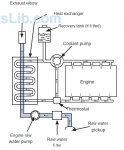
By any chance, do you have a diagram of your engine, or one you can link to, which shows the complete cooling system and the coolant flows?

Your proof that you can get the engine up to temperature means that a solution should be possible but without a diagram I'm not sure how to capitalise on this knowledge as I don't know this engine at all.

Richard
 
nanni cooling.jpg

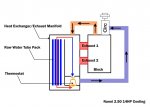
Okay hopefully there's a diagram attached to this. Please excuse my drawing skills.

What I have shown inside the exchanger is to some extent speculation by me, but appears to be the case based on what I can see through the inside of the stat housing. With the stat closed the coolant follows the blue arrow and circulates through the engine and exhaust without (apparently) meeting the raw water tubes. When the stat opens this path is closed off and the coolant flows through the tube stack shown by the red arrow.

What actually seems to be happening is that the heat is draining away to the raw water even with the stat closed and so nothing gets properly hot.
 
I was at the boat again today and ran the engine in gear at 2000rpm for twenty minutes or so. The temperature guage hardly got above 40. With careful use of mole grips and some padding I "throttled" the main coolant return hose and had to close it completely before the temperature guage showed any interest, reaching 70ish, and the calorifier hoses got properly hot. If nothing else it showed the guage was working correctly. As soon as the grips were released, even just a little bit, the temperature dropped to about 40 again. Obviously no solution here.

Don't know what to try next. I could lock out into the sea and try it, but I can't imagine the sea is so much warmer than the river that it's going to make any real difference. I can't see that a hotter stat will make any difference being as the housing it's in hardly even gets warm.

I have to say I'm very un-wowed by this Nanni. It's new to me but I have some service history and in its 17 years and 750 hours it seems to have cost almost as much to maintain as it cost in fuel. I've just fitted its fourth exhaust elbow and they're £250 a go.

Have you tried this with the Calorifier valves closed!?

How does it fare once under way and under load at higher revs?
 
View attachment 69151

Okay hopefully there's a diagram attached to this. Please excuse my drawing skills.

What I have shown inside the exchanger is to some extent speculation by me, but appears to be the case based on what I can see through the inside of the stat housing. With the stat closed the coolant follows the blue arrow and circulates through the engine and exhaust without (apparently) meeting the raw water tubes. When the stat opens this path is closed off and the coolant flows through the tube stack shown by the red arrow.

What actually seems to be happening is that the heat is draining away to the raw water even with the stat closed and so nothing gets properly hot.

This is odd. A 14HP engine is going to produce a lot of heat and I just can't see any way that so much heat is going to be conducted away through the metal of the block/ HE/ exhaust manifold unless the H/E comes into service before too long and that should be dependent upon the thermostat.

As No Regrets suggests, I would shut off the calorifier as another experiment. I can't see this being the problem as the hot water tank can only act as a heat sink for a finite period anyway and the fact the the water never gets hot suggests that the heat is escaping somewhere else.

I'm assuming that this is a single port stat in that it is either open or closing a flow and it is not closing one port and opening another. The port to the H/E should start opening as the stat reaches its operating temperature so some coolant starts to flow through around the H/E tubes which reduces the coolant temp until the stat starts to close again. Presumably this is like a car engine where the coolant flows around the block and, when the stat is closed, is directed through a bypass and back to the block again. This ensures that the circulating coolant maintains an even temperature to avoid local hot-spots and ensures that the stat is exposed to this temperature so it opens when the entire volume of coolant reaches the opening temp.

It would help if there was a simple way to keep the engine coolant circulation going but ensure 100% that no coolant is going around the H/E tubes. You have shown that clamping off the coolant return will overheat the engine so the over-cooling is related to the coolant circulation rather than being something really odd like conduction through metal.

The fact that your stat housing does not get hot suggests that there is always a flow through the H/E. It looks to me as if the only way you can ensure that there is no coolant going around the H/E is to remove the thermostat and put a piece of plastic bag in the housing and then put the stat back. This will effectively act as a blanking plate and give you a completely self contained coolant circulation circuit. Then run the engine and keep a very close eye on the temp.

Ideally, buy a couple of remote temperature probes and displays for a couple of quid each (I have 4 of these on the boat to use for troubleshooting!) and fix these onto the block/coolant pipes (I use ordinary cable ties). If you use a couple you can actually monitor the circulation and see how one probe climbs before one later in the circuit which gives a clear idea of what is circulating where.

If your engine gets up to a sensible operating temperature within 15 minutes (close off the calorifier to simplify the cooling if its circuit is on the coolant side of the stat) then you definitely know that it is not conduction cooling and there is something not right with the current stat or its fitment and some coolant is always going through the H/E such that the stat never actually needs to do anything.

What is the temp stamped on your stat? I'm assuming it's 70 or 80 degrees which is too hot to stick your finger in the header tank.

If the engine still never gets up to temp with the stat blanked off which would be amazing, then it would seem that something is not plumbed-in correctly in the coolant circuit (might not even be possible to mis-plumb it?) or a restrictor is required. You could perhaps use a valve on the coolant circuit to make it easily adjustable?

Richard
 
Last edited:
This is odd. A 14HP engine is going to produce a lot of heat and I just can't see any way that so much heat is going to be conducted away through the metal of the block/ HE/ exhaust manifold unless the H/E comes into service before too long and that should be dependent upon the thermostat.

As No Regrets suggests, I would shut off the calorifier as another experiment. I can't see this being the problem as the hot water tank can only act as a heat sink for a finite period anyway and the fact the the water never gets hot suggests that the heat is escaping somewhere else.

I'm assuming that this is a single port stat in that it is either open or closing a flow and it is not closing one port and opening another. The port to the H/E should start opening as the stat reaches its operating temperature so some coolant starts to flow through around the H/E tubes which reduces the coolant temp until the stat starts to close again. Presumably this is like a car engine where the coolant flows around the block and, when the stat is closed, is directed through a bypass and back to the block again. This ensures that the circulating coolant maintains an even temperature to avoid local hot-spots and ensures that the stat is exposed to this temperature so it opens when the entire volume of coolant reaches the opening temp.

It would help if there was a simple way to keep the engine coolant circulation going but ensure 100% that no coolant is going around the H/E tubes. You have shown that clamping off the coolant return will overheat the engine so the over-cooling is related to the coolant circulation rather than being something really odd like conduction through metal.

The fact that your stat housing does not get hot suggests that there is always a flow through the H/E. It looks to me as if the only way you can ensure that there is no coolant going around the H/E is to remove the thermostat and put a piece of plastic bag in the housing and then put the stat back. This will effectively act as a blanking plate and give you a completely self contained coolant circulation circuit. Then run the engine and keep a very close eye on the temp.

Ideally, buy a couple of remote temperature probes and displays for a couple of quid each (I have 4 of these on the boat to use for troubleshooting!) and fix these onto the block/coolant pipes (I use ordinary cable ties). If you use a couple you can actually monitor the circulation and see how one probe climbs before one later in the circuit which gives a clear idea of what is circulating where.

If your engine gets up to a sensible operating temperature within 15 minutes (close off the calorifier to simplify the cooling if its circuit is on the coolant side of the stat) then you definitely know that it is not conduction cooling and there is something not right with the current stat or it's fitment and some coolant is always going through the bypass such that the stat never actually needs to do anything.

What is the temp stamped on your stat? I'm assuming it's 70 or 80 degrees which is too hot to stick your finger in the header tank.

If the engine still never gets up to temp with the stat blanked off which would be amazing, then it would seem that something is not plumbed-in correctly in the coolant circuit (might not even be possible to mis-plumb it?) or a restrictor is required. You could perhaps use a valve on the coolant circuit to make it easily adjustable?

Richard

Presumably the Nanni 14 is based on the same Kubota engine as the Beta 14? Has the Beta 14 a reputation for under heating? If not then it would appear to be the difference in marinisation - a comparison of the two might suggest some lines of investigation?

.
 
This is odd. A 14HP engine is going to produce a lot of heat and I just can't see any way that so much heat is going to be conducted away through the metal of the block/ HE/ exhaust manifold unless the H/E comes into service before too long and that should be dependent upon the thermostat.

As No Regrets suggests, I would shut off the calorifier as another experiment. I can't see this being the problem as the hot water tank can only act as a heat sink for a finite period anyway and the fact the the water never gets hot suggests that the heat is escaping somewhere else.


I'm assuming that this is a single port stat in that it is either open or closing a flow and it is not closing one port and opening another. The port to the H/E should start opening as the stat reaches its operating temperature so some coolant starts to flow through around the H/E tubes which reduces the coolant temp until the stat starts to close again. Presumably this is like a car engine where the coolant flows around the block and, when the stat is closed, is directed through a bypass and back to the block again. This ensures that the circulating coolant maintains an even temperature to avoid local hot-spots and ensures that the stat is exposed to this temperature so it opens when the entire volume of coolant reaches the opening temp.

It would help if there was a simple way to keep the engine coolant circulation going but ensure 100% that no coolant is going around the H/E tubes. You have shown that clamping off the coolant return will overheat the engine so the over-cooling is related to the coolant circulation rather than being something really odd like conduction through metal.

The fact that your stat housing does not get hot suggests that there is always a flow through the H/E. It looks to me as if the only way you can ensure that there is no coolant going around the H/E is to remove the thermostat and put a piece of plastic bag in the housing and then put the stat back. This will effectively act as a blanking plate and give you a completely self contained coolant circulation circuit. Then run the engine and keep a very close eye on the temp.

Ideally, buy a couple of remote temperature probes and displays for a couple of quid each (I have 4 of these on the boat to use for troubleshooting!) and fix these onto the block/coolant pipes (I use ordinary cable ties). If you use a couple you can actually monitor the circulation and see how one probe climbs before one later in the circuit which gives a clear idea of what is circulating where.

If your engine gets up to a sensible operating temperature within 15 minutes (close off the calorifier to simplify the cooling if its circuit is on the coolant side of the stat) then you definitely know that it is not conduction cooling and there is something not right with the current stat or its fitment and some coolant is always going through the H/E such that the stat never actually needs to do anything.

What is the temp stamped on your stat? I'm assuming it's 70 or 80 degrees which is too hot to stick your finger in the header tank.

If the engine still never gets up to temp with the stat blanked off which would be amazing, then it would seem that something is not plumbed-in correctly in the coolant circuit (might not even be possible to mis-plumb it?) or a restrictor is required. You could perhaps use a valve on the coolant circuit to make it easily adjustable?

Richard[
/QUOTE]

This is what i found listed as the thermostat

Double ported thing like many car ones where as the main port opens the bottom flap closes the by pass

Photo-1-a-copy54-300x300.gif


Diagram I found in a manual shows how it will work

Nanni thermostat.JPG
 
Last edited:
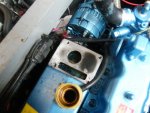
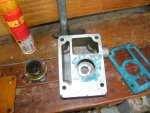
I dug out old photos of the thermostat housing - it's a 62hp 5.280 HE so still may bear no relation to the problem with the Nanni 14.

17  June 001.jpg

The first photo shows the original thermostat and gasket removed, and the two waterways under. The long thin aperture is what gets sealed off.

17  June 006.jpg

The top part of the housing

View attachment 69167

The "River Kit" a simple blanking plate and it's thermostat

View attachment 69168

The blanking plate in position.
 
Last edited:
Top