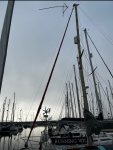
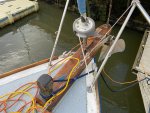
Najad 34 - 1979 Masthead sloop adding a staysail/second forstay..

Hi Dunedin,

Yes I do like that idea also. I will make some enquiries from the local sail maker and see what I can get. I had also considered using hanked on sails instead og the roller when doing a crossing. Maybe with a couple of sail options.

Cheers!
Personally I wouldn’t go to hank on. A really good furled sail is so much less hassle.
You will occasionally get sudden, unforecasted, 30-40 knot gusts off the hills when close to land in places with hills and fjords - like in Scotland. But they tend to be short lived and much easier to furl jib / drop main than phaff around on the foredeck with inner stays and hanks. I generally reduce (or if sea room simply dump) sail and put the kettle on - then rehoist when past.
If you get your forecast right the North Sea to Scotland should be a doddle, without the gusts off hills that get inshore.
Will definitely get Atlantic swell west of Ireland, but too little sail might be a problem for that. Enjoy your voyage.
PS. I did fit a third reef for the mainsail, as a relatively simple improvement. Works well.
 
Hey all! This is the best info I've found in one posting on rigging a solent or slutter, thanks for all of your thoughts here.

I've got a Northstar 26 that I'm rigging as a slutter/solent with a temporary inner dyneema forestay. The inner forestay will attach to the mast about 30cm from the top of the mast.

On a somewhat unrelated note, we just finished installing (4) halyard exit plates on the mast which had (2) external halyards up until now. Now we have (4) new halyards, 2 forward and 2 aft.

I'm wondering how I should install the halyard for the inner forestay? I could just hang a block from the same bracket that holds the inner forestay, I could use the recently added second forward halyard, or maybe install a block in the mast immediately below the inner forestay, which seems to me would be the ideal location for the inner forestay halyard.

I would appreciate your thoughts and comments. I would also appreciate pictures of what you've done on your boat ;-)

Thanks!

Don
 
I've added a fixed inner stay with a rugged staysail - a 'slutter' setup. Of course, the underdeck needed beefing up. The Selden recommendations were followed. Both the genoa-jib and the staysail are on furlers.

Should I want to be 'short-tacking', I use the staysail. Otherwise, and in modest breeze, there's the genoa. In open water, should I want to tack, I roll the genoa away, then tack, then roll it out again on the other tack. No drama!

That's as easy and as idiot-proof as I can make it.
 
Not sure how I managed to miss this thread first time round.

My previous boat had a removable inner forestay. It was pretty basic and ran from near masthead to just aft of the bow roller. Our principle headsail was a small self tacking jib with a track (no boom) so obviously you couldn't tack that with the IFS rigged.
The IFS was only used when off the wind in light conditions. I had a huge lightweight hank-on genoa that came almost back to the winches. Brilliant sail, dead easy to pack away because it was so light- you could just bundle it up like a spinnaker.

On one cruise I managed to jam the furler, and the hank on genoa got us home.

On our current boat I'm toying with adding a similar stay, primarily for trade wind sailing under twin headsails. It would be great to not have to worry about rounding up to reef the main.
 
I'm wondering how I should install the halyard for the inner forestay? I could just hang a block from the same bracket that holds the inner forestay, I could use the recently added second forward halyard, or maybe install a block in the mast immediately below the inner forestay, which seems to me would be the ideal location for the inner forestay halyard.

In my installation I installed a sheave box below the IFS attachment point.
As can be seen in this photo, there is a second forestay halyard (red/white), but if this was to be used for the inner stay sail I think wear from rubbing on the inner stay would be hard to avoid.
mast%20top.jpg
 
Surely another of those Selden Halyard Deflectors, positioned to one side of the stay's mastwall fitting, would resolve that?
 
Surely another of those Selden Halyard Deflectors, positioned to one side of the stay's mastwall fitting, would resolve that?

Possibly so, but one would then lose the spare genoa halyard as such.
A dedicated sheave box was not difficult to install and not particularly expensive. But one has to think through how to tension and belay at the mast foot.
 
In my installation I installed a sheave box below the IFS attachment point.
As can be seen in this photo, there is a second forestay halyard (red/white), but if this was to be used for the inner stay sail I think wear from rubbing on the inner stay would be hard to avoid.
mast%20top.jpg
Thanks for posting this. I was looking at this sort of arrangement yesterday as am planning to do similar to achieve a "slutter" rig on my GH which has 2 masthead forestays, one to the stemhead and the other to the end of a short bowsprit. This is the current arrangement
image0 (6).jpeg


and as can be seen highlighted by the arrow there is conflict at the masthead. The plan is to move the current Genoa to a new furler on the outer forestay and have a working sail on the current Furlex. The stemhead fitting is a horizontal bar about 30cm long with alternative holes for the lower stay fitting like this on another boat of the same type

317530_50c7409df73cb69a14a0fe8b344a76b5 (1).jpg


It is currently on the outer one, so moving it back to the innermost one and attaching the top end as you have done should make the 2 stays parallel. There are various Selden fittings - the O type you used is common, but there is also one that has a sheave box incorporated. Hopefully the new furler will arrive soon and I can discuss the best way of achieving the aim with the rigger - hopefully without dropping the mast again.

Is it possible to post your photo as a jpeg so that I can print it off to show the rigger. Many thanks
 
Last edited:
I'm very interested in the arrangement as shown/ringed, and would welcome others' observations.

I have to fit an identical Plastimo furler to a very similar multi-hole deck fitting, which is mounted further aft about in line with the pulpit legs as shown. I'm most interested in how others have managed arrangements using the same kit... so I can evade some of the possible mistakes.

52769372692_cdcc9d7206_z.jpg


The above looks as though there's a U-link between the deck fitting and a bolt through the lowest of the 13 holes-pairs in the Plastimo 'straps'.
That seems to provide articulation both fore-and-aft and laterally.

How is the lower end of the enclosed rigging screw secured?
How is the rigging screw adjusted?
.
 
Hello All,

First time to use this forum so I hope I'm using the correct area from which to post this question.

I have a Najad 34 - 1979 aft cockpit version. It has a single set of spreader half way up and the mast is fairly solid looking I think. I have been sailing a couple of years now and am starting to do a bit more offshore sailing. I am starting to think about how the boat is setup with intentions of sailing from the West coast of Norway to Ireland round trip in the next 18-24 months.
As part of my plan I am considering adding a second stay so I can have more sail flexibility when sailing in a blow.
I am planning to carry out most of the work myself if possible. I am looking for advive on how best to carry this upgrade out.

1. A slutter?
2 A staysail? preferred option

Do I need running backstays? What components do I need? Installation tips etc...

I have attached some pictures of the boat which I have boat 6 months ago to show current rig setup and a few sketches to give a rough idea of what I'm thinking.


Michael
Your top fixing must be close to the fixed rigging points to ensure load control and prevent mast "pumping" under load.
The deck fixing is often more problematic. A deck hook must be through bolted to a tang secured through multiple points in a bulkhead below. Or by extension to the bow. If not practical the hook must not be just secured to the deck with a pad behind. The loading can be severe so must be distributed to the structure not just the cladding..A solid strut is needed below the hook spanning the under-deck to offload stress at the deck/hull joint, And well padded wherever it touches. I had a piece of L form girder cut and shaped for this purpose.

When tension is applied to the set stay and play remains however tightened, you know you have undercooked seating for the deckhook
 
Top