
My Father used to waterproof tents and stuff when I was a kid ...

Refueler

Well-Known Member
Joined
13 Sep 2008
Messages
24,125
Location
Far away from hooray henrys
Visit site
As title ... my Father used to saok tents etc in a solution to 'waterproof' them .. to stop water passing through - providing no-one ran finger inside of course when rigged.

My motor boat cockpit awning has just been repaired - new zips, doubling where frame wore through etc. But I noted today that water is passing through the material and cockpit is not staying dry as expected. There are no 'windows' in the awning ... only zips and dot and lift fasteners.

Is there still any solution out there that 'waterproofs' tents etc ??
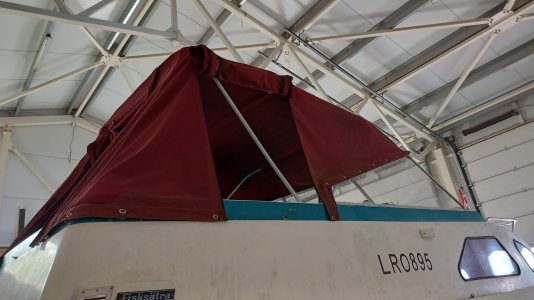
WhatsApp Image 2025-07-04 at 14.21.17.jpeg
 
I'm uncertain as to whether this trick will work on the heavier materials used in cockpit covers etc: but it is highly successful on light cotton and similar material. I've used it to waterproof a Painter's dust sheet resulting in a very waterproof camping Tarp.

Mix white spirit with clear silicone sealant. A full tube of silicone and I think I mixed a couple of litres of white spirit. Give it a good stir and soak the material, although with a cockpit canopy you could try painting it on.

There are several YouTube videos on the drill for waterproofing material in this way. It's where I learned the trick. My 'tarp' is still waterproof after nearly three summers use.(y)
 
I know that Fabsil gets recommended but a recent thread on Facebook group "Sailing Cruising Scotland" reported a complete failure of Fabsil on a Spray Hood. The comments suggested that it made the situation they were trying to repair, worse. There are all sorts of reasons why that could happen, so just stating what was written and that you may want to look at another product. However from that post on FB, some comments: -

1. Don't spray Fabsil, a couple of posts stated same experience with sprayed on Fabsil.
2. Good Fabsil experience when brushed on using Fabsil Universal Protector, brush on two coats. Second about a month later, claimed heavy rain now beads on surface.
3. Coats were brushed on after washing and dried thoroughly. Then brushed on and hung again to dry i.e. not brushed on with canopy in place.

Some edited quotes from the FB group

... last month I had a perfectly great spray hood and Bimini, I treated it with Fabsil, immediately it started to leak ... contacted Grangers ... they recommended Fabsil gold ... washed off ... Applied ... Fabsil gold ... As a controlled experiment ... coated half of the Bimini ... has rained for two days ... everything with fabail is leaking like a sieve ... not leaking is the controlled area that did not get coated ..

... good experience with Fabsil Universal Protector ... Sprayhood of unknown vintage ... wash ... Treated with Fabsil ... generous coat with a brush while bone dry and allowed to dry ... fully ... a few outings , treated a 2nd time straight on top ...

Another poster stated that they had success with silicon diluted with white spirit. When asked what type of silicon they only stated builders merchant stuff in tubes. Make of that what you will.
 
This subject has appeared not long ago.

The consensus was Fabsil Gold I believe (I had success on a tent with ordinary Fabsil) but I have had success with mixing white spirit and silicone sealant (learned via YouTube) and applied it to tents and even my best (but 20 year old) GoreTex coat. It works but if too much silicone sealant added, it shows:

so use less silicone or buy Fabsil…

I have also used a spray from Aldi on coats and that worked (but you would need a lot of cans for a ‘tent’). It is also a seasonal product at Aldi.

I have used wash in Nikwax and many other products over three decades.

I would recommend some type of Fabsil, however.

I was also given a spray directly from Gotetex under a guarantee type of thing and it worked REALLY well, but took a lot of phone calls and negotiating some years ago.

For you project I would go for Fabsil or Fabsil Gold depending upon your budget.

If urgent and can afford, go straight for most expensive Fabsil (or Fabsil Gold?)
 
Last edited:
Bought 5 ltrs of SIMPRAX Tent Waterproofing spray ...

Thanks for all replies ....... lets see what SIMPRAX does ...

I'm hoping that I can also do my ageing boating jacket which is literally only showerproof now ! But it has served well many years .,...
 
I'm very disappointed nobody has yet recommended a traditional mixture used to tan sails.

I vaguely recall variations including any or all of linseed oil, red ochre, cutch (= Catechu - vegetable extract containing tannin, apparently), donkey urine, cow dung, etc.
I thought fish oil was an important component of such recipes, along with black magic!
 
You can buy silicone based transparent paints for exterior application, roller, paint brush. If you follow the instructions they are robust, you can drive over the product, and water proof. The key is to apply to a dry, really dry substrate - any moisture destroys the adhesion between substrate and the paint. When applied by roller they don't need thinned, for application to concrete or brick, you simply roll in with a bit of vigour. You might be able to thin with turps or white spirit (I have used turps to thin transparent silicone that you buy in hardware stores in those plastic tubes). The products are meant to be UV proof - but you would need time to confirm this. You can over coat your first coat and the second coat adheres well - as long as the first coat is dry (it dries to be quite hard but they are flexible - I don't know if they can be folded, which is what somer biminis would require - if the frame is folded flat).

The key to application is - the surface to which you apply must be dry, so concrete or textile needs time in full sun and concrete needs days of full sun to dry and textile can feel dry but retains moisture (dew).

They are available from Temu, Alibaba and Aliexpress. They are shipped by sea, or possibly by land - depends where you are located and come in conventional 1l - 25l plastic drums. Because they do not airfreight they take a long time to arrive. Sometimes you need to have the drums packed in a wooden crate.

These products are cheap, though cheap is relative :)

I don't know about application to textiles - I suspect you would need to apply with the textile on a firm surface - so that you could squeeze the silicone into the fibres and that the end result would be stiffer but still flexible. Some exterior textiles are already coated or impregnated with silicone - these Chinese products should work well.

We have used these products to seal a steel reinforced concrete bridge/drive to our house to control concrete cancer and to seal a large 35' x 12' fibre glass skylight on my underground workshop.

The instructions are all in Chinese - so it helps if you can read Chinese characters or can speak to the factory. However other than the warning about 'dry' - you just use them like ordinary paint, or AF! You could always use Google translation.

Jonathan
 
Fabsil worked well on my Flying Fifteen's cover and has given my leaky gore-tex oilskins a new lease of life.
 
Top