
Mounting a semi-flexible solar panel

rszemeti

Well-Known Member
Joined
17 Jul 2018
Messages
735
Location
Bewdley, Worcs
Visit site
I'm about to mount a semi-flexible solar panel on the coach roof, just ahead of the spray dodger.

What is the best method? A good coating of silicone-like goop and pressit down? Or just use the 4 holes at the corners?

It will (occasionally) get troden on when mucking about with the sails, my thinking is well glued on a very thin layer of silicone might be best.

thoughts?
 
I'm about to mount a semi-flexible solar panel on the coach roof, just ahead of the spray dodger.

What is the best method? A good coating of silicone-like goop and pressit down? Or just use the 4 holes at the corners?

It will (occasionally) get troden on when mucking about with the sails, my thinking is well glued on a very thin layer of silicone might be best.

thoughts?

I just used the 4 holes in the corners with self-tappers with large pan-heads straight into the GRP (pre-drilled first) for my 100W panels.

Richard
 
I just used the 4 holes in the corners with self-tappers with large pan-heads straight into the GRP (pre-drilled first) for my 100W panels.

Richard

So did I and the panel was held securely. However, depending on boat design and the type of sailing you do I would think long and hard about a deck mounted panel. If you regularly take green water over the decks my experience, over 5 years and as many panels of various marques, is they will not survive long as the conductors between the panel and junction box corrode. I've given up on the idea and only deploy a folding panel at anchor, which is also much easier to orientate towards the sun.
 
I have used polysulphide for three large panels. Grabbed the shape of the roof instantly . Added by some reasonable weights in each corner for 12 hours and they are totally secure. No need to drill holes.
 
I'm about to mount a semi-flexible solar panel on the coach roof, just ahead of the spray dodger.

What is the best method? A good coating of silicone-like goop and pressit down? Or just use the 4 holes at the corners?

It will (occasionally) get troden on when mucking about with the sails, my thinking is well glued on a very thin layer of silicone might be best.

thoughts?
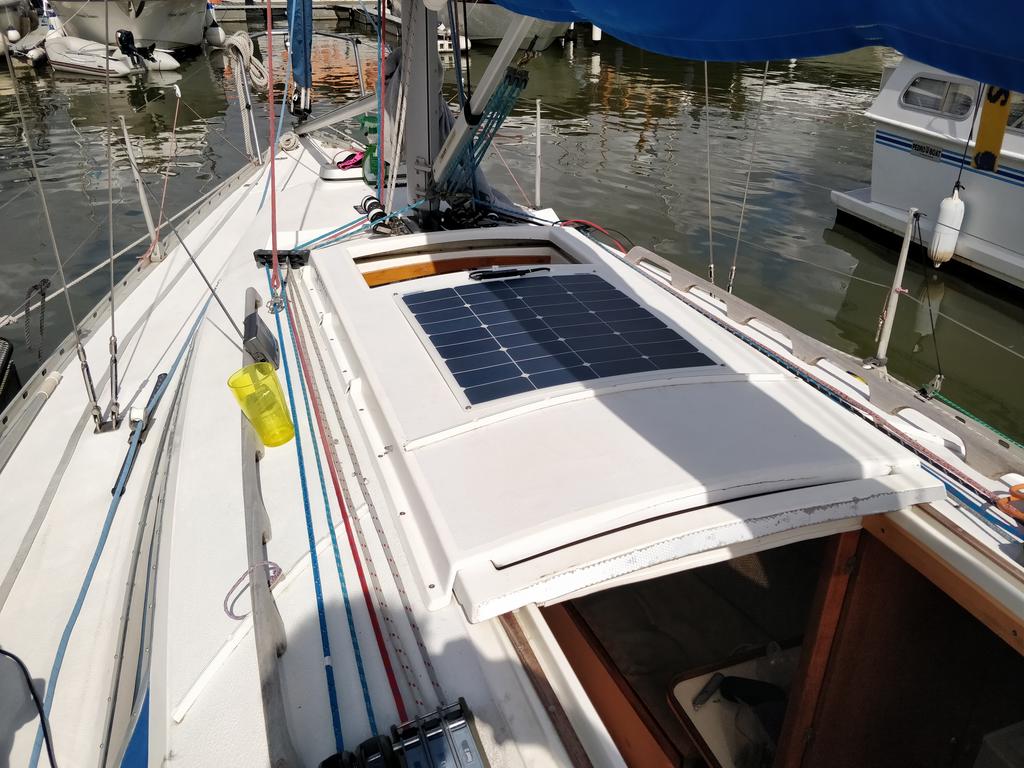
As ever, it depends.

If you're mounting onto a hatch garage that the hatch slides under then I would say just screw it down. You aren't penetrating the deck so no need to worry about sealing, and then you take it off easily if you want to.

This is how I mounted it in mine, in hindsight a solar panel with back connectors would make a much more streamlined installation.

IMG_20180825_120008.jpg


Its a 50w panel, and to be honest I wasn't to impressed with the power it made, the location is the real problem, too easily shaded.

If its directly to the deck I would bond it on so you aren't drilling holes in your deck.
 
It is on the "garage hatch" so I may go for the screws then ...

The cables will come back under the edge of the dodger and enter the instrument pod through existing holes.

As you correctly noted, shading can be a problem, it only takes part of a "string" of panels to be shaded and the whole string loses power. effectively, the current output of the string is limited by the current output of the most shaded cell.

I just want it to keep the batteries "topped off" while hanging on the mooring, so it doesn't need to do much.
 
Mine are mounted on the fore and aft part of the pushpit. They can rotate which helps with sun angle.

I have considered an alternative (they are clipped on and with flying connectors) to mount on the boom (when in harbour!).

There they can be angled more effectively.

I have a 100w panel on the camper van which is actively controlled in elevation. It has performed very well.
 
Mine is mounted with screws ahead of the sprayhood. It appears as if some flexing would occur if trodden on so I take great care to avoid doing this. I think that if I were doing it again I would put a thin but firm layer under it, something like neoprene in texture, to reduce movement as much as possible. Mine is still working fine after maybe 12 years but an identical panel on a friend's boat was visibly crazed overall after only a short time.
 
Contemplating a similar problem, the area I have available on the hatch garage is constrained by the hood behind and dorade vents in front limiting it to 780mm wide by only 450mm long, this might accommodate a 40w. panel but it has been suggested that mounting two 20w. side by side might overcome the inevitable shading from the boom better. (Photonic Universe 450 x 350 each). My hope is just to keep the batteries topped up when the boat is not being used and is sitting on our unserviced pontoon facing west.
Good idea or would one larger 40w. do better.
 
Somewhat as an aside; if permanently mounting it's worth making sure that the panels are IP67, not IP65. IP65 is ok on dwellings but is not rated for waves, low pressure jets of water, etc, all of which are routinely experienced on a boat. It would be a PITA to permanently install only to suffer a premature failure, esp if relying on system for reliable top-up charging. .
 
We have three panels mounted on deck: one forward of the mast, the others just aft of the mast. They are fixed in place by corner screws rather than glued to the deck. Given that we had to replace the original ones, which were glued in place, we made the decision to use screws for two reasons: first, the difficulty in removing them and second the mess they made of the deck beneath.
The panels have now been in place for 6 years, they are regularly walked over and take the waves with equanimity. We will fit an additional panel on the hatch garage roof this summer, fixed in place by screws.
 
Top