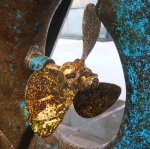
More reflections on our prop issue.

webcraft

Well-Known Member
Joined
8 Jul 2001
Messages
40,410
Location
Cyberspace
www.bluemoment.com
I spoke to the guy at Norris and he reckoned that 13 x 9.5 was only slightly overpropped for the Beta and was standard for the previous Yanmar so was unlikely to have been repitched.

There is no way we should be losing nearly 1,000 rpm at the top end, more like two or three hundred.

He suggested I quite probably didn't need a new prop, especially if I liked the higher gearing.

He suggested checking alignment, stuffing box tightness, cable movement (for full throttle opening) and the rev counter.

I know you can get an android app to check rpm, but pics show it being pointed at a mark on a fan blade - how would I use a device like this on the engine?

- W
 
I was a little bit puzzled that you say you got 2.3 knots at 600rpm and 7 knots at 2600rpm. 600 is below tickover speed, although when you engage gear revs will drop to that, but you should be barely moving. Equally 7 knots is well over what is achievable with the hp you have. You have just enough to get hull speed approx 6.3 knots in flat water.

Do you have the rev counter panel and have you followed my suggestion of checking the tickover and then running up to maximum in neutral to see if the rev counter is giving accurate readings. If you want to check with the app then put the blob on the crankshaft pulley as that runs at engine speed.

Yes the 13*9.5 should allow around 3200 if the recommended 13*8 allows 3600. However, although restricting revs will allow a lower rpm for a given cruising speed you will lose some of the ability against adverse wind and waves because you can't access the last 2 hp . Overpropping a bit is is fine if you have surplus power, eg if you had fitted the 20hp but when you only have the bare minimum available, perhaps not a wise move.

Before you doing anything drastic (other than determining whether the rev counter is accurate), follow the commissioning routine for new installations which is to do a series of runs in flat water at 200 rpm intervals from 1600 up to as far as it will go and plot speed against rpm. Obviously you need to compensate for tide if you have any and are using GPS, or be confident in your log readings. Until you have this type of hard data you are relying on a bit of guesswork.
 
I spoke to the guy at Norris and he reckoned that 13 x 9.5 was only slightly overpropped for the Beta and was standard for the previous Yanmar so was unlikely to have been repitched.

There is no way we should be losing nearly 1,000 rpm at the top end, more like two or three hundred.

He suggested I quite probably didn't need a new prop, especially if I liked the higher gearing.

He suggested checking alignment, stuffing box tightness, cable movement (for full throttle opening) and the rev counter.

I know you can get an android app to check rpm, but pics show it being pointed at a mark on a fan blade - how would I use a device like this on the engine?

- W

The Blue View - Troubleshooting Engine Tachometers — Just a Little Further

You will also need a strobe tachometer to determine the engine speed. This is an adjustable strobe light with a digital readout. They used to cost hundreds of dollars, but can now be found online for less than $50. I have also seen apps for smartphones and tablets that simulate a strobe tachometer, and while I can't vouch for the accuracy of these apps, they are probably good enough to calibrate your tachometer to within 5% or so. You can rent, borrow or buy a good one, buy a cheap one or try one of the apps. Then you need to put a mark on the big pulley on the front of the engine. This can be a small piece of tape, a line drawn with a marker, or a dot of paint, just as long as it can be easily seen when you shine a light on it.
 
I spoke to the guy at Norris and he reckoned that 13 x 9.5 was only slightly overpropped for the Beta and was standard for the previous Yanmar so was unlikely to have been repitched.

There is no way we should be losing nearly 1,000 rpm at the top end, more like two or three hundred.

He suggested I quite probably didn't need a new prop, especially if I liked the higher gearing.

He suggested checking alignment, stuffing box tightness, cable movement (for full throttle opening) and the rev counter.

I know you can get an android app to check rpm, but pics show it being pointed at a mark on a fan blade - how would I use a device like this on the engine?

- W
Double check throttle cable and or carb butterfly's.

I had a right nightmare a couple of months ago when my current outboards butterfly valve wouldn't open fully!

I tried everything and to no avail.
And was starting to think my 40hp outboard was actually a restricted 30hp by the butterfly not opening fully and reaching full RPM'S, I had a max of 3000RPM

There was slight tention in cables so i bought new.

And just like that with no messing about its now running at WOT, Full fluid motion in the cables and reaching recommended RPM range (5500), When before it was restricted by the old rusty cables with exessive slack.

Maybe worth a try.

Sometimes its easy to delve into the obvious and expensive routes only to find out later on it was something alot cheaper and easier in the first place.

Double check your carbs are opening up fully and synchronised at WOT and idle speed is set to factory specs in the water, If not I'd do the cables/Carb sync first before re-prop.
 
Last edited:
Listen to what Tranona is saying and do the simple / cheapest things first.

Start by seeing what max rpm you can achieve in neutral - it should limit itself to 3,600 anyway but don't exceed that if it doesn't. 1 minute job, report back with result.
 
I was a little bit puzzled that you say you got 2.3 knots at 600rpm and 7 knots at 2600rpm. 600 is below tickover speed, although when you engage gear revs will drop to that, but you should be barely moving. Equally 7 knots is well over what is achievable with the hp you have. You have just enough to get hull speed approx 6.3 knots in flat water.

Do you have the rev counter panel and have you followed my suggestion of checking the tickover and then running up to maximum in neutral to see if the rev counter is giving accurate readings. If you want to check with the app then put the blob on the crankshaft pulley as that runs at engine speed.

Yes the 13*9.5 should allow around 3200 if the recommended 13*8 allows 3600. However, although restricting revs will allow a lower rpm for a given cruising speed you will lose some of the ability against adverse wind and waves because you can't access the last 2 hp . Overpropping a bit is is fine if you have surplus power, eg if you had fitted the 20hp but when you only have the bare minimum available, perhaps not a wise move.

Before you doing anything drastic (other than determining whether the rev counter is accurate), follow the commissioning routine for new installations which is to do a series of runs in flat water at 200 rpm intervals from 1600 up to as far as it will go and plot speed against rpm. Obviously you need to compensate for tide if you have any and are using GPS, or be confident in your log readings. Until you have this type of hard data you are relying on a bit of guesswork.
Are you sure it was your suggestion? :cool:
Anyway I agree with all that you are saying though.
My money is on the tacho being out as if you stuck it in gear at 600rpm with that prop it would almost certainly stall. The fact that it isnt suggests you are seeing more like 3000 - 3200 at the top end.
 
.

... I know you can get an android app to check rpm, but pics show it being pointed at a mark on a fan blade - how would I use a device like this on the engine?

- W

Place a small blob of paint on the fly wheel edge (if exposed) or fan belt pulley that is driven directly from the engine. The mark can be on the side as well. Not sure how these phone devices work, picking up the dot on the camera, or by adjusting the flash rate.

Regarding TS Noris advice. I am over propped and they calculated the exact same prop size as was fitted. However, I get full rpm and can punch into big seas and wind with no issues; just high speed at low rpm. So, I don’t know, it may be more subtle in my case.
 
Fantastic input as usual, thanks everyone. Raining and Web work to do tomorrow, but the sun comes out at the weekend and the investigation will begin in earnest.

- W
 
There are some Android RPM counter apps that work from audio - I have tried one called "RPM Gauge" that seems to work well. It indicates that my rev counter is under-reading by 200rpm, which I had suspected. I need to check it on my car, as a crude form of calibration
 
Are you sure it was your suggestion? :cool:
Anyway I agree with all that you are saying though.
My money is on the tacho being out as if you stuck it in gear at 600rpm with that prop it would almost certainly stall. The fact that it isnt suggests you are seeing more like 3000 - 3200 at the top end.
Yep. Only repeating everything I have suggested in the earlier thread except to add the last paragraph. Would have suggested it earlier but there were other basic things to sort out first before actually doing test runs.

Agree the tacho is suspect. Already suggested that is checked as I think the tacho has to be programmed for the specific model engine. Also suggested in the earlier thread.
 
OK, an update . . .

Tacho is OK, engine produces 3,600rpm+ in neutral, throttle cable travel is OK in and out of gear.

When we initially pushed the throttle lever forard the boat went astern. Miguel did something with the morse control and I thought no more of it.

Now, as I understand it, this was not because the morse control was set up wrong, it was because the prop was the wrong hand so things were set up so ahead was reverse and vice-versa. Apparently this is OK with most modern gearboxes where the ratio in ahead and astern is the same.

Turns out it is not OK with the TMC gearbox we have fitted. It has a different reverse ratio, and should not be used at more than 33% power in astern.

The thing I don't understand is I was sure that the Yanmar 2GM20 with Kanzaki gearbox required a right hand prop. Seems that cannot have been the case, as what we have on must be a left hand prop if the boat initially went astern when engaging ahead.

If I am making any fundamental misassumptions please let me know. In the meantime, I have emailed a copy of the TMC40 manual to Joao. Looks like we definitely need a new prop after all. The Beta 16 rotates anti-clockwise at the flywheel, so it needs a RH prop. Recommended is 13 x 8.


- W
 
not sure that is quite right if you have a 2:1 TNC as I think that reverse is also 2:1. However as you say it is not rated for continuous running in reverse. The reason I question it is because I had a TMC with the optional 2.6:1 so that i could swing a 15" feathering prop but the reverse was still 2:1 which was meant reverse was very aggressive and revs limited. OK for what I wanted which was good stopping power on my heavy old wooden boat.

Agree though you need a RH prop and makes sense to have the recommended size. Just double check though that you do have a 2:1 reduction - it is stamped on the identity plate.
 
Place a small blob of paint on the fly wheel edge (if exposed) or fan belt pulley that is driven directly from the engine. The mark can be on the side as well. Not sure how these phone devices work, picking up the dot on the camera, or by adjusting the flash rate.

Perhaps that is different from post #3. But I doubt it.
 
not sure that is quite right if you have a 2:1 TNC as I think that reverse is also 2:1. However as you say it is not rated for continuous running in reverse. The reason I question it is because I had a TMC with the optional 2.6:1 so that i could swing a 15" feathering prop but the reverse was still 2:1 which was meant reverse was very aggressive and revs limited. OK for what I wanted which was good stopping power on my heavy old wooden boat.

Agree though you need a RH prop and makes sense to have the recommended size. Just double check though that you do have a 2:1 reduction - it is stamped on the identity plate.

In the manual it specifies ahead as 2,0 and astern as 2,13

I am assuming the comma is a decimal point.

That should theoretically allow more revs astern, not less, as the reduction is greater, so not sure how that is the cause of the problem, but Joao seems to think it is.

As I can turn the shaft by hand fairly easily and the engine reaches max revs in neutral it is hard to see how the problem can be anything but the prop though.

Am going to check the reduction on the gearbox plate, just in case!

I just wish we had bought a new prop with the engine. This is turning into an endless saga.

- W
 
I agree the manual on the Beta website says that the TMC40 gearbox has a slightly different gear ration ahead to astern, and that they specify which is ahead. I think this must be a change? Presumably Beta have linked to the correct manual?

Doesn't explain a big loss or rpm though as even if the gearbox is running in astern, the ratio should allow a slightly faster rpm.
 
I agree the manual on the Beta website says that the TMC40 gearbox has a slightly different gear ration ahead to astern, and that they specify which is ahead. I think this must be a change? Presumably Beta have linked to the correct manual?

Doesn't explain a big loss or rpm though as even if the gearbox is running in astern, the ratio should allow a slightly faster rpm.

Yes. Not sure the astern ratio is correct? I agree, if it is then revs should be slightly higher like this.

Anyway, to make sure I know what I am talking about...

In ahead the Beta should turn the shaft/prop anticlockwise looking from the front of the engine?

(So the prop turns clockwise looking from astern)

- W
 
Top