More battery talk

, if the batteries get charged then it should go into float mode.
Doubtful, imho, Unlikely the controller will have any idea about the state of charge of the batteries, it doesn't say on the brochure but isn't it more likely to be a timer at absorption before switching down to float? Even if it's very clever it still doesn't know what current is going to loads and what's going into the batteries. My procharge ultra puts less than an amp into the 2 x t105 charged batteries at 13.6v float, if the OP has nearly 10a actually going into the batts at 13. 5 then doesn't sound charged.
 
I'd first check the cabling and connections between your controller and the battery. Poor connections and corroded wiring will drop the voltage seen by the battery and reduce the amount of current they will accept. Ideally, the controller should be mounted as close to the battery as practical. The battery voltage should rise as it charges until such time as the absorption phase is reached and then drop to the float voltage when fully charged.
 
I'd first check the cabling and connections between your controller and the battery. Poor connections and corroded wiring will drop the voltage seen by the battery and reduce the amount of current they will accept. Ideally, the controller should be mounted as close to the battery as practical. The battery voltage should rise as it charges until such time as the absorption phase is reached and then drop to the float voltage when fully charged.

Controller is about a foot away from the battery's and the reading I am getting is at the controller which is the same as the BM1, so I doubt if there a wiring problem .
 
So your saying it's going straight into float mode 13.4 instead of Bulk mode 14.2

Not sure, you need to keep an eye on it from early in the morning, see what it does. But, if the panel voltage doesn't get over 13.5 volts the controller can't increase that to 14.2v.

It's a 12v controller it I wire panels in S 24 v won't that harm the MPPT !

It's for charging a 12v system, it can take up to 50v input, which as Mac says, is 2 panels with some margin.
 
Doubtful, imho, Unlikely the controller will have any idea about the state of charge of the batteries, it doesn't say on the brochure but isn't it more likely to be a timer at absorption before switching down to float? Even if it's very clever it still doesn't know what current is going to loads and what's going into the batteries. My procharge ultra puts less than an amp into the 2 x t105 charged batteries at 13.6v float, if the OP has nearly 10a actually going into the batts at 13. 5 then doesn't sound charged.

My Victron controller spends varying times in bulk and absorption modes.

Like you Pro Charge (and mine) the Victron controller is putting just under and amp in to maintain float.
 
.....For those who think that solar panels cannot fully charge batteries, my controller went into float mode at 1100...... For the rest of the day my batteries will remain fully charged......
I think most solar arrays can't fully charge most cruising boats - yes we have had this discussion before!

I'm afraid with your quote above you have now shown your complete lack of knowledge on when batteries are "fully charged".

Droping to a Float Voltage of 13.4v by 1100hrs doesn't mean your batteries are fully charged. Even "Smart" controllers are pretty dumb. They don't know what's actually going into your battery, so they work on a timer after they have reached the absorption voltage of about 14.4v They could stay at this voltage for as little as 1 hour - depending on the setting of your solar controller. That could mean when you drop to Float your batteries are between 85%-95% full. Even the last 5% at 13.4v will take many hours - from 85% to 100% there will certainly not be enough hours left in the day at the lower Float voltage..

The OP's original problem is very common - I have the same problem on my boat - I only get to 13.5v with a small 140w solar array and a large battery bank. If the charging source is not high enough or the boat loads are too high, and the batteries are low then a solar charger will never get to 14.4v.

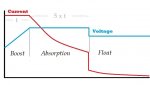
What everyone needs to understand is that a smart controller starts as a constant current charger and slowly raises the charging voltage to the absorption voltage setting of around 14.4v. It then switches to a constant voltage charger and holds that voltage for the duration of the built in timer. Really smart "Smart Chargers" may adjust this time at absorption based on how long it takes to get to 14.4v. At Float the voltage drop will mean the charging current will drop by a factor of about 4. This makes getting back to 100% so much harder than if the controller kept the voltage at 14.4v. But chargers have a Float mode because they are designed to charge batteries - not overcharge them - so leaving a fully charged battery at 14.4v instead of dropping to Float will make it gas severely and quickly kill a sealed battery. This is what overcharging really means - its not taking too much current because a battery takes what current it needs depending on its state of charge.

The OP could try charging the batteries on shorepower or alternator and leave them at 14.4v for an hour and then disconnect all loads and use only the solar for charging. If the charge controller and the array are working properly it should get to 14.4v.
 
I think most solar arrays can't fully charge most cruising boats - yes we have had this discussion before!

I'm afraid with your quote above you have now shown your complete lack of knowledge on when batteries are "fully charged".

You're entitled to your opinion, even if it is wrong :)

I have been running on solar power without resorting to shore power or running the engine for the last two months. I've been carefully monitoring use, solar yield, battery state etc and my findings differ to that which you have just posted.
 
So are you challenging my facts that Float does not mean the batteries are fully charged?

This is fundamental to the understanding of getting the maximum life out of batteries.

My smart chargers only switch over to float voltage once the battery voltage starts to climb above 14.4V / 14.8V depending on the setting. This means that the battery has just started gassing and is fully charged. You could force it over 14.4V until the ice caps melt but it would never get any more charged. :)

Richard
 
......
What everyone needs to understand is that a smart controller starts as a constant current charger and slowly raises the charging voltage to the absorption voltage setting of around 14.4v. It then switches to a constant voltage charger and holds that voltage for the duration of the built in timer. Really smart "Smart Chargers" may adjust this time at absorption based on how long it takes to get to 14.4v.......
My smart charger holds 14.4V until the current drops to a point where it decides the battery is charged.
It then drops to float.

But bear in mind smart chargers are easily thrown off their routine by drawing a load from the battery, or charging from another source.

If you put too small a battery bank on to some smart chargers, they will switch to float too early, because the battery is still bulk charging at the decision point.
 
My smart chargers only switch over to float voltage once the battery voltage starts to climb above 14.4V / 14.8V depending on the setting. This means that the battery has just started gassing and is fully charged. You could force it over 14.4V until the ice caps melt but it would never get any more charged. :)

Richard
Good to get your feedback - but I have to say even 14.4v does not mean fully charged.

14.4v is when the battery starts gassing (temperature dependent). It needs to gas lightly to stir up the electrolyte and even out the Specific Gravity. This voltage is limited by the charge controller so now the current actually going into the battery reduces as the state of charge increase. This can go for many hours before the battery is fully charged.

Graph attached of the charging voltages and current.Charge graph 2.jpg
 
Good to get your feedback - but I have to say even 14.4v does not mean fully charged.

14.4v is when the battery starts gassing (temperature dependent). It needs to gas lightly to stir up the electrolyte and even out the Specific Gravity. This voltage is limited by the charge controller so now the current actually going into the battery reduces as the state of charge increase. This can go for many hours before the battery is fully charged.

Graph attached of the charging voltages and current.View attachment 63718

The volts rising to 14.4 just means the charger is coming out of current limiting.
You could get the battery to 14.4V with less charge in it, but you would need more current.
Likewise if the current limit is lower, it will need more charge in it to get to 14.4V.

If you put enough current in, even a half charged battery can be over 15V.

Gassing will occur to some extent well below 14.4V, depending on the state of charge.
 
In my experience a battery will not gas below 14.4V apart from some negligible local and transient effects caused by unevenly distributed electrolyte. These can be ignored.

Once the voltage rises to 14.3 - 14.5 volts the chemical process of converting lead sulphate back to lead and sulphuric acid is complete and the battery is fully charged, once again ignoring any negligible transient effects caused by stratification of the electrolyte.

If the input voltage is maintained at too high a level all that happens is that a different electrochemical process starts to take effect because the previous conversion is complete. This new process is the breakdown of the water component of the electrolyte into hydrogen and oxygen. This is irrelevant to the charging process as that is now finished.

Richard
 
Last edited:
Once the voltage rises to 14.3 - 14.5 volts the chemical process of converting lead sulphate back to lead and sulphuric acid is complete and the battery is fully charged,
Not the case I'm afraid. Get the voltage up to those levels the battery will still be accepting charge and probably be around 80% charged depending on charger max current , you need to keep the voltage up for charge acceptance to tail off and the battery get fully charged deeper inside the plates - around 4 hours on my trojans. Or leave it at float voltage for a few days.
 
Last edited:
Not the case I'm afraid. Get the voltage up to those levels the battery will still be accepting charge and probably be around 80% charged depending on charger max current , you need to keep the voltage up for charge acceptance to tail off and the battery get fully charged deeper inside the plates - around 4 hours on my trojans. Or leave it at float voltage for a few days.

All I know is that once the battery has started gassing at 14.4V/14.8V I can remove the charger, allow that battery to settle for 24 hours and when I check its voltage it will be around 12.8 volts which is good enough for me. ;)

Richard
 
In my experience a battery will not gas below 14.4V apart from some negligible local and transient effects caused by unevenly distributed electrolyte. These can be ignored.
......

Richard
Not my experience!
If you leave a battery at 14.0V (or even a bit less) for a long time, it will slowly gas until it is dry.
That's why chargers back off to a lower float voltage.
 
All I know is that once the battery has started gassing at 14.4V/14.8V I can remove the charger, allow that battery to settle for 24 hours and when I check its voltage it will be around 12.8 volts which is good enough for me. ;)
That is maybe what you observe on your boat - but you have Lifeline AGMs - so when the charge settles at 12.8v that is too low as a full resting voltage for Lifelines is 12.9v to 13v - very clearly your batteries are not fully charged.

The reason that batteries need to sit at 14.4v is because it takes time for the charge to diffuse to the deeper parts of the plates. You see this on discharge as well. With a high current load the battery volts might go down to 12.2. but take off the heavy load and the voltage will immediately rise to 12.3 or more. Let the batteries rest for two hours - with no charging - and the voltage may rise to 12.5v
 
Not my experience!
If you leave a battery at 14.0V (or even a bit less) for a long time, it will slowly gas until it is dry.
That's why chargers back off to a lower float voltage.

Probably worth mentioning temperature here: the significant gassing point for lead acid is something like 14.8V at 10C (average UK bilge), 14.5V at 20C and 14.2 at 30C. With average boat alternators now apparently set to 14.5V this could cause problems, especially with sealed batteries. No first hand knowledge, so no idea how important this effect might or might not be in hotter climates.
 
A decent smart charger or solar controller doesn't simply work on a timer. It will have a more complex algorithm whereby it will monitor the voltage and amperage that the battery is accepting. If the voltage is at a given level and the amps have fallen to a predetermined level it will consider that the voltage can be dropped to float level. This is why i get varying times of bulk and absorption times every day.

I currently have no charging at all it's dark and the mains charger is off (has been off for two months). With a 2.74 a drain the domestic bank is showing 12.73 volts. The engine battery has no load and shows 12.83 volts.

I think that's classed as fully charged., especially as the domestic bank has been off charge for about over 2 hours, with a small load.
 
Top