Mooring shackles

slawosz

Well-Known Member
Joined
26 Sep 2018
Messages
625
Location
London
Visit site
Hi,
my club has its preferred shackles but I don't have spares and I am not sure if I will get them on short notice. Now, I bought those (one each):
6mm - 30mm Bow Shackles | Galvanised Steel Bow Shackles
Galvanised Steel Bow Shackles BS 3032 | GS Products
One 8 T, other 4T working load.
What I don't like is the fact that pin is loose in non threaded hole - could it case some issues? Other shackles I used has more snug fit. Also, what is good mousing except of heavy duty cable wire and monel wire?
 
I agree, not ideal to have slackness in the unthreaded end but hopefully getting it tight will help.

In addition to mousing I would use thread lock, Loctite or similar, both to prevent unscrewing and to seal the threads. I have seen several mooring shackle failures due to severe corrosion of the threads.
 
Technically speaking screw pin shackles should only be used when there is a need to frequently fasten and unfasten them. If a shackle is out of sight a "Bolt Type Shackle" should be used. These have the advantage that the pin can rotate without any fear of coming undone (assuming the split pin is inserted after the nut). A good make is Van Beest Green Pin shackles or Crosby ones. Most screw pin shackles have clearance through the non threaded hole.
 
Technically speaking screw pin shackles should only be used when there is a need to frequently fasten and unfasten them. If a shackle is out of sight a "Bolt Type Shackle" should be used. These have the advantage that the pin can rotate without any fear of coming undone (assuming the split pin is inserted after the nut). A good make is Van Beest Green Pin shackles or Crosby ones. Most screw pin shackles have clearance through the non threaded hole.
All shackeles in groung tackle, up to mooring bouy is welded. The one I bought will be used for mooring strops - chain as main and polyester strop backup.
 
All shackeles in groung tackle, up to mooring bouy is welded. The one I bought will be used for mooring strops - chain as main and polyester strop backup.
In any application where a shackle is subjected to varying tensions including going slack, screw pin shackles make me nervous. Welding forged components makes me nervous too although perhaps not a factor in relatively low load mooring applications where sizes are more to give corrosion contingency. Bolt type with a cotter pin is best especially where is can be inspected on a regular basis. Not very user friendly for installation or dismantling but should provide peace of mind.
 
In any application where a shackle is subjected to varying tensions including going slack, screw pin shackles make me nervous. Welding forged components makes me nervous too although perhaps not a factor in relatively low load mooring applications where sizes are more to give corrosion contingency. Bolt type with a cotter pin is best especially where is can be inspected on a regular basis. Not very user friendly for installation or dismantling but should provide peace of mind.
I think that welding a shackle closed outside the threaded eye is probably safe enough as any cracking would not cause failure of the connector. I agree in general about welding forged components, especially of course if the carbon content might be higher than about 0.2%, the limit for anchoring gear. When I had a mooring on the Menai Strait all joints were made from welded rebar in 'paper clip' configuration giving a good long weld.
 
Hi,
my club has its preferred shackles but I don't have spares and I am not sure if I will get them on short notice. Now, I bought those (one each):
6mm - 30mm Bow Shackles | Galvanised Steel Bow Shackles
Galvanised Steel Bow Shackles BS 3032 | GS Products
One 8 T, other 4T working load.
What I don't like is the fact that pin is loose in non threaded hole - could it case some issues? Other shackles I used has more snug fit. Also, what is good mousing except of heavy duty cable wire and monel wire?
If the threaded bit fits OK I wouldnt worry about the looseness in the non threaded hole unless its silly loose. If you have doubts ( and it no good being sat at home wondering if the boat has gone walkabout) then go to a lifting tackle shop and get proper shackles rather than cheap chinese cr*p
 
I always avoid Bow Shackles in moorings for good reason.

Bow shackles are designed for multi lifting chains or similar and not actually for single. Over time - they have appeared in applications that really a properly sized D shackle should be used.

It was brought home to me in the most clear way that no-one who saw the results could deny the evidence.

Farlington Marshes swinging moorings.... Langstone Hbr. I took up a guys mooring and had noted the use of a bow shackle connecting ground chain to concrete sinker. I had in mind to change it ... but as with many things it got put aside.
We had a surprise storm pass through when myself and brother returned to mooring. While mooring - the boat was literally touching bottom at times ... about 12ft usual depth ... boat 3ft draft with the waves.
I decided to throw out the anchor and as much chain as possible as well .... just in case ... then we got into the Avon and struggled to shore.

Next morning I drove down to the shoreline to check on the boat. She was up against the marshline having broke free from her mooring ...
When tide was out - I walked out to her. ... anchor had clearly slowed and saved her from getting high up on the marshes. The mooring chain was intact right down to the bow shackle. BUT the bow shackle had clearly 'rotated' and come under side load instead of designed direction and failed. D shackle prevents this. Because the shackle was still there ... I took in hand and carried in back of my Land Rover to show others .....

I am sure someone will now argue the point .... but I will never ever again use a Bow Shackle in a swinging mooring setup.
 
OP speaks of a 6mm shackle. That in my experience is far too small. It is not a question of strength but of volume of metal in the baering parts where wear can be remarkably fast. Galvanising wears away rapidly. So rust sets in. The rust will normally protect the underlying metal but is also quickly worn away to make way for more rust.
For my 1 ton boat I would rate 6mm as dangerous within one season with wear on the rubbing surfaces. Yes the 6mm shackle will take the load when new but not when more than half the metal has gone. Use the biggest (cheapest) GI shackle you can fit in to the chain etc. Of course this concern relates to the chain as well. Use the biggest old chain you can find. This opinion based on moorings never lifted but inspected by diver. if you do lift everything every year then perhaps lighter would be OK. ol'will
 
OP speaks of a 6mm shackle. That in my experience is far too small. It is not a question of strength but of volume of metal in the baering parts where wear can be remarkably fast. Galvanising wears away rapidly. So rust sets in. The rust will normally protect the underlying metal but is also quickly worn away to make way for more rust.
For my 1 ton boat I would rate 6mm as dangerous within one season with wear on the rubbing surfaces. Yes the 6mm shackle will take the load when new but not when more than half the metal has gone. Use the biggest (cheapest) GI shackle you can fit in to the chain etc. Of course this concern relates to the chain as well. Use the biggest old chain you can find. This opinion based on moorings never lifted but inspected by diver. if you do lift everything every year then perhaps lighter would be OK. ol'will

I don't think the OP is using, or even thinking of 6mm shackles. He has simply offered a link that provides information on a range of shackles from 6mm to 30mm - and suspect 30mm is a bit OTT - but maybe the OP has a large yacht. Some of the shackles a bit smaller than 30mm and a bit bigger that 6mm will be ideal. However the galvanised shackles are bit of a waste of time - the gal will be gone within about 1 month on all the wearing surfaces but gal shackles are fairly common and maybe the choice is simply convenience.

I posted this one recently - and its the chain that has abraded (as well as the shackle) but the chain has failed. Most of the shackle shows no sign, at all, of corrosion - abrasion is the killer - NOT corrosion (so again - forget gal).

IMGP1634.jpeg

Jonathan
 
Hi,
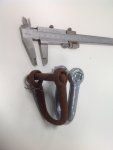
sorry, I wasn't precise. I just got the package when wrote this post - was quite disappointed. So the shackles I bought are very strong - the pin has 28 mm and the body 25 mm. I will use them on top of the bouy- attached to similar shackles for the primary and secondary strop. Those are oversized for sure. But despite the size, the pin can come loose.
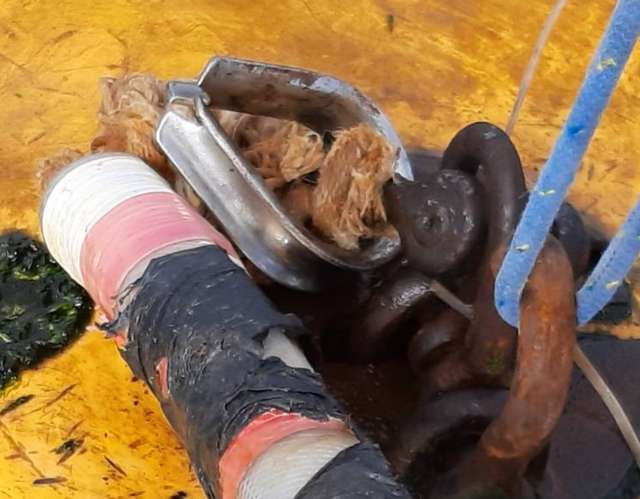
I need new shackles as apparently, my strop chain shackle (8 mm chain) come undone, and my other strop (28 mm rope) was of thimble, and only one strand out of 3 was on the shackle by the bouy. It was very worrying. I could imagine that a small shackle (the one from the strop chain) pin damaged the rope.
The mooring is exposed, and occasionally can be bumpy there.
 
........ Also, what is good mousing except of heavy duty cable wire and monel wire?


I use monel wire plus a cable tie and inspect on each visit. In poor weather these things get a lot of stick esp when the tether goes slack.

If you tighten the thing giving it a load of welly you can sometimes get two or three threads showing on the other side. This can be drilled for a small dia split pin, I generally do this and have never found it damaged unlike the wirelocked end. The essence is to pick a shackle from the pile that has a good length to the thread as they are quite crudely made.
I appreciate you have what you have but it may be possible to split pin it, for extra peace of mind.

.
 
I'd go and find a similar sized shackle with a extra long clevis pin which will be extra long to take a nut on the end. The nuts are commonly drilled to accept a split pin. These shackles are not 'special' you should be able to source one easily. If you do have problems send an email to Van beest in Holland/Belgium and find out who their nearest distributor might be - they will then direct you to a retailer. Van beest make the best or some of the best shackles in Europe and certainly make shackles with the extra nut. Their Green Pin range is highly respected.

You now have a shackle with a threaded clevis pin (which you can secure with Loctite). It will have a threaded nut on the end, which you can secure with Loctite. It will have a split pin, offering further security.

The Loctite will, or can, set off underwater and if you need reassurance use red Loctite - but you will need a blow torch to allow the Loctite to release (be warned)!

I don't think you need a thimble, it simply adds complication. I would simply use a hosepipe to encase, cover, the splice that is attached to the shackle.

I'd check the mooring ever time you sail - just a quick glance. But an annual service is in order.

Jonathan
 
IMG_0812.JPG
This is a shackle that was used for mooring a small boat on Menai Strait. Relatively short life, one year if I remember correctly. I attribute the damage to corrosive wear, in which the rusted surface is worn away quickly, allowing the fresh surface to rust .... and so it persists. I think that Loctite would have helped by eliminating some of the wear part of the cycle. But note that it is not only the parts in immediate contact that wore: the pin and the head of the D are also worn. (Not my photo)
 
View attachment 141476
This is a shackle that was used for mooring a small boat on Menai Strait. Relatively short life, one year if I remember correctly. I attribute the damage to corrosive wear, in which the rusted surface is worn away quickly, allowing the fresh surface to rust .... and so it persists. I think that Loctite would have helped by eliminating some of the wear part of the cycle. But note that it is not only the parts in immediate contact that wore: the pin and the head of the D are also worn. (Not my photo)
that looks like the shackles i seen last week on a boat. I had to row out to in my dinghy as it was floating away on a very big tide at Red Wharf Bay. lucku i spotted that no one was onboard .
 
View attachment 141476
This is a shackle that was used for mooring a small boat on Menai Strait. Relatively short life, one year if I remember correctly. I attribute the damage to corrosive wear, in which the rusted surface is worn away quickly, allowing the fresh surface to rust .... and so it persists. I think that Loctite would have helped by eliminating some of the wear part of the cycle. But note that it is not only the parts in immediate contact that wore: the pin and the head of the D are also worn. (Not my photo)
That's why I always feel more secure lying to my own anchor than picking up a mooring of unknown condition!
 
I always avoid Bow Shackles in moorings for good reason.

Bow shackles are designed for multi lifting chains or similar and not actually for single. Over time - they have appeared in applications that really a properly sized D shackle should be used.

It was brought home to me in the most clear way that no-one who saw the results could deny the evidence.

Farlington Marshes swinging moorings.... Langstone Hbr. I took up a guys mooring and had noted the use of a bow shackle connecting ground chain to concrete sinker. I had in mind to change it ... but as with many things it got put aside.
We had a surprise storm pass through when myself and brother returned to mooring. While mooring - the boat was literally touching bottom at times ... about 12ft usual depth ... boat 3ft draft with the waves.
I decided to throw out the anchor and as much chain as possible as well .... just in case ... then we got into the Avon and struggled to shore.

Next morning I drove down to the shoreline to check on the boat. She was up against the marshline having broke free from her mooring ...
When tide was out - I walked out to her. ... anchor had clearly slowed and saved her from getting high up on the marshes. The mooring chain was intact right down to the bow shackle. BUT the bow shackle had clearly 'rotated' and come under side load instead of designed direction and failed. D shackle prevents this. Because the shackle was still there ... I took in hand and carried in back of my Land Rover to show others .....

I am sure someone will now argue the point .... but I will never ever again use a Bow Shackle in a swinging mooring setup.
I’m intrigued by your findings. We always used bolt type anchor shackles for lifting offshore, usually for single wire strops as they are safer than screw pins and easier for divers to use. I think they were also better at being righting themselves when loaded away from the axis, which is why anchor shackles tend to be bow type. But to have one fail as you describe sounds interesting. Do you have anymore detail on how the shackle failed and it’s arrangement in the mooring system?
 
Top