Mooring plank - how long, how thick?

I just picked out one of the photos and wasn't suggesting that particular design would suit your requirements. I suppose it depends on the conditions.
Some of these "foam" fenders appeal to me. But I have no "rubbing strip" so that would limit what I could used
boat fenders foam/board at DuckDuckGo
I am glad that you did post that picture because it gets one thinking.
The foam fenders that you link to do not, in my mind , suit because they are not long enough (along the boat) & can slip between the poles. However, I do not see how not having a rubbing strip makes any difference. In fact one can be a liability as it sometimes rides over a lump as the boat rolls in a lock, or rubs down a harbour wall & snags.
I think that in the OP's situation- being SH like myself- a 1.800-2.400 * 125 * 18 foam backed ply section might be useful. Then he can try it out & tell me if it works before I do one ?
 
I haven't thought seriously about fender boards yet but I imagined I'd use something like this. (I'm surprised no-one has mentioned the design. Maybe not suitable for my 43ft/12 tonne yacht anyway?

fender-board.ashx

That's exactly what I suggested, and what I use, and would do the job for the OP's 28' boat. For your 12 tonne lump I'd up the thickness a bit as Thinwater suggests.
 
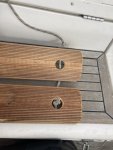
When you make a fender board consider where it will lie, it will rest at the point of maximum beam and be supported by a fender at each end. Now there needs to be a gap at the point of maximum beam and depending on the curvature of the hull (fore to aft) that gap needs to be a minimum of about a third of the diameter of the fenders you use. Most likely though for a board of about 4 to 5 foot which is as big as you need on a 28 foot boat the gap will be larger as seen in the photo. Next you need to consider how you will hand the board and I have issues with the one shown, if you ever use it against a wall as opposed to a pier or piling then the ropes will get braided away as they chafe against the wall. A better solution is to drill / bore a hole about 11/2" through the board in the position shown in the photo then drill vertically a hole to intersect the large hole, this should be just large enough for the rope used to hang the fender to pass through. You then tie a couple of half hitches in the end of the rope, snug them up and pull them into the large horizontal hole, now you have a chafe free means of hanging the board. Another problem with fender boards particularly short ones where the fenders are close to the ends of the boards, is that the board will roll across the fenders with any swell in the sea state and invariably fall off one or both fenders. This can be stopped by rigging two lines that will act as springs by attaching the lines as before but at the ends of the board and below the two supporting lines. Rigged like that on the occasions that the sea state is causing the boat to move the fender board will stay in place.
 
I used a couple of cut down old scaffold boards approx 5' X 8" X 1½" which is what I had, probably a bit OTT. The important thing is they need to be long enough to span between the piles on the wall.
 
I have just realised that I have a spare sheet of 25mm celotex insulation with an aluminium foil covering both sides. That is a fairly ridgid foam. So if I put multiple layers glued with plenty of "Sticks Like", onto some 18mm ply , then cover in sail cloth - the sailing club has a stock of sails ready for the bin- that should solve the rolling fender issue & just provide enough protection against the Dutch walls. It is mainly a problem at ladders because sod's law always dictates that one lines up with the void & I like to get a midships line on a ladder first, if possible, to get the boat anchored so I can get fore & aft lines on to the inset bollards.
I just need to work out how to hang it, as I cannot drill as suggested above & I want to keep it as light as possible. Perhaps cut the ply with 2 humps near each end, sticking up & drill holes in the humps. The board will then hang fairly true & the lines will only be at the top edge.
The suggestion of max 1.800 long to fit an unused forward bunk is a good one.
 
Last edited:
Lashed across the insides of two stanchions is as good a place as any to keep it and if you are cruising long distance makes a good place to lash the fuel cans to as well. Another thing you can do is cut some large holes that will take your foot alternating which gives you a ladder for those odd occasions you might need one.
 
Lashed across the insides of two stanchions is as good a place as any to keep it and if you are cruising long distance makes a good place to lash the fuel cans to as well. Another thing you can do is cut some large holes that will take your foot alternating which gives you a ladder for those odd occasions you might need one.
A 28 ft boat like the OP has, does not normally have side decks wide enough to do that. I certainly do not have room, even up forward on my 31 ft boat. It would get in the way of normal docking proceedure at pontoons in marinas.
 
A 28 ft boat like the OP has, does not normally have side decks wide enough to do that. I certainly do not have room, even up forward on my 31 ft boat. It would get in the way of normal docking proceedure at pontoons in marinas.
As long as you can access the cleats, I don't see a problem with normal docking procedure. My 28' doesn't have mid cleats. It should be possible to find a suitable position although everything on a smallish boat is a bit of a compromise.
 
I've just remembered, when I made mine, instead of using ropes to tie plank to boat I put a smallish eye splice on the ropes at the 'top edge' of the plank. The length from the eye to the plank was set to put the plank at the centre of the fender so when I deploy the plank, I just have to put the fender ropes through the eye splices and tie the fenders onto the boat. It saves having to do any plank adjustment and the fender can't pop out from the end of the plank.
 
Garden decking board from Wickes has done for my Centaur 26 foot heavy bilge keeler. It seems like tough resilient wood.
 
Top