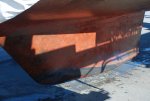
Moody 34/346: Gap between Hull and Keel...?

SonicArmin

Member
Joined
1 Jan 2020
Messages
32
Location
Tel Aviv
Visit site
I'm still looking for a yacht... COVID-19 stopped me from viewing a couple of boats in the Med I had shortlisted. Now I'm using the time to reconsider and perhaps lengthen the list for the day I can travel again. Doing that I discovered that a Moody 346 may also fit my requirements, and perhaps also a Moody 34, which is not very different. I found one in Greece which makes a good impression judging only by the photos - with one exception. The shot from the hull under the water line shows a clear line of separation between the hull and the keel, see attached pic - I had never seen that before anywhere. Snooping around further I found a few more pics of various Moody models with similar lines, although usually not quite as pronounced as this example.
Screen Shot 2020-04-15 at 23.12.45.png
Questions: Ist that"normal"? I mean, every boat with a bolted keep has such an interface, but usually it is not visible. Is this just shoddy maintenance and easy to fix, or does this indicate a wobbly keel soon to fall off?
 
Not unusual to rake out the joint and fill it with a flexible sealant. I can see the joint in my Moody (and in every boat I ever owned) But when I did fill, (on the Trapper 300 almost every second year) I faired it off rather than leave a raised bead. The keel nuts in Moodys (and Sigmas from the same boatyard) tend to be surrounded in thick flowcoat which cracks if there is movement.
The photo seems to indicate that there might be flaky rust that has been painted over?
 
The weight of the boat can be compressing the keel joint.
Hanging in strops has the opposite effect.
Recent paint job could hide issues.
It has been suggested that keel bolts should be inspected every 10 years ?
 
It has been suggested that keel bolts should be inspected every 10 years ?

AFAIK, there has never been an issue with keel studs on all Moody models. In all the reports on MOA forum, whenever surveyors have seen rusty nuts and have suggested withdrawing, the studs have been in excellent condition.

The OP could post his question on Moody Owners site in "Thinking of Buying" section, without having to become a member.
 
It doesn't look bad to me, but it's near impossible to tell with 100pc certainty. The seal and paint job can easily be faired in, regardless of whether the seal is intact

Periodic keel-off inspection is recommended. A quick lift into strops may also help give you peace of mind.

My surveyor last year reassured me there's nothing scary about the antifoul around the keel join cracking on a mass-produced fin-keeler; it's due to flexion of the hull rather than keel bolt movement per se. A moody may be a bit stiffer in that regard than my Dufour

If you really want it to look nice, and stay looking nice when lifted, consider doing the sealant and paint while she's in slings.
 
, there has never been an issue with keel studs on all Moody models. In
I'm not so sure it's about the track record of a brand but more about what might have happened to the keel throughout its life.
A little water gets in at the joint and it can seriously ruin stainless bolts due to galvanic corrosion.
 
I'm not so sure it's about the track record of a brand but more about what might have happened to the keel throughout its life.
A little water gets in at the joint and it can seriously ruin stainless bolts due to galvanic corrosion.
Unless they have been previously replaced they won't be stainless.
 
Re ".... Periodic keel-off inspection is recommended. "

I might accept this statement for most older GRP production cruisers if the period was every 50 years or so, though usually you'd just spend a lot of money to find not much wrong. It might be more true for some race boats or lightly built modern boats.

Removing keel bolts or studs one at a time for inspection can go smoothly: or it can turn into a real nightmare ening up with paying a yard to fully remove the keel. In lead keels the only option usually is full keel removal, as the studs are often J-shaped cast into the lead when the keel is made. Fully removing a keel is an expensive boatyard bill exercise.

Some surveyors tend to recommend removal to check, but this may be a "covering their back" option. Others, particularly with well known production GRP cruising boats, simply look at what is visible, and do not suggest removal, based on what they see and the builder's track record. I've known of a problem with one Moody 346's bilge keel studs, a keel splaying movement problem akin to that found on many Westerly Centaurs. Never heard of similar on Moody fin-keelers.
 
I had the same issue when I sold my Moody 346 a few years back. Buyer insisted that keel bolts were inspected and found no problem whatsoever. Can highly recommend these Moody's.
 
I might accept this statement for most older GRP production cruisers if the period was every 50 years or so, though usually you'd just spend a lot of money to find not much wrong. It might be more true for some race boats or lightly built modern boats.
People have perfectly good seacocks/skin fittings removed and replace. why would you then ignore keel bolts?
It is a personal choice,
based on what they see and the builder's track record.
But the problem can be what you cant see and as already mentioned, its about what sort of life a keel has had rather than a reliable brand.
A seacock fails then you sink slowly or stop the flow.. A keel falling off , you know the outcome of that.

In the grand scale of things keel detachment is fairly rare so we play the odds that it wont happen to us..
 
I've known of a problem with one Moody 346's bilge keel studs, a keel splaying movement problem akin to that found on many Westerly Centaurs. Never heard of similar on Moody fin-keelers.

There was a problem reported a few months ago with a twin keeler where for some reason a water tank hadn't been fixed down properly during its life (very unlikely during manufacture) and the tank movement had worn through stringers, causing failure of the skin surrounding the keel.
 
People have perfectly good seacocks/skin fittings removed and replace. why would you then ignore keel bolts?
It is a personal choice,

But the problem can be what you cant see and as already mentioned, its about what sort of life a keel has had rather than a reliable brand.
A seacock fails then you sink slowly or stop the flow.. A keel falling off , you know the outcome of that.

In the grand scale of things keel detachment is fairly rare so we play the odds that it wont happen to us..
If you take that view of second hand boats, what would you consider not worthwhile replacing?
 
Seacocks and keelbolts are a bit different. Seacocks used to be designed to last a very long time but be regularly serviceable. Newer ones are non-serviceable but much cheaper and some in brass do not last long. In any case they are fairly easily replaced when necessary.

Fin keels on GRP yachts are normally designed and built to stay on for the life of the boat. Usually they are bolted on to a bed of Sikaflex or similar adhesive sealant. Undo all the bolts/studs and the keel will quite possibly stay firmly attached, to the point that when you finally force it off with wedges/blades/banging there may well be some gelcoat or even some glassfibre still attached to the keel. Then you have a working-upside-down GRP repair job on a boat hanging expensively in the boatyard hoist with a strong wooden or steel frame built under to support the keel from falling over.

There is almost always evidence visible if there is something wrong with a fin keel attachment. Hard and/or repeated accidental groundings usually causes GRP damage - cracks or distortion often at the aft end of the keel. Serious corrosion of the studs/bolts at the GRP/keel interface usually causes rust streaks externally in places matching keel bolt locations.

If removing a keel and checking keelbolts or studs was a straightforward job boatyards could give you a fixed quote, as they can for antifouling or polishing the hull. They won't quote a fixed price, or even give much of an estimate, for they know how many things can go wrong during the process.
 
If removing a keel and checking keelbolts or studs was a straightforward job boatyards could give you a fixed quote, as they can for antifouling or polishing the hull. They won't quote a fixed price, or even give much of an estimate, for they know how many things can go wrong during the process.
And that's why people have no idea what condition their keel bolts are in and accept a leap of faith when buying a boat.
Unhung rudders can carry a similar risk in that fatigue can snap them, but it's another of those items that can be very difficult and expensive to assess.

If you take that view of second hand boats
What view? I've said about things that can happen and said it's very rare.
 
It is an internet forum, The OP was not expecting a survey, just an opinion of the likliehood of a problem taking account of the marque and its history. Moodys are a bit old fashioned in terms of design and specification with a well earned reputation for strength and durability, I have owned three boats built by Marine Projects, one for 7 years, another for 12, that experience together with the Primrose offices conservative design approach has given me confidence in them.
I was happy to share the results of my experience with the OP.
 
AFAIK, there has never been an issue with keel studs on all Moody models. In all the reports on MOA forum, whenever surveyors have seen rusty nuts and have suggested withdrawing, the studs have been in excellent condition.

The OP could post his question on Moody Owners site in "Thinking of Buying" section, without having to become a member.

I had a Moody 44 and can vouch for that. In 2009 I was recovering from a serious illness and arranged for the Marina brokerage to have my boat lifted and antifouled. Upon lifting I received an email telling me that the keel was out of line, and the studs would need replacing.

Not really trusting the marinas report, I arranged for an urgent hull survey by a YDSA surveyor. Nothing wrong with the keel and no misalignment - the marina brokerage were pulling a fast one. The surveyor did suggest drawing the keel bolts and replacing them, as there was a bit of rust around the nuts.

I got myself off my sickbed, flew to Malta

As I was planning to sell, I arranged for them to be replaced despite the fact that, when removed, they were as good as new, ( 14 years previously). I kept them to show to the new owners.

There was a slight channel around the keel/hull join perhaps 2 or 3mm deep. Also a bit of rust after 3 years since the previous lifting. Rubbed it down, filled with Sikaflex, primacon and antifoul - all good, as evidenced when lifted by my buyers a year later. Glad I antifouled it myself.... lots of reports of contractors diluting antifoul to save money.

If you are worried by what you can see in the picture, I wouldn't bother looking at any more Moodys.... it will be a common theme, to some degree.
 
Top