Monitoring old engine.

pandos

Well-Known Member
Joined
15 Oct 2004
Messages
3,215
Location
Ireland, (Crosshaven)
Visit site
I have an old engine which has less than perfect wiring. This year I will rewire it to the switch panel which shows an oil pressure light, tacho, temperature of the coolant, and the Bulb/alternator light.

several more things on board have alarm outputs, Ais, gps,autopilot, radar, echomax, battery voltage.

I would also like to monitor vacuum in the fuel system and in the intake cooling water, and maybe pressure in the heat exchanger.


I think Home Assistant(home automation) would be a domestic 220v version of what I have in mind... And I know boy racers do similar but they take the info from their ECU...

I think a raspberry pi and a touch screen would be a good display for all of the the information, which interests me, which is floating around from various sources

Ignoring any difficulties I may have in physically fitting sensors and wiring to the engine and picking up on /off outputs from the electronics.

What would I need to join the various sources/ outputs to the pi. And can anyone suggest an existing open source programme to use or anything else that may be a usable solution. I do not want wireless stuff all to be hardwired...

I have no vocabulary or clue when it comes to these things (although I will learn) so any help will need to be given in English....(as if talking to a willing golden retriever...)

..
 
Seems relatively straightforward so an Arduino would be cheaper and possibly less 'tyranny of choice' than a Pi based system. For the alarm inputs you'd need an interface device of some kind; for automotive based sensors these days it would be CANbus-based, or for more trad analogue stuff I think Arduino can read some directly but probably safer to buffer them to avoid the smoke escaping.
 
the intake cooling water, and maybe pressure in the heat exchanger.


Sounds like a very fun project, please keep us updated here on how it goes.

Some suggestions regarding the above, I suggest to monitor flow in the intake cooling water, either real time or just yes/no flow. Measuring vacuum there on a small engine will be very difficult of not impossible.

A similar comment regarding the heat exchanger, measuring pressure there will not tell you anything. For the fresh water side, temp is fine, for the raw water side, measuring exhaust gas temp would be better.
 
I would second the suggestion of using Arduino.
Very versatile and so cheap you could have several.

TBH, if you just want an alarm which sounds when any alarm signal is raised, you just need some diodes as an OR gate.
 
Take a look at node-red, it will allow you to much of what you want in terms of display and graphing and is a low.code visual environment and runs well on a pi. For things like temp look at one wire sensors that allow many to be joined up and not use too many io ports.
 
This sounds like fun!

A rpi sounds good to me. You can make nice displays with openhab/home assistant/grafana.

In terms of hardware it's quite a broad question. You could look at all the pi hats available (eg on www.seeedstudio.com) and see whether they do what you want if you don't want to go custom. For temperature, the mentioned ds18b20 sensors are good. If you need a remote acquisition then you can always use an arduino and connect that to the pi.

You can also check the forum, there was a pretty nice engine monitoring project (search for esp32 or esp8266 as it was based on that).
*edit* I think I meant this thread Boat data monitor - what next..... with GHAs project.
 
Last edited:
Measuring vacuum there on a small engine will be very difficult of not impossible.
My cooling water is pulled through the heat exchanger on the transmission and my oil cooler before being pumped into the main heat exchanger. when I recently (stupidly) started the engine without the seacock open...the vacuum flattened the pipe so I figured this was a really quick way to detect a blocked inlet either through user error or a plastic bag on the outside...
 
My cooling water is pulled through the heat exchanger on the transmission and my oil cooler before being pumped into the main heat exchanger. when I recently (stupidly) started the engine without the seacock open...the vacuum flattened the pipe so I figured this was a really quick way to detect a blocked inlet either through user error or a plastic bag on the outside...


Hi, in that extreme, yes. But exhaust temperature will be just as quick to respond, and a simple flow/no flow sensor in the inlet pipe will probably be easier than rigging up a manometer. It's fun stuff so I'm not telling you what to do - just pointing out existing sensors that are already used in those applications that may be easier and cheaper to install and configure into your system. ?
 
I have a yanmar 3gm30f. I found this solution SensESP/README.md at master · SignalK/SensESP was excellent and relatively straightforward to follow.
You purchase a Wemos D1 mini, load the code from github link and point it towards a raspPi running SignalK. You can either connect several sensors to each Wemos or have one sensor per Wemos.
The pi can either create a website or you can use a native android/ios app to view the data.

I monitor 3 temps and oil pressure.
The Wemos is powered when the engine is running..

Has worked all season..
 
a good way to spent a few days in the depths of winter :cool:
have done so on my yanmar 2GMF MASE generator engine.
monitoring:
oil pressure (vdo sender)
coolant temp (vdo sender)
EGT (probe on exhaust elbow with a 10euro board converting to SPI)
seawater pressure (at the exit of the heat exchanger (low value, blocked intake/wasted impeller - high value blocked exhaust elbow)
rpm (reed sensor iirc)
fuel pressure (on the primary engine mounted filter)
and then gone overboard using a linear actuator to run the governor and slowly warm up the engine before reaching 3k rpm and slowing turning the engine off letting it cool first.

Mostly straightforward (he says...) slightly difficult sourcing certain sensors, namely a decent quality seawater pressure sender. I've used a plastic bodied one that got for 30quid, Danfoss proper seawater rated one was 150 or so. Fuel pressure sensor that measures vacuum as well is not easy to source (mostly get 0-30psi or so senders but you really need a -10 to 30psi one)
then gone another step further converting the lot to NMEA2000 sentences so that I can control and monitor everything from my plotter and 4in multidisplays

if you'd like any further info, happy to help if I can or give you # of the ones I've used

V.
 
....
monitoring:
oil pressure (vdo sender)
coolant temp (vdo sender)
EGT (probe on exhaust elbow with a 10euro board converting to SPI)
seawater pressure (at the exit of the heat exchanger (low value, blocked intake/wasted impeller - high value blocked exhaust elbow)
rpm (reed sensor iirc)
fuel pressure (on the primary engine mounted filter)

V.
Those are probably all that I want to monitor on the engine..

The EGT probe I presume is a basic automotive sensor as are the oil pressure and the coolant temperature sensors.
I like the idea of monitoring the flow/pressure in the heat exchanger rather than waiting for the exhaust/ coolant temperature to rise.

As I look further at this project I see more and more possibilities separate to the engine such as tank levels etc.
 
Personally I would want some of these alarms to be pretty bullet proof.
Simple stuff you can test.
Not some amateur 'learn theeself pi' hackery..
How do you know, when you are sat in the cockpit, that the pi hasn't found some error in your code and has stopped monitoring something crucial?
How will you test it?
In industry, something this complex might require a few man-months of testing, even if the software was written by someone reasonably 'skilled in the art'.

There is much to be said for simple stuff that you really understand.
You can write an arduino sketch to do e.g. a cooling water temp monitor in a couple of dozen lines maybe, and you can test it and know that it works.
Then again, you could use a comparator and a few resistors and run it on a fraction of a milliamp, but an arduino will easily give you a nice LCD display with text readout of the temperature.
There is a happy medium between multi-tasking stuff and complicating thinss.
 
Personally I would want some of these alarms to be pretty bullet proof.
Simple stuff you can test.
Not some amateur 'learn theeself pi' hackery..
How do you know, when you are sat in the cockpit, that the pi hasn't found some error in your code and has stopped monitoring something crucial?
How will you test it?
In industry, something this complex might require a few man-months of testing, even if the software was written by someone reasonably 'skilled in the art'.

There is much to be said for simple stuff that you really understand.
You can write an arduino sketch to do e.g. a cooling water temp monitor in a couple of dozen lines maybe, and you can test it and know that it works.
Then again, you could use a comparator and a few resistors and run it on a fraction of a milliamp, but an arduino will easily give you a nice LCD display with text readout of the temperature.
There is a happy medium between multi-tasking stuff and complicating thinss.
I have no intention of removing the existing stuff, so even if the PI hachery went wrong nothing really is lost...

Most of what I have in mind is a simple reassurance that things are probably well, seeing the vacuum fuel in the filter will let me know that things are probably ok, but might give warning that things are going wrong...before the engine splutters.. Likewise with the cooling water flow etc.

I agree that multi tasking can be a death knell...but as someone who has nothing linked on the boat I see no danger in linking just for the purpose of secondary or additional monitoring.

learn by doing is a good way to do things...
 
  • Like
Reactions: vas
each to their own, but generally a pi or an arduino is either working or locked solid (lack of power or code messing with it)
if second applies, the only solution is to have the data from the pi displayed onto something.
Then the something will note and warn for data out of bounds or no data and you're aware it's not working.
Had lots of that when writing and testing code, but now after a couple of summers actually using the boat only problem I had was a snapped exhaust elbow in July, noticed by the change of exhaust tone and the lower EGT values (and bilge pump operating...)
 
Those are probably all that I want to monitor on the engine..

The EGT probe I presume is a basic automotive sensor as are the oil pressure and the coolant temperature sensors.
I like the idea of monitoring the flow/pressure in the heat exchanger rather than waiting for the exhaust/ coolant temperature to rise.

As I look further at this project I see more and more possibilities separate to the engine such as tank levels etc.
EGT probe from the depths of china (get a couple just in case :-) )
oil/coolant values using normal resistive sensors fitted
In a yacht I'd definitely get diesel/water tank levels in the same device, no big deal.
The biggest issue to decide upon is HOW you're going to visualise that lot. If you do have N2K that's ideal, if on N0183, it's much more difficult/impossible for some.
 
Sounds fun. On fuel pressure - the critical reading is not absolute pressure, but the pressure drop across the primary filter. Simply connect a pressure gauge across the filter, in an ideal world it will read practically zero, and then as the filter clogs the pressure difference between the input vs the output side will increase. That's the critical measure of the state of your primary filter.
 
but wont take into account the condition of the prefilter and the lift pump.
I was trying to sort out an issue with a leak/failure of the mechanical lift pump on mine.
If OP gets into signalk stuff, it's easy to plot the values over time and then you can make guestimates on what's going on.
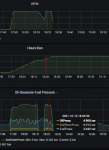
Following is a few days ago on my last run of the generator. Fuel press is fluctuating a bit (never figured out why as I also never figured out why fuel pressure goes up during the day and down at night)

1634365507007.png

ah, another thing to measure (fairly easily) is hours run especially if your hourcounter has stopped working
 
but wont take into account the condition of the prefilter and the lift pump.


That's true. Ideally you would monitor both. But I think that clogged primary filters are the single biggest cause of problems with marine diesels, so that would be my priority. And I completely agree that logging everything over time gives you a really valuable understanding of what is going.
 
That's true. Ideally you would monitor both. But I think that clogged primary filters are the single biggest cause of problems with marine diesels, so that would be my priority. And I completely agree that logging everything over time gives you a really valuable understanding of what is going.
I think measuring vacuum in the line between the lift pump and first fuel filter is a good spot as it will indicate an issue is developing, whether it is falling vacuum due to failing pump or rising due to clogging filter, yes there could be other issues, but I think this value will provide some comfort as one chuggs along towards the difficult harbour entrance...

I was advised to fit a gauge at this point some years ago when I had engine/fuel problems. (I bought the gauge but it lies in the unfitted things box )

I do not have any great urge to log or store info whilst I fully agree that this kind of logging can be useful and interesting I am after something less complicated and more basic,.

This project is really about real-time comfort by being able to see that various parameters are in the ok range...bit like the comfort that the absence of the check engine light on the dash of the car provides, as you head onto the motorway.

And also to centralise the various other warnings so that at a glance I can see if it is the high level bilge alarm is pinging, or if a ship 30 miles off has painted my active radar reflector, or the smoke/heat detector in the engine bay has gone off...

These response have been very useful in identifying what I want to achieve thanks to all.
 
Top