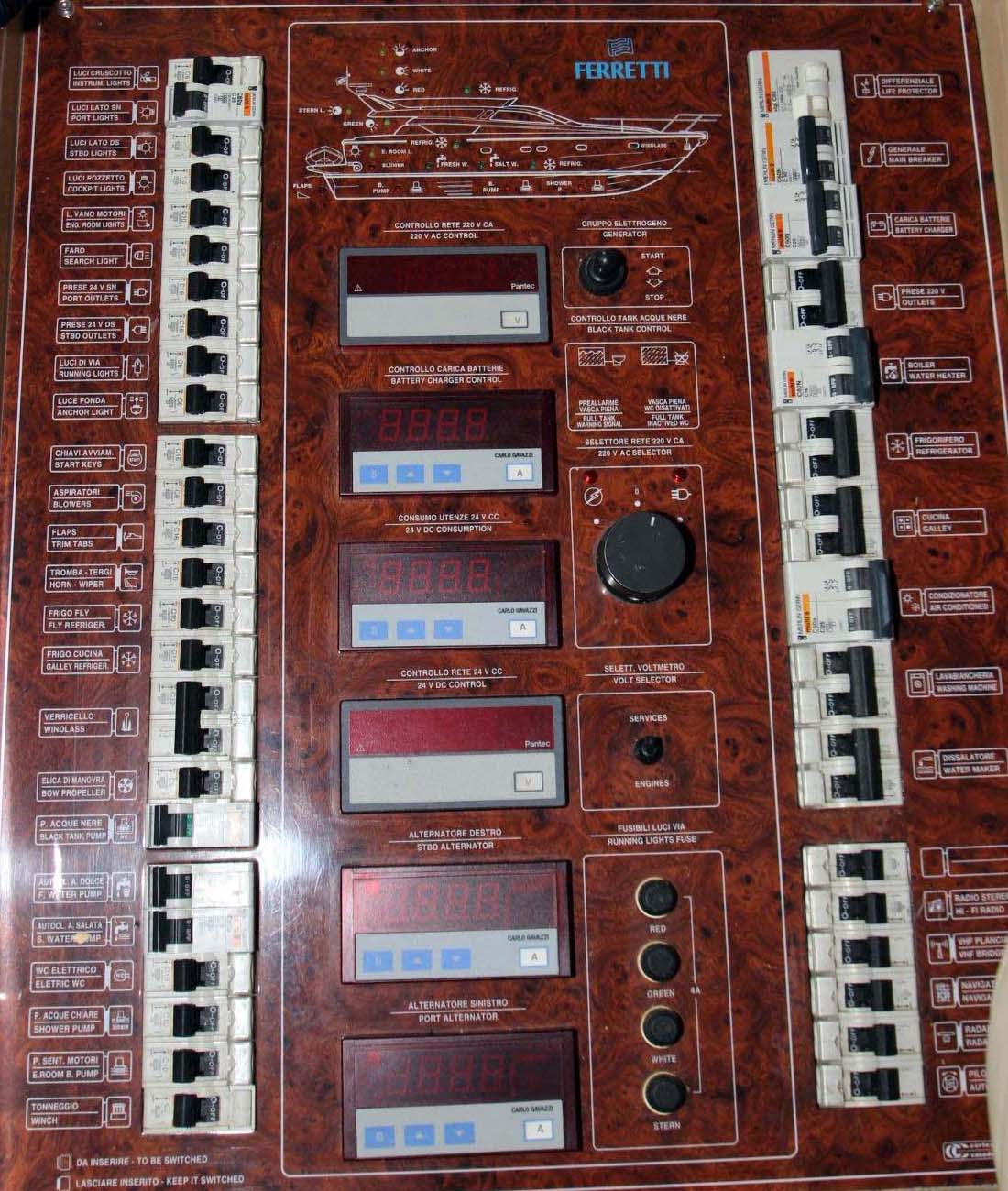
Monitoring of onboard electrical system

MapisM

Well-Known Member
Joined
11 Mar 2002
Messages
20,658
Visit site
My otherwise very well made electrical panel lacks the AC current absorption.
I can always check it with a clamp meter of course, but that is neither convenient nor immediate.
So, the first idea was to fit a small display like for instance this one - which btw is worryingly cheap - any thoughts?

Then again, this got me thinking that it would be nice to have a similar device, not necessarily with an LCD display, but capable of wireless connection and accessible from a smartphone app.
In fact, aside from the convenience of being able to check the values from anywhere onboard, theoretically this could also allow a remote access, through an onboard router permanently connected, which I already have. And this would be a very handy feature, obviously.

I did make a quick search, expecting to find plenty of devices like the one I'm envisaging, also because their application field stretches well beyond boats, practically into every building.
But I got patchy and confusing results, hence this thread.

All suggestions welcome!
 
As you know we have a fairly sophisticated electrical monitor panel,
But the display’s on it are really basic and cheap, (we bought from Alibaba for that occasion)
So I think you are good with the device in your link,


No personal experience with more sophisticated units,
Except this here, which a friend (Peter) has installed in his electric installation at home
I was really impressed with that, the unit can “listen to the sound” that all electric devices produce on the network.
(the unit recognizes electric supply distortion…)
It can learn all the different distortion pattern, and show the consumption of all separate devices on a smartphone or …
It is very easy to install (all DIY)
It used to be a one box solution for approx. 500euro iirc.
It’s a Belgium co, They won several awards I’ve been told,

https://www.smappee.com/be_en/infinity
 
Thanks B, that Smappee thing seems very clever indeed, on paper.
It's way OTT for my needs, though - not only for its cost, but also its complexity.

If a device similar to the one I previously linked but with remote accessibility exists, I'd happily spend twice its cost, or possibly also x 3 or 4.
But I'd rather stick to the wired-only version, than fork out an x 50 or so amount...! :rolleyes:
 
So, the first idea was to fit a small display like for instance this one - which btw is worryingly cheap - any thoughts?

I didn't get an overwhelming support to this idea, the first time I posted it.
But eventually, I decided that 10 quid or so was an amount I could afford to waste, so I bought the thing.
And I'm pleased to confirm that it does what it says on the tin, and it's also pretty accurate, by comparing its results with my portable multimeter.

There is just one thing I can't get my head round.
Actually, I'm now asking for a solution to a problem I do not have, sort of.
But hey, ain't this place notorious for debates on useless problems? :rolleyes:

So, here's the thing: on top of AC voltage and Amp absorption (which is really all I was interested to monitor, since in my otherwise pretty good electrical panel I was missing AC Amp), the panel measures also the power factor (PF), and transform A into kW accordingly.
Now, this is purely academic, since I'm not on a metered connection, but I noticed a huge PF (hence kW) variation depending on what I am using onboard.
All well and good, I know (well, barely) the theory behind that: capacitive vs. inductive loads etc.
But it's the range of variation which I didn't expect to be so high.
I mean, the PF reported by the panel stretches anywhere from 98% to well under 50%.
I've even seen as low as 30% in one occasion, when I wasn't using any AC equipment other than the battery charger, which being on float was absorbing close to nothing.
I usually see the highest PF values (unsurprisingly) when I have AC motors running, like dishwasher, washing machine, airco.

Now, just in case it weren't already clear, it's the first time I'm using an instrument that shows the PF, and I don't have a clue about what to expect... :o
So, over to the electrical experts: is what I'm experiencing normal and I should just stop looking at the PF, or is there anything I should do about it? TIA!
 
I didn't get an overwhelming support to this idea, the first time I posted it.
But eventually, I decided that 10 quid or so was an amount I could afford to waste, so I bought the thing.
And I'm pleased to confirm that it does what it says on the tin, and it's also pretty accurate, by comparing its results with my portable multimeter.

There is just one thing I can't get my head round.
Actually, I'm now asking for a solution to a problem I do not have, sort of.
But hey, ain't this place notorious for debates on useless problems? :rolleyes:

So, here's the thing: on top of AC voltage and Amp absorption (which is really all I was interested to monitor, since in my otherwise pretty good electrical panel I was missing AC Amp), the panel measures also the power factor (PF), and transform A into kW accordingly.
Now, this is purely academic, since I'm not on a metered connection, but I noticed a huge PF (hence kW) variation depending on what I am using onboard.
All well and good, I know (well, barely) the theory behind that: capacitive vs. inductive loads etc.
But it's the range of variation which I didn't expect to be so high.
I mean, the PF reported by the panel stretches anywhere from 98% to well under 50%.
I've even seen as low as 30% in one occasion, when I wasn't using any AC equipment other than the battery charger, which being on float was absorbing close to nothing.
I usually see the highest PF values (unsurprisingly) when I have AC motors running, like dishwasher, washing machine, airco.

Now, just in case it weren't already clear, it's the first time I'm using an instrument that shows the PF, and I don't have a clue about what to expect... :o
So, over to the electrical experts: is what I'm experiencing normal and I should just stop looking at the PF, or is there anything I should do about it? TIA!

From memory from college 40 odd years ago:

Power (Kwatt) is calculated by multiplying Volts and Amps and only works for pure Resistive loads, eg a kettle giving a power factor of 1 or 0% ie multiply you reading in Watts by 1.
A power factor is produced when the current sine wave is out of phase with the volt sine wave. To a max of zero or 100% at 90 deg. This occurs on purely inductive loads eg motor or transformer (disregarding winding resistance).
The resulting calculation of multiplying V and A can give a reading of zero (at 90 deg out of phase max V at the same time as zero current) This is why on an inductive load its info plate will give the power consumption as Va instead of Watts.
If I remember correctly the measured Power (if pure W) can be corrected by divided by the Pf fo give the equivalent power W
Without going back and reading the spec of the instrument I don’t know if the displayed reading in Kwatts is an actual or derived reading.

Happy to be corrected as it is a few years since I have had to think about this. Got much more important stuff going on, like where did I leave my other sock this morning?
 
Is this going to be marketed like BodgeFlow™©® ? AmpFlow™??? :encouragement::cool:
 
Is this going to be marketed like BodgeFlow™©® ? AmpFlow™??? :encouragement::cool:

nah, most ppl have an Amp meter on their dash (actually quite astonished DP doesn't! )

sorry P., cannot help with your problem, never studied electronics/powersystems at Uni

V.
 
Not so long ago i stumbled across Power-store, I remember them being on the scene about 5 years ago and they where great! I contacted them about an electrical system problem i had myself and they responded very promptly, i was able to order the part there and then off of their site. Maybe worth a shot, they have a good selection of battery monitoring systems. I used support@powerstore.com to contact them. and the website is www.power-store.com

Hope they can help!
 
As P says, unless you're being metred it's an academic exercise.
Actually, when I said it's a bit academic, I was referring to the PF/kW conversion.
But knowing the A absorption is almost essential in my books, in any boat with an array of AC equipment.
Without it, it's impossible to "manage" AC usage, understanding what you can and can't use, depending also on the shore power available.
I did have the AC Amp meter also in my old lady in fact, even if her electrical system wasn't half as complex as the one of the DP.

So, I perfectly understand Vas point - so much so, that I asked Mr.DP directly.
He told me that it used to be included as standard in their electrical panel (together with several other components), but according to some clients it was too complicated, so at some point in time they got rid of all unnecessary stuff, installing them just on demand.
They didn't have many forumites among their clients, obviously... :rolleyes: :D
 
Last edited:
Got much more important stuff going on, like where did I leave my other sock this morning?
I sympathize with that. Right now, my main concern is whether to shave before going to bed or tomorrow morning... :cool:

Thanks for the theoretical refresh anyway, but that leaves the question about whether the PF differences I am seeing are "normal" or not unanswered.
Assuming that there is such thing as a normal/usual variation range, that is (I suspect there isn't).
 
I don't have AC amps either - Digital AC voltage, battey voltage, DC amp consumption, battery charger supply amps, and amp meter for both alternators. An AC amp meter would be pretty useful
 
An AC amp meter would be pretty useful
Yup M, coming to think of it, I remember to have noticed the lack of AC Ammeter also on a couple of F165 which I've seen.
Btw, the earlier F175 did have it. Maybe they also decided to keep it simpler, 'dunno.

Anyway, if you should decide to give the thing a try, I can confirm that it does work well and the electrical installation is dead easy.
I can't vouch for its duration/reliability yet, only time will tell...
The main problem you would have, if your electrical panel is like the one below, is that there's nowhere to put it.
Which is the same problem I'm also having, btw.
But the thing itself is pretty small (you can see exact size in the Amazon link above), so hopefully you could find a spot somewhere nearby...
1Tb1X0LL_o.jpg
 
I sympathize with that. Right now, my main concern is whether to shave before going to bed or tomorrow morning... :cool:

Thanks for the theoretical refresh anyway, but that leaves the question about whether the PF differences I am seeing are "normal" or not unanswered.
Assuming that there is such thing as a normal/usual variation range, that is (I suspect there isn't).

Sometimes monitoring something you don’t really need to know can just confuse the issue. In my old calibration world we used to ask the question “if a bit of black tape was stuck over the display, would you do anything different”?
 
MapisM I wouldn't worry at all about that PF display, referring to the post above,
and knowing that you have a nice clean and straightforward installation, and you're aware of whats going on reading AC Volt and Amps,

now answering your question why this huge fluctuation on the PF reading,
I think its a combi of
1) many modern (lo Q) 230V adapters / switched power supply's have a bad PF
2) when AC consumption is very lo, your PF display is out of its usefull range, and does a wrong calculation, (like dividing by nearly zero ...)

not much experience with that, but thats what I think..
 
Actually, when I said it's a bit academic, I was referring to the PF/kW conversion.
But knowing the A absorption is almost essential in my books, in any boat with an array of AC equipment.
Without it, it's impossible to "manage" AC usage, understanding what you can and can't use, depending also on the shore power available.
I did have the AC Amp meter also in my old lady in fact, even if her electrical system wasn't half as complex as the one of the DP.

So, I perfectly understand Vas point - so much so, that I asked Mr.DP directly.
He told me that it used to be included as standard in their electrical panel (together with several other components), but according to some clients it was too complicated, so at some point in time they got rid of all unnecessary stuff, installing them just on demand.
They didn't have many forumites among their clients, obviously... :rolleyes: :D

Fair enough. For me it would be an academic thing as I can't recall ever tripping the main RCD or marina RCD, even when I assume the A/C, kettle and immersion heater are running. If I did get a trip in this circumstance then it wouldn't be difficult to adapt behaviour accordingly.

P, are you saying that you trip your RCD if you're running too many power consuming items at once? Are houses in Italy the same as in the UK this is a non issue for residential property.
 
It’s all a bit of a academic exercise as they have said .Does not change the outcome .You either have enough Amps for the stuff you elect to run or don’t .
If you don’t you soon know and adopt behaviour to accommodate what’s offered .

On the S/Sker 16 A boat in France wife would trip the shore if the Aircon ( 2 x marinair self contained units ) , hob 4 burner induction , micro wave then kettle boiling for cuscus or something ?
She figured out when to knock the Aircon off etc while cooking .

With the 32 A boat in Fr this did not happen it was fine to run a full galley and air con .But the Aircon s a Ac to DC brushless motor system that never turns off , just slows down so no start spikes to trip out the shore power .

In Italy same in theory 32 A berth , but the quality of power feels not quite as strong as the Fr .
Kettle for example takes longer , my 220 V drill feels a bit anaemic .Cant put my finger on it .No worries we haven’t tripped it yet so that’s the main thing it’s just the 220v feels weaker than in Fr .

The only thing we do need to think about and activity manage is the geny power as it’s a tiny aircooled 3.5 KvH , up side is 90:kgs .
It powers the Frigomar AC which chucks out 42000 btu and the leccy cook top .The cook top is ( sorry can’t recall the brand ) a “ marine “ not domestic and lower than Ave power requirements.
Both units were fitted by a specialist marine sparky who’s dealing with “ trip “ wether shore or geny issues as his bread n butter business .
He rips out nearly new OEM air con and galley appliances on large charter boats , usually in the first winter .

Our tiny geny can’t cope with after a day @ anchor , theses 3 on at once
Aircon if the outside temp is nearer 40
Cook top with all 3 burners on
Charger a massive 80 A / 24 v

One of the above needs to be off for the other two feed on the 3.5 kvh geny If@ anchor .
It’s no biggie .

I’ve only got a V meter and can see it fall from 220 to 215 or what ever and hear a deeper note from the geny to realise it’s struggling .

As said never had any issues with the 220 v on shore except it feels weaker in Italy .
 
well I beg to differ...

it's v.helpful to be able to monitor how ONE device is doing...
FE, watermaker will suck 12A (geny is 8KW) when working properly prefilters clean, etc.
Will drop to 10A if I'm going too fast for it and cannot suck enough water to produce the expected 120lph of if prefilters are fouled slightly.
So just looking at it I know how this device is functioning
Similarly on the stabs if operating through the el.motor and not engine.

now sure I'd have any use for the PF that P. now also has though :p

cheers

V.

PS. haven't bothered turning on the AC this year, but that is a constant load nothing I've noticed changing on it
 
Top