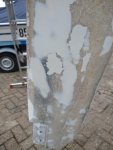
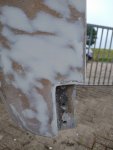
mold in the laminate?

That is a moulded in skeg and suspect the white patches are filler used when fairing the original or possibly the remains of the original gel coat after the skeg has been blasted sometime in the past. Unusual to see so much bare laminate.
 
I might be saying the same thing but I suspect you are looking at delamination, one layer of glass and resin lifting of a layer underneath or lifting off the base core. This means the strength is compromised and the core if 'wood' is, will, may, rot

I'm no expert - at all - wait for further more knowledgeable comment.

But it is were mine I I'd sand, grind, relevant patches out, look at the laminate as I sand, maybe strip the lot of and re-sheath. If this sounds drastic - there are plenty here who will have done there same, or something similar (and will lead you through the process).

But don't panic - wait for more knowledgable comment.

Jonathan
 
I suspect that water has entered the skeg at some time. Have you hammer tapped the skeg to see if there is any delamination. Hollows will sound different to solid glassfibre.

I disagree with Tranona that a lot of laminate is showing. Many early glassfibre boats had no gel coat below the water, only on the topsides. Boats moulded by Tylers were normally made this way.

Not knowing what sort of boat the OP has, does make it a lot of guesswork. In the early days of glassfibre some hulls were made in 2 parts and then stuck together. This method made a skeg easy to have as part of the design. So check for a possibe joint along the edges and see if there is a split, if so then repair.

On some Scandinavian built boats, rudders had a hole at the bottom to allow water to drain out when out of the water. It may be possible the top of the skeg has been glassfibred over level with the hull and a hole on the bottom edge made for drainage.

If the skeg sounds as though it has no delamination, I would not worry about the black colour. Just apply the primer and antifouling over it as no one will see it and it should not affect the structural integrity of the skeg.
 
I'd have thought it looks fairly typical of a skeg after being peeled or blasted. It's highly unlikely to have plywood, etc, inside it. I don't think the discolouration is anything to worry about. I'd fill and fair, epoxy, and antifoul.
 
I'd have thought it looks fairly typical of a skeg after being peeled or blasted. It's highly unlikely to have plywood, etc, inside it. I don't think the discolouration is anything to worry about. I'd fill and fair, epoxy, and antifoul.

What does 'peeled' mean?

Jonathan
 
It does look the mold!

But who knows?! Recently I’ve been using a lot of Sharpie in our glasswork, mainly to help line up complex shapes, but also so that the First Mate and I are on the same page with what goes where.

I also have a lovely print of ECF’s logo running across a piece of glasswork where I left the tape from the end of a roll on a piece of peel ply!

I know that peel ply and sharpies probably didn’t exist when the boat was built! But I bet the workshop was a bit of a mess. Maybe just some black grime (or even mold) got on the materials during layup?!
 
I disagree with Tranona that a lot of laminate is showing. Many early glassfibre boats had no gel coat below the water, only on the topsides. Boats moulded by Tylers were normally made this way.

Not so, they had clear gelcoat below the waterline instead, it was actually a sign of better quality mouldings to use clear gel as it is far more resistant to osmosis, also easier to see defects in the moulding.
On many rudder skegs such as this two part foam was poured in (Prout Cats, Marcon boats & Twisters for example) or sometimes a porridge of resin & filler might be used (Mirage's). Same with rudders.
End result is that water & mud soaks into the foam or any voids. Worst i ever saw was my Sabre 27 where the builders had only half filled the skeg with foam, when i removed the skeg It was completely full of thick black Conyer mud about 2 gallons of it.
The skeg was so waterlogged that i moulded a new one.
 
As Keith 66 says unlikely hulls (or skegs) were moulded without gel coats and for a while clear gel coat underwater was popular in upmarket boats for the reason stated. Skegs were made in a variety of different ways, Sometimes part of the hull moulding particularly when split mouldings were used because of tumblehome in the hull. You can usually tell this by signs of a join on the 2 halves of the skeg running up into the hull. More commonly separate mouldings were made, again often in 2 halves like rudders, filled with foam and attached to the hull. Arguably better ones were slotted in from inside and laminated in, but others were attached externally.

Really would be helpful to know what boat it is as someone may know the exact method of construction. On the face of it though my money is still on the moulding having had the gel coat blasted (or peeled mechanically) and faired ready for epoxy coating.
 
Top