MOB Precautions on a (Very) Small Yacht

Little Rascal

Well-Known Member
Joined
28 Jul 2010
Messages
933
Location
east anglia
Visit site
I'm looking for a bit of advice on practical precautions I can take to prevent and/or recover a MOB on my little Hunter Europa. So far I've been sailing where it wouldn't matter so much (inland), and wearing buoyancy aids rather than lifejackets. I usually sail with a novice crew so if anyone goes over it'll likely be me :eek: I plan to get some MOB practice in with a fender/bucket early this year...

First off, I intend to get a lifejacket with a harness and fit a strong point in the cockpit. For fordeck work I could clip to a mast fitting at chest height and still reach more or less everything. (Can anyone see any potential problems with that?) I'm also getting most things led back to the cockpit to minimize fordeck time, but I don't have roller reefing so have to go forward to change headsails.

Second, I have no lifebuoy/danbuoy/throwing rope of any sort. Can anyone suggest something suitable for a small boat. (We do always wear buoyancy aids.)

Third - recovery. The boat has low freeboard and my guardrails are made off with cord lashings so they can be released (or cut). I'll probably fit a step on the transom too.

Anything else I need to think about?
 
Last edited:
When we did our recovery practice weekend in 2008 (thread not now available :() we came to the conclusions that avoidance has to be the main strategy. With low freeboard you are a better position. A throw line or Oscar type recovery system would be good to have.
I have the article on this subject in 2007 PBO in pdf form - PM your email and I'll send it to you.

Come to the East Coast practice in September - a berth can be if you can't get your boat there.
 
The MOB drills have a use as boat handling practice and teamwork exercise for sailing schools - of course I'm not dismissing them but my priority has been to keep myself tied on with harness and line but have the dan buoy and horseshoe as well..
Have you considered jack stays? Then you can clip on while still in cockpit and shuffle up the weather side to the foredeck.
 
I think your main problem would be to get the MOB back on board, with an equally small boat, a Caprice, I have recently fitted a telescopic boarding ladder.
 
Have you considered jack stays?

I have, but with such a small boat I think I could manage with just two strong points. I can reach the mast from the companion. There are no side decks as such - you go forward over the cabin top. I'm quite confident but when it gets rough I only have to get it wrong once.

The problem with even a central jackstay is that with such a low attachment point I'd be over the side even with a 3-4ft lifeline. Clipping onto the mast (spin pole D-rings?) would give me a much better chance of staying aboard. I'd probably make up a cowtail type lifeline with a climbing karabiner, maybe a long one for moving about and a short one for working by the mast or pulpit?

I singlehand quite a bit so staying aboard is my main issue...
 

Attachments

  • DSC00996.JPG
    DSC00996.JPG
    88.5 KB · Views: 0
Last edited:
I think the trouble with a small boat is locations to clip on so that you cannot go overboard.

Around the base of the mast is possibly better than onto a jackstay.

Make sure you can get back on board if you do go overboard. Its incredibly difficult even on to a small boat.

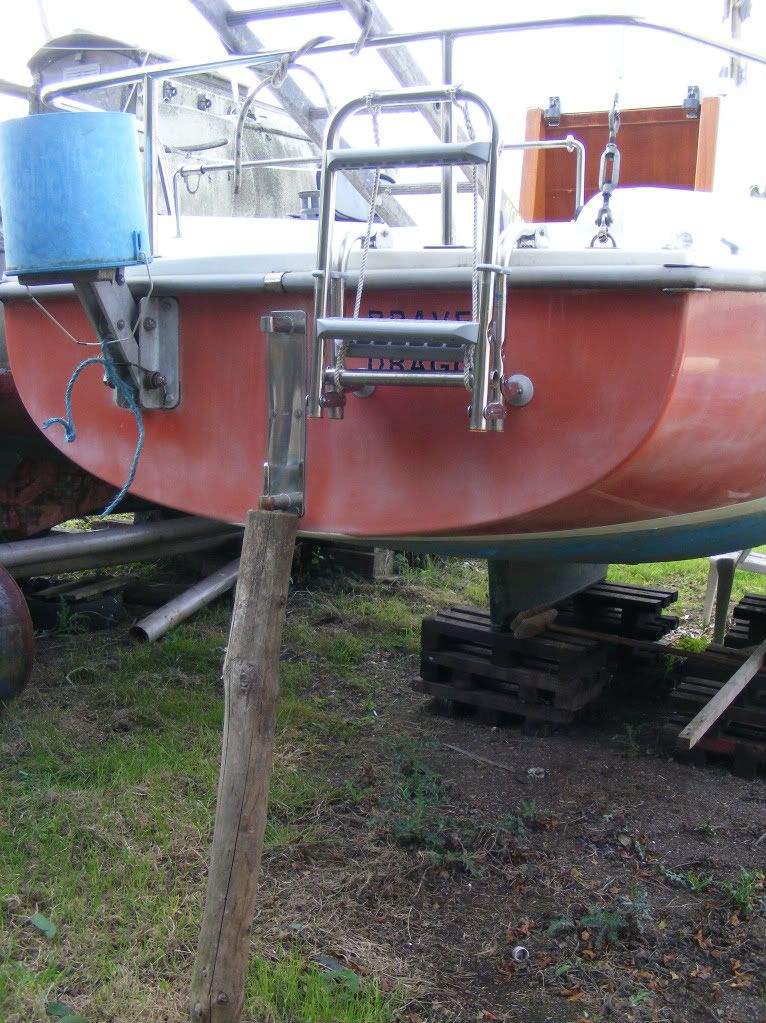
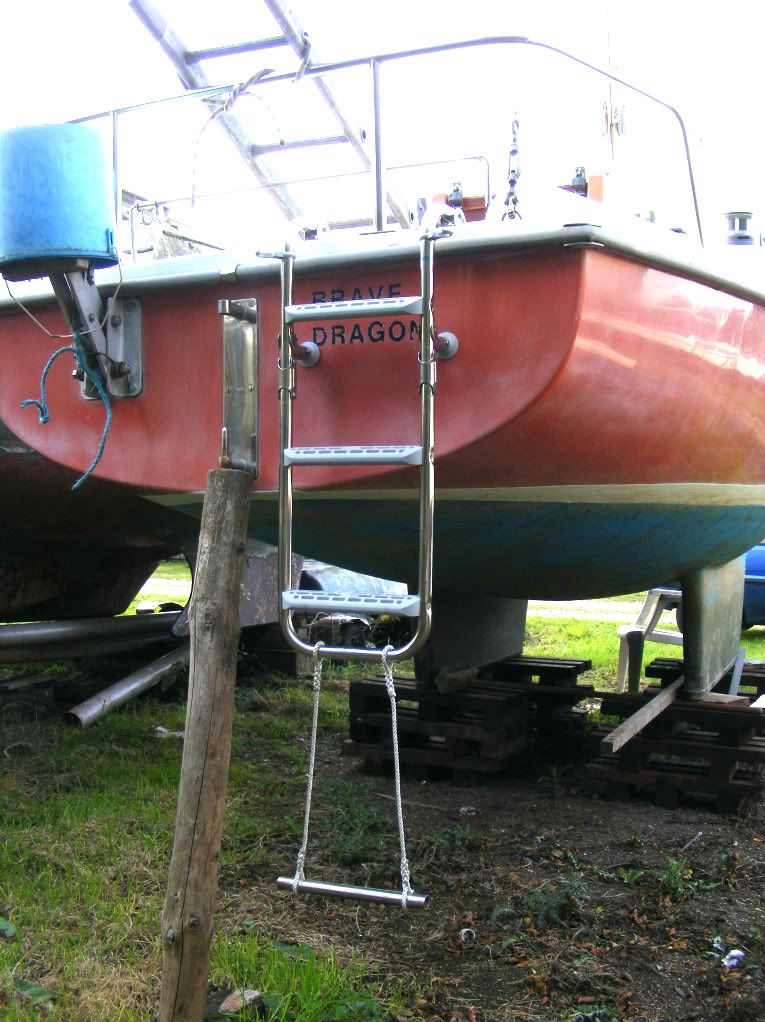
As a result of a minor mishap ... like I capsized the dinghy while getting into it.. I have fitted a boarding ladder to the transom. Not only a ladder but an extended one so that I can get a foot on it while in the water.

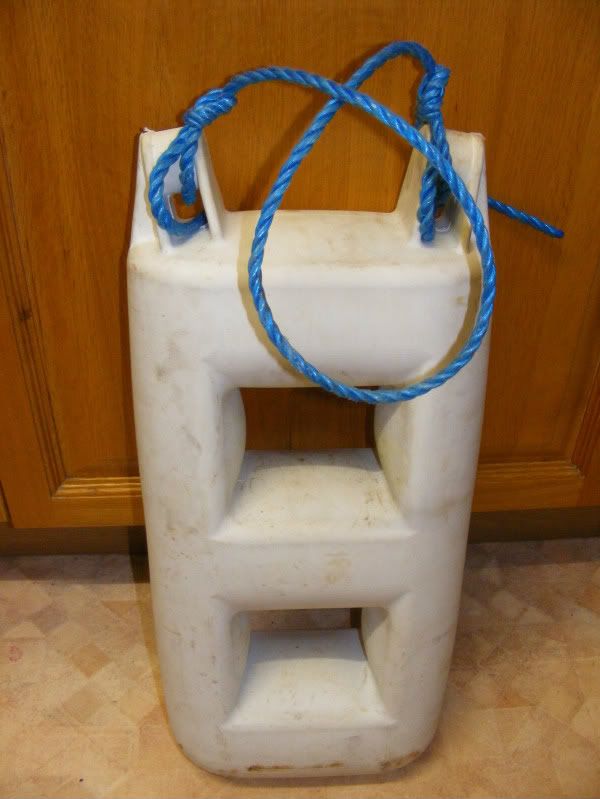
Photos below show it but not yet tried out. I have also bought a fender step thing to help with getting between dinghy and boat

 
Last month when I was last on my boat I tried to step off a small motor boat onto one of the mooring fingers in out marina. The boat had about 600 mm free board and a pulpit about 300 high. I slipped and when in but managed to keep hold of the pulpit so did not go completely in.

The crew on the motor boat consisting 2 women and a strong man could not pull back on board and not having anything to get my feet on to push myself up could not get back on board.

The boat got me close to a moored boat, a cat with a low stern, and I managed to grab one their mooring lined and was able to swing one of my legs onto the marine finger. The mooring line and the top of the marine finger was about 200 mm above water level. Once I get my one leg onto the finger I was able to roll onto the mooring line and scramble onto the finger.

This took quite an effort for a 64 year old half fit man in water of a temperature of 24 C, and it took about 10 mins to recover my strength to get back to my boat.

This has given me new insight into a MOB situation.

I like most have done MOD drill for my skippers ticked but that did not include recovery of the MOB.

To me now the two most important things is finding the MOD as quickly as possible and easy way to get the MOD back on board.

If as I was able to help my self a ladder with a rigid bottom rung to have something to lever against with your feet or some lifting gear if the MOB is incapacitate.

Vic I note your bottom rung is attached by rope. From my dunking I would have my doubts that that would be much help a tired man at it gives limited ability to lever oneself up. Don't get me wrong it is better then northing but I would try it yourself to ensure it is effective in any seaway with the stern's up and down movement.

On my boat I have a rigid dive ladder with at least 4 rungs below water but it is not permanently rigged and I am considering adding a rigid telescopic ladder each side or my boat at mid ships to allow easy recovery and some other means to recover a disabled MOB.

I also think that the currently available MOB finding equipment and techniques need some work in the case of a MOB at night with a single person on watch in semi remote areas like I sail.

Yes PLB and like tag devices help but are far from the golden bullet. Some means of locating the MOD, an on board alarm and automatically stopping the boat is also needed and this could needs to be combined into a single economically priced unit.

BTW PLB's are not allowed in South Africa as it does not have all the functionality of an full EPIRB which must be registered to a boat.
 
Vic I note your bottom rung is attached by rope. From my dunking I would have my doubts that that would be much help a tired man at it gives limited ability to lever oneself up. Don't get me wrong it is better then northing but I would try it yourself to ensure it is effective in any seaway with the stern's up and down movement.

the best I could do. The small size of the transom prevents a decent sized ladder being fitted.

I had a handy bit of stainless tube so I thought an extra rung hanging on a rope might be a solution. It should be no worse than a rope ladder, and it will be better than climbing up the dinghy painter which was how I had to get out.

In the past when I have swum from the boat I have deliberately put a bight of rope over the side to climb out on.
 
VicS, thanks for the pics. I now have a suitable bucket on the van ready to fit over the o/b bracket at the weekend. :) Also a mod to the boarding ladder is in hand.
 
A folding step on the transom ( with a good backing pad ) is a good start, when I went in after overturning my dinghy last year this proved vital.

Detachable guardrails via pelican hooks are expensive but infinitely better than lashings, after an emergency like MOB - when it may well be rough - one can do without a complete lack of guardrails on at least one side.

Even with low freeboard, as previously mentioned it's really hard recovering someone from the water; have a strong topping lift and a snap-shackle on the bottom of the mainsheet, so the boom can be used as a derrick.

Netting on the forward guardrails is a real boon, especially with separate headsails, keeps sails and people on board.

I have harness points at the mast foot, and find a standard harness line will reach the cockpit allowing me to hook on before going on deck, and in the other direction to reach the stem for sail changing, anchoring etc; they may allow one to go over the side, the only answers to that are keeping to the windward side and using a 3-point harness line with long & short lengths - also allows hooking both lines on if things are getting fraught, which may well keep one onboard.

One of those rigid alloy boarding ladders which hook over the coaming would be handy, to rig when getting in or out of the tender or for MOB if there's someone left onboard to get it; if singlehanding may be worth having protruding over the aft coaming, to reach up and fit from the water - I have a flexible plastic boarding ladder but one's feet tend to shoot under the boat, very tiring.
 
As others have said getting back on is hard even with a small boat; it takes a real effort. I have seen an adult struggle to get back on a Squib after jumping off to push the boat off the mud having run aground - and he was being hauled back on by a strong lad (my son).

A rigid ladder ladder is almost essential; it is certainly much easier than a non-rigid one....

For your boat I would look at strong eye or two in the cockpit and probably two jackstays from the forward end of the hatch opening to a central stong point on the deck (have you gotr the typical cental cleat as the Squib has??) I'd be inclined not to run them along the side decks as, if you go over, you will be a long way in the water; jackstays off the cabin top have a better chance of keeping you on board - at least at the begining.
 
MOB ing

I think it vital that you get a stern ladder of some sort and practice using it. Perhaps wait till summer for warmer water. You will be surprised how hard it is to get back on alone. You need not only foot steps down low enough but hand holds up high enough. If the boat is now on the hard try climbing on over the stern from a suitable height.
A said staying on board is more important.
I tried my harness out on my 21fter. On the end of a long rope being towed by an attachment at the chest it was near impossible to do anything but keep my face out of the water. A middle of the back attachment would be much better. While you do slow the boat down with your drag you still can't pull yourself to the boat.
So the only option is a tether so short that you can't go overboard. Yes an attachment in the middle of the cockpit floor and certainly one near the centre of the foredeck. You need at least 2 tethers so you can change from one to the other.
Throwing line? I don't know if they are of any real value but I carry one. The local hardware had cheap 8mm polypropelene (I think) rope. It is quite stretchy but does float (V important). I keep it stuffed into a sail cloth bag so that it can be pulled out easily. A weight in the bag might help throw it further but you don't want it to sink. Practice throwing your rope.
good luck olewill
 
I'm looking for a bit of advice on practical precautions I can take to prevent and/or recover a MOB on my little Hunter Europa. So far I've been sailing where it wouldn't matter so much (inland), and wearing buoyancy aids rather than lifejackets. I usually sail with a novice crew so if anyone goes over it'll likely be me :eek: I plan to get some MOB practice in with a fender/bucket early this year...

First off, I intend to get a lifejacket with a harness and fit a strong point in the cockpit. For fordeck work I could clip to a mast fitting at chest height and still reach more or less everything. (Can anyone see any potential problems with that?) I'm also getting most things led back to the cockpit to minimize fordeck time, but I don't have roller reefing so have to go forward to change headsails.

Second, I have no lifebuoy/danbuoy/throwing rope of any sort. Can anyone suggest something suitable for a small boat. (We do always wear buoyancy aids.)

Third - recovery. The boat has low freeboard and my guardrails are made off with cord lashings so they can be released (or cut). I'll probably fit a step on the transom too.

Anything else I need to think about?
On a small boat conventional big-yacht each sidedeck jackstays are just another slip-trip hazard. Better by far is a single central line to which you can clip. I practiced getting back aboard on my own on a similar sized boat once without a boarding ladder, and found I could do so once - just. Went back in the water to try again and failed that time - only by using with a loop of rope to get a foot into could I get back again - the first effort had been so hard.

Much more recently I ran MOB exercises for a club using fully-crewed big boats and real fit wet-suited men overboard. Even after a tied-to-pontoon exercise first the average time to get a real live MOB back on board once underway under sail was about 15 minutes. I was in a RIB watching closely. Getting the boat back is the easy and usually quick bit, even under sail - I banned engines due to prop risks to the MOB.
 
Mayday if it does happen, Mayday immediately. You can always cancel once you recover. If you wait until you have failed pickup a few times, it can be too late. Emergency services won't mind being stood down or arriving to find a recovered MOB.

If you sail with a novice crew, then this is where a GPS connected DSC radio is good. They need to know how to send the auto mayday. Better if they can use audio too.

On the subject of lifejackets, make sure you have an auto inflation type. Someone died wearing a manual jacket in the Solent a while ago. He was knocked in by the boom hitting his head. If you sail at night, make sure they are fitted with a light. A 150n lifejacket is fine unless you really need a 275n one. If you do get a 275n, bear in mind they are huge when inflated. I did a sea survival course with one & failed to get out of the pool unassisted with it inflated. I had 30cm to pull myself up!

One last point: practice in rough conditions. Anyone can do it in flat water & no wind.
 
You will be surprised how hard it is to get back on alone. You need not only foot steps down low enough but hand holds up high enough. If the boat is now on the hard try climbing on over the stern from a suitable height.

Thanks guys, some good points.

I have no illusions about how difficult it is to get back in. I am young and as a rock climber pretty strong. When swimming from a Cornish Shrimper in summer we all struggled to get back in with a step on the steeply raked transom. It was effectively climbing an overhang! The same effect is there with a rope step, your feet will shoot under the boat.

In technical (climbing) terms, the problem is getting your center of gravity over the widest point of the boat (likely the guardrail) Until you do this you can't flop into the cockpit. A rigid step vertically below you or a high handhold is the only way to do it.

I have climbed in and out of the boat on shore enough to know where the holds are but I think a step on the transom is a bare minimum for me.


The boat is small for me to worry that any strong point on the fordeck with a lifeline that's long enough for me to stand with, will mean I will be in the drink. The max beam is 6 feet. That's why I'm thinking of clipping to the D-rings on the mast at waist height. A two foot tether will let me work at the mast and stop a slip before I go over the rail. I know it's unconventional but I think it would be safer. I'd still appreciate any insight on pitfalls I may have missed with this though....
 
The obvious pitfall is that if you fall hard enough, you will take the mast with you.
The mast could be surprisingly weak to an impact at right angles, such as you falling on it in a knockdown.

In my o-so humble opinion, the best thing for preventing MOB is decent hand holds, including rails along the coachroof that are not cluttered up with shyte like boathooks.

Think what jobs you will need to do on the foredeck, think if you can make them do-able without letting go. If you need both hands, are there decent toe-holds? Could the pulpit be better?
It's interesting to watch the way some people behave on a boat. Some people will naturally stand where there is a handhold in the event of wash or whatever, others will stand where they will go flying if there is some unexpected wash. Some people will sit so they remain stable if the boat heels etc Some people move along a deck expecting it to be slipperry, even in a marina.
Food for thought?
I'm a dinghy sailor myself so must add, the key to not going over the side is not missing the toestraps.
 
There's been a MAIB report into a racing accident recently which criticised the length of the safety line used in the accident. IIRC the problem was too long a line, which didn't stop the casualty going overboard. The report is on the YBW news page and I think it's worth reading as having too long a line seems to have been a significant contributary factor in the death of the casualty.

So what? Well, if you're looking at a small boat and proposing just a couple of anchor points, then you should resist the temptation to use a long safety line. Better fit more anchor points or a variation on the jackstay rather than having too long a line.
 
If you need both hands, are there decent toe-holds? Could the pulpit be better?

Actually the pulpit arrangement is very sensible. It's inside the forestay and allows you to brace yourself effectively.

I see what you say about 'taking out the mast' but the idea is to stop a slip before it becomes a fall...

Wandering about on the cabin top means using the mast, shrouds and occaisionally boom as handholds. Stepping back down into the cockpit can feel a bit vulnerable but sitting down and shuffling sorts that out when neccesary.

A jackstay from centre cleat to mast base might well be handy.
 

Attachments

  • DSC00078.jpg
    DSC00078.jpg
    94.5 KB · Views: 0
Little Rascal,

re. getting on & off deck into / out of the cockpit, I had a couple of stainless handrails made up which go from the ( near ) vertical of the cockpit bulkhead to horizontal along the deck beside the main hatch.

They cost about £100 and work very well, though getting on & off deck is much easier than it looks, so this is a bit of a fop to inexperienced girlie crew !

A taller version could be used as the basis for a main hatch only sprayhood, which would provide sheltered standing headroom when pulling on trousers etc...

CoachroofGrabhandles003.jpg
 
Last edited:
Top