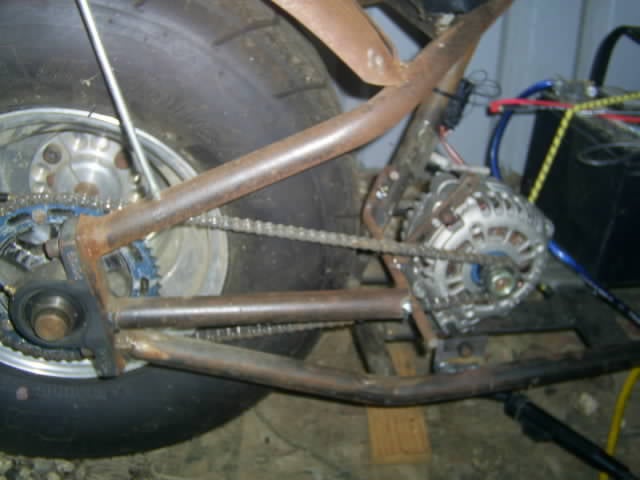
Micro 12v Generator Project

Originally posted by Scuppered_skipper
viewpost.gif

The beauty of my solution is that the on board charger deals with this situation plus the SDMO regulator/invertor has superb control built in anyway. All in a one handed quiet package ready to go, all I paid for mine was £239!
Stu

Oh so there's a good solution to all this all along.

Whats all the debate been about then ?

I should have taken the Scuppered_skipper off ignore sooner. :D

On second thoughts i'll put him back on ignore :)
 
Last edited:
'Yes, you can, but it involves messy electronics which mean it's not easy to instantly turn it back into an alternator.'

I thought it might be done using a multipole relay energised to start switched to run by speed detection electronics which mattnj has already got sorted.

More certain and simpler than electronics?
 
Its called a dynostart.
I thought Dynastarts were dynamos not alternators and not quite a question of connecting differently to use as starter or generator. Better viewed as a starter motor and dynamo in one package.

No reason why they should not be an alternator and a starter motor in one package though I suppose.. Maybe modern ones are .. if there is such a thing as modern Dynastart. Still not the same as rewiring an alternator to use as a starter as far as I can see.
 
No reason why they should not be an alternator and a starter motor in one package though I suppose.. Maybe modern ones are .. if there is such a thing as modern Dynastart.

Indeed there is such a thing. Integrated starter-alternators are being used in the new generation of "stop-start" cars. But they have a shed-load of electronics to control them.
 
You cannot wire an alternator as a motor for starting ... can you ?

yes you can....easy ish too (but dont actually have it working yet)....dont need that many electronics, i have been playing around with it on my "spare" alternator (the one i blew up the regulator on)

May save me the trouble of the electric start i have already, as that sticks out a fair way out the back and weighs a few kg too.

All you need is a set field current/voltage, then a brushless electronic speed controller connected up to the alternator

something like this:-

http://tinyurl.com/274jxfb

before you say it, let me guess...the SDMO solution is better.....as it can make toast....
 
Last edited:
Do not understand what you say when you say :
"with a simple diode mod on the regulator to boost the output voltage."
Diodes do not boost voltage as far as I know and would be intrested to know more as a regulator is as far as I know 1 to 4 diodes in a circuit.
Regulators can take many forms. A diode (or chain of diodes) can be used to 'boost' the output voltage of a regulator by simply inserting same into the regulator's reference line. The output is duly lifted by by a diode drop (or several diode drops), which is usually calculated as 0.6V for a silicon diode, although in practice the P-N junction can rise to as much as 1.0V. The forward voltage (as it is known) is both temperature and load dependent, but 0.6V is a good enough value for experimenting with.
 
yes you can....easy ish too (but dont actually have it working yet)....dont need that many electronics, i have been playing around with it on my "spare" alternator (the one i blew up the regulator on)

May save me the trouble of the electric start i have already, as that sticks out a fair way out the back and weighs a few kg too.

All you need is a set field current/voltage, then a brushless electronic speed controller connected up to the alternator

something like this:-

http://tinyurl.com/274jxfb

Is controlling the field current and voltage to some set value that will turn the engine over insufficient on its own to limit the current drawn whilst starting?

Presumably the hand start will remain available for emergencies?
 
i dont understand..

Presumably because the current drawn by the 'motor' stator will not be limited by the rotor, field, current?

I wondered whether the pull start had to be removed in order to use the Honda electric start arrangement.

Once at sea its good to have a second means of starting an engine when the electric system fails for some reason.
 
Many thanks for the posting Matt and for others input.... mostly way over my head and please forgive my ignorance, ( just an interested observer here really ), but would it help to fit some form of flywheel to assist the engine maintain it's speed under load changes and to cope with the initial load of a fairly flat battery, or is the torque of these engines just inadequate unless they are fairly high revving?
I was involved in the Shell mileage marathon as a school teacher years ago and the 6th formers left me standing as they converted a small diesel aero engine to run on unleaded and achieved an average of 800mpg in our lightweight 3 wheeler.... far less than the professional crews of course but this thread has the same spirit of 'engineering adventure'.
 
Many thanks for the posting Matt and for others input.... mostly way over my head and please forgive my ignorance, ( just an interested observer here really ), but would it help to fit some form of flywheel to assist the engine maintain it's speed under load changes and to cope with the initial load of a fairly flat battery, or is the torque of these engines just inadequate unless they are fairly high revving?
I was involved in the Shell mileage marathon as a school teacher years ago and the 6th formers left me standing as they converted a small diesel aero engine to run on unleaded and achieved an average of 800mpg in our lightweight 3 wheeler.... far less than the professional crews of course but this thread has the same spirit of 'engineering adventure'.

The engine has a flywheel already, then the alternator has a fair bit of mass too, it doesnt have any issues really in this area, well nothing that the servo govenor hasnt fixed, that has the benefit of being able to select any engine speed (noise level) that you fancy, you just press the button and it increments, 3000-3500-4000-4500-5000-5500-6000-3000....with a matching charge rate from the regulator.

I did think of going for a bigger flywheel but it hammers the bearings more, better solution is the "softstart" regulator and servo throttle, it is all interlocked in software so if engine speed drops, it adds more throttle and decreases or holds the charge rate (it hold the rate if the drop is small, if its large then it drops the rate)
 
You cannot wire an alternator as a motor for starting ... can you ?


Its called a dynostart.[/QUOTE]
dynostart means dynamo start, a DC device. Most (for the toothsuckers I am speaking in generalities) DC motors, if you turn them will produce voltage with out any further add ons. Voltage to the brushes, it turns, turn them and they produce voltage. They are not as efficient as power producers, thats why dynamos were superceded by alternators.
Stu
 
Presumably because the current drawn by the 'motor' stator will not be limited by the rotor, field, current?

I wondered whether the pull start had to be removed in order to use the Honda electric start arrangement.

Once at sea its good to have a second means of starting an engine when the electric system fails for some reason.
I phoned a Honda main dealer up, who sells these pumps. I enquired about a Honda retro fit start sytem for them, he laughed at the idea!
Stu
 
I phoned a Honda main dealer up, who sells these pumps. I enquired about a Honda retro fit start sytem for them, he laughed at the idea!
Stu

he must have not known what he is talking about them? Its not a honda kit, so you wouldnt expect him to know about it really would you? i will post some pics of it when i get a minute for those that ARE interested.
 
Top