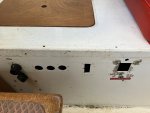
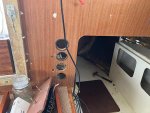
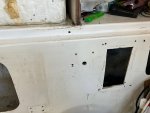
Methods of filling these holes in the saloon.

for just one or two holes i have used cheap black plastic louvred vent covers.

for all those holes, a bit of varnished thin ply?
 
I'm almost with johnalison and bikedaft - no point messing about with the individual holes, just a nice simple varnished wooden panel with bevelled edges. Probably solid wood rather than ply because of the edge 'stripes' and breaking up.

An alternative to wood would be coloured plastic panels, such as used for switch panels, again bevelled, but would need to be a deliberately different colour to what it's going on (nothing worse than almost matching, and you won't get an exact match), but close enough to general blend in.

I think wood, though, would be easier, cheaper and best suit the Westerly.
 
Paxolin, HPL or Tufnol sheet would work well on the fibreglass bits - especially if you can find it with a white front - you'd only need it a couple of mil thick.
 
If you decide to go GRP for the holes in bunk sides I would suggest firstly laying fibre glass over all the holes on the inside. Once that is hard you can build up the fill of the holes with mat or cloth glass and resin. Sand off smooth when hard and finally paint the repair. ol'will
 
Another vote for thin ply. On the wood, I'd put a bit of trim around it, as you'll never make it invisible, so better to make it a "feature". I used 3mm ply for the same job, and it's so thin that the edges aren't an issue on grp, unless you want them to match the ones on the wood.
 
Get to a Cabinet makers and see about getting a veneer ..... very thin wood sheet provided for sheeting door panels etc. The thickness is thin - so it does not really change your cabin dimensions / furnishings fit etc.

Have a chat with them ... I'm sure they would have good suggestions ... and veneers are available in different woods ....

Contact glue is used to apply ...... then a nice careful sanding - not too much or you could sand through it ... then a decent Poly Varnish on top ...

Before applying veneer .... holes can be filled with insulation foam cut to fit ... that will give support to the veneer. If you do - then use Foam Safe contact glue - such as used to stick van lining etc.
 
+1 for veneer on the plywood, although I prefer to glue-in some plywood first rather than use a foam filler. Surprisingly easy to do in practice.

For the fibreglass I'd glue filbreglass cloth behind the holes, some chop-strand in them and filler to finish. Then 2-part epoxy paint (I had a hole filled by a professional and in the end I couldn't see the repair, so it can be done with gelcoat, but it's hard to get a match hence the suggestion of 2-part paint.)

West publish an excellent guide to DIY fibreglass repair, and some videos as well. Instruction
 
Actually, the round ones, could I pit some kind of dials in them connected to things like a fuel sender in the deisel tank and some kind of sensor in the water tank, something like a fuel gauge?
You should always have a an unlabelled gauge that only reads 'Normal', and a switch labelled 'DFA' for those situations when you need to reassure and calm your crew.
 
Boatworks Today on YouTube. Everyone with a grp boat should learn the skills needed. Not hard. Mostly sanding with a random orbital sander.
 
Top