Metal Tube Strength?

Ronald_M

Well-Known Member
Joined
29 Sep 2007
Messages
161
Location
Glossop, Derbyshire
Visit site
Any forumites out there who are versed in the calculation of the strength of materials?

I'm trying to design a simple Gin-Pole or A-Frame system to help in raising/lowering my mast. I estimate that said mast weighs about 60-70 kilograms. I have a supply of 25mm stainless (316) tubing, wall thickness 1.5mm, and I am hopeful that this might suffice, although I have no idea whether a mast-raising rig constructed of this would have a sufficient reserve of strength or would be liable to deform under the pressure.

Any thoughts?

TIA

Ron.
 
Unless you weld up a very fancy latice structure i would have thought 1 inch steel tube too thin to make a .

Hire in some 2 inch aluminium scaffold tube and clamps?
 
flyingjunior - thanks.

My mast is deck-stepped - a simple pivot pin allows the mast to swing down. The mast is about 8.5m long, tapered (the boat is a 21ft fractional-rig bilge-keeler) and, as I say, weighs about 60kg or so - just about OK if two people undertake the procedure unaided. I would like to devise a way of lowering/raising the mast single-handed. My intention is to use a multi-part purchase arrangement - I figure that the boats mainsheet will do - one end shackled to the lower end of the forestay, the other to the forestay deck fitting. Obviously, it will be necessary to arrange an adequate angle between the forestay and the mast in order to provide sufficient leverage - hence the need for a gin-pole. I believe that the main force acting on the gin-pole would be compression along its length - I would have thought that a 25x1.5mm tube should be strong enough - but it would also be advisable for the pole not to bend and collapse. trouble is, I don't know how to calculate how likely such bending might be........

Ron.
 
Hi Ron,

I think the number you need is called the "yield strength", and the equation involves Hooke's Law and the modulus of elasticity. Before you Google all that, a more scientific method would be to take one of your poles, lay it across two chairs and step on the center. If you can, calculate the weight at which the tube begins to permanently deform. An easy way would be to have one foot on the tube and your other on the bathroom scale.

Then using the geometry of your A-frame, make a right triangle with the pole length as your hypotenuse (p), the number used for the base (b) is 1/2 the width of the bottom of the A-frame, and the height (h) is easily calculated using h = (p^2 - b^2)^0.5

Next use ratios to calculate how much weight you can put on your A-frame before it breaks. Let's say your pole is 3 meters long and started breaking at 18 kg, and the bottom of your A-frame is 1.5 meters wide. So:

b = 0.75 and

h = (3^2 - 0.75^2)^0.5 = (9 - 0.56)^0.5 = 2.9

So:

w = 18
b = 0.75
h = 2.9

Use the ratio w/b = ?/h

which rearranges to w*h/b = ? = 18 * 2.9 / 0.75 = 70 kg

This means that each side of your A-frame can hold 70 kg, or 140 kg total. Now pick a factor of safety, personally in this case I might use three, so the max weight you would expect the two poles to safely handle together is about 50 kg.

Then you add cross braces along the length of the poles and the strength increases, which means you can put more weight on the frame, and I don't know about you, but it is sounding like beer-thirty.

Hollow tubes are surprisingly strong compared to their solid counterparts (part of the reason our bones evolved to be hollow), and you are correct that compression (aka "axial loading") is a non-issue for your application.

Priscilla
 
Theoretically, the pole is in pure compression, and there is no bend ing on it. The reality may be more complex, once any bend is applied, the compression force causes further bending.
My inclination would be to find a pole of bigger section, maybe a length of old dinghy mast or boom. A further problem is that once the shrouds are slack, the mast, pole and forestay can get out of plane, imposing huge forces on the pivot at the tabernacle. If the boat is afloat, it only takes a bit of wash to make everything very messy.
do you really need to do this on your own? If you can't get someone to give you a hand in return for a pint, are you in the right sailing club?
take care,
 
You need to calculate the "buckling load" for the strut. There are off-the shelf formulae for that but I'd need to know how long the strut was and I'd need to assume it was a single strut "pin jointed" at either end. If you give me the length you want, I'd have a stab at it if you like. 60kg sounds like quite a lot though. My mast is about that long on a 27 footer. It's a pretty stout masthead rig and the mas doesn't taper (nor is it in the least bit bendy)! I'd be surprised if it weighed 50kg. Intuitively, the stainless you have access to would seem a bit too small in diameter to do it as a single strut in pure compression (or even as two in a triangle), but as has been said, if you had some sort of triangulated "crane jib" type structure, it would be fine.
 
Thanks for all the replies, folks.

I guess my original instinct was that 25x1.5mm might be liable to buckle.

My latest instinct is to go with something beefier - (aluminium) scaffolding pole should be gutsy enough I reckon?

Cheers,

Ron.
 
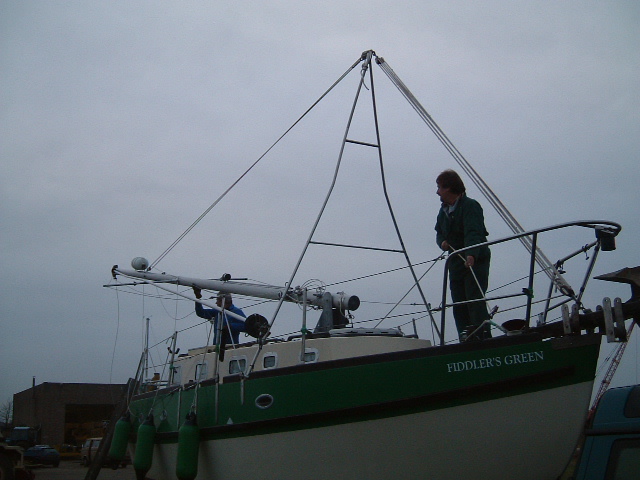
Your tube would appear to be adequate, tried and tested
heading%20for%20mast%20crutch.JPG


Although the upper cross support tube would have been better positioned lower down at the point where he has bent the uprights.
 
The design in the photo in the previous post is awful. If the legs had been straight, it would be fine, but the way it is, is asking for it to collapse. Why on earth did you put the kinks in the legs?
 
Buckling of columns can be calculated by Euler

http://www.tech.plym.ac.uk/sme/desnotes/eulerderiv1.htm

My advice is do not even go there!! It is one thing calculating the point at which the column collapses but another to work out what load you are actually applying with block and tackles, sudden pulls on the rope and changing angles of the stays forward and aft)

My boat is 22ft Dehler trailer sailer and the purpose designed pole is about 35mm diameter.

If you are buying a piece of tube go for bigger rather than smaller! Aluminium tube is cheap!
 
I think the number you need is called the "yield strength", and the equation involves Hooke's Law and the modulus of elasticity. Before you Google all that, a more scientific method would be to take one of your poles, lay it across two chairs and step on the center. If you can, calculate the weight at which the tube begins to permanently deform. An easy way would be to have one foot on the tube and your other on the bathroom scale.
***************************************************

NO>>>NO>>>>NO..

I think you missed the point of the question most of this is irrelevant.

The A frame has the tubes in simple compression so long as they are straight so non of this is of importance as no bending other than due to eccentric loading produced by poor design...
 
a single strut in pure compression (or even as two in a triangle), but as has been said, if you had some sort of triangulated "crane jib" type structure, it would be fine.
************************************************

He did say A frame ...

/forums/images/graemlins/laugh.gif /forums/images/graemlins/laugh.gif
 
'The design in the photo in the previous post is awful. If the legs had been straight, it would be fine, but the way it is, is asking for it to collapse. Why on earth did you put the kinks in the legs?'

I never!

It was the guy in the picture. He achieved that design by trial and there was error involved as his selected assistant was too fit and managed to jump out of the way when the Mk I version collapsed so the mast bent the stern rail which had to be jacked straight again! /forums/images/graemlins/blush.gif

All described here in an Eventide Owners website
 
Are you sure 60kg?

Look here for typical mask section weights:

ZSpars

Even including the sheave box and standing rigging (3 or 4mm?) it would seem that 30-35kg would be more realistic.
 
Top