Mermaid turbo 4 low power, black smoke.

Bill W

Member
Joined
23 Jul 2024
Messages
39
Visit site
Evening All. I have a Channel Island 32 with twin Turbo 4s. These were factory reconditioned units, fitted in 2009 and rated at 170hp each.
Both engines will rev, no load to over 2800rpm. Under way, both are reasonably smoke-free (in Ford terms) up to about 1500rpm and the Morse control levers are in line with each other. Above this speed, the starboard engine begins to produce black smoke and the stick has to be pushed further forward than the port one to reach the same revs. At 1900rpm, the starboard engine will rev no higher and puts out some pretty hefty amounts of black smoke. The port engine will merrily rev to 2300 or more and remains clean.
Oddly, the starboard turbo seems to produce higher boost pressure, around .6 bar, compared to less than .5 on the port gauge. This I find confusing because black smoke usually means not enough air for complete combustion. I don't see how there can be good boost pressure but not enough air.
The boat had brand new stern gear fitted, including one new prop and one refurbished. I've been over the side and checked there is no fouling of either prop and they are both equally easy to turn manually.
If I can ever shake off the dose of covid I have just now, I'm thinking of starting with a look at the air pipework, charge air cooler, etc. Someone has suggested a possible raw water leak into the CAC, but I find it hard to see how that would produce these symptoms. I've done a fair bit of googling but no lightbulb moment. So, here I am asking for help from the very knowledgeable members I know frequent this forum.
 
Which side had the new prop ?
Black smoke is unburnt fuel , could be a faulty injector , you could be loosing boost pressure to the cylinders , check the inlet manifold gasket and associated hoses , pressure test the intercooler .
Could be advanced pump timing .
 
Which side had the new prop ?
Black smoke is unburnt fuel , could be a faulty injector , you could be loosing boost pressure to the cylinders , check the inlet manifold gasket and associated hoses , pressure test the intercooler .
Could be advanced pump timing .
I don't know which is the new and which the refurbed one. The work was carried out shortly before I bought the boat.
I'll look at all the points you mention as soon as I feel well enough.
Losing boost pressure to the cylinders? Interesting. I can see that might occur with a bad inlet gasket. Would wrong valve clearances do similar?
I should clarify, I've only had the boat a month or so. The starboard engine has never made full revs in that time, originally topping out at 2100 and a bit of smoke, which recently dropped to 1900 with quite a lot of smoke.
 
Did the S/B engine make full revs on the sea Trial prior to purchase, any mention of engine issues in the survey report?
 
Did the S/B engine make full revs on the sea Trial prior to purchase, any mention of engine issues in the survey report?
I didn't get a survey report done prior to purchase. I did have chance to look at her in detail while she was in the boatyard having new sterngear fitted.
On sea trial I didn't try WOT, in hindsight maybe I should have, but she ran nicely up to 2000 revs and easily achieved the cruising speed I was looking for.
I got her as a project, to bring up to scratch over the next few winters, at a project price, so expected to be doing some bits while running her for the season.
 
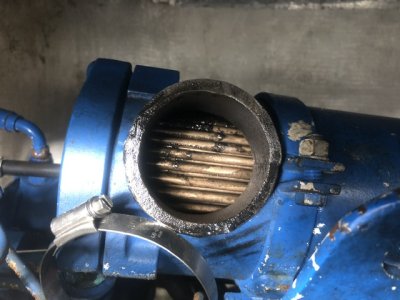
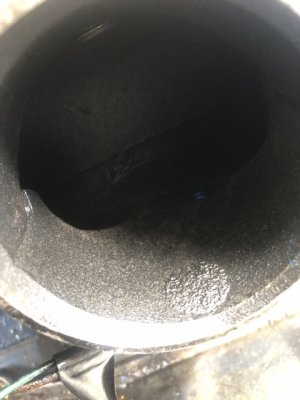
I’m out on the boat just now. I’ve taken the crossover pipe off from between the CAC and the inlet manifold. No sign of any water or corrosion, just a light film of oil. Looking into the CAC via its outlet, the tube stack looks in good Nick, with a light coating of oil. Second pic is the inlet manifold.IMG_3539.jpegIMG_3540.jpeg
 
I managed to get out to the boat again this afternoon. Took off the rocker cover from the offending engine and adjusted valve clearances, which were a tiny bit on the slack side. This was done to cross another possible cause off the list. Took the boat out for a short run. Starboard engine still not going above 2000 revs. Port engine happily making between 23-2400 revs. With both sticks right forward the port engine was on 2350 and the satrboard just short of 2100 but on throttling back the port engine the revs also fell on the starboard, back to 1900-2000. Still black smoke from the starboard engine above about 1500 revs.
Back on the buoy, I pointed a laser thermometer at each of the charge air coolers in turn, They were almost identical. Did the same with the gearboxes, negligible difference between them.
Next suspect has to be the props. I find it hard to believe that a professional marine engineer would fit non-matching props but it has to be ruled out.
 
Last edited:
Bill did you check the Turbos? My boat has developed a similar issue with soot all over the place. From all the forums there seem to be 6 causes 1. Barnacles on the bottom 2. Fuel injectors 3. Turbo waste gate blocked 4. Fuel. 5. blocked/dirty intercooler. 6. lack of air due to dirty filters. I'm starting at the turbo waste gate as we know we have good fuel and I have just changed all the filters..would be interested to see how you have got on.
 
Bill did you check the Turbos? My boat has developed a similar issue with soot all over the place. From all the forums there seem to be 6 causes 1. Barnacles on the bottom 2. Fuel injectors 3. Turbo waste gate blocked 4. Fuel. 5. blocked/dirty intercooler. 6. lack of air due to dirty filters. I'm starting at the turbo waste gate as we know we have good fuel and I have just changed all the filters..would be interested to see how you have got on.
Hi Tim, are yours Turbo fours too?
I had a tip from someone to check the intercoolers. I removed them from both engines and stripped them. Both tube stacks were seriously blocked on the seawater side with rotting bits of eelgrass, with only a few of the cooling tubes remaining open. I cleared the blockage and checked that all tubes were clear. The outside of the tubes were oily, so I assume there is some oil seal leakage from the turbos, but there didn't appear to be enough oil fouling to restrict air flow. I cleaned them with brake cleaner, using a whole large can on each. After refitting, there did seem to be some improvement but not huge. Port engine fine but starboard engine only getting 2000 revs with some black smoke, which has got worse with added use. Transom and everything aft of the wheelhouse is covered in oily soot.
I dried her out on the beach and checked the prop numbers. They are both 20x21.5 three bladed and both clean and undamaged. There are no barnacles on the bottom, just some slime and the odd strand of green weed.
I have temporarily removed the air filters, which made no difference. I have KKK K26 turbos which don't have a wastegate. Fuel appears bright and clean. Filters were changed in May.
Exhausts appear to be clear as she is passing gases and water quite readily on both sides.
Our next plan is to get some spare turbo gaskets and swap the turbos over to see if the fault moves to the other engine. I'm doubtful that it will because the one on the reluctant engine is showing .5 bar of boost at 1900+ revs, but we're running out of ideas for things to try. If that doesn't identify a turbo fault, we will pull the injectors and put them on the tester to check spray pattern and no dribbling.
If all that fails, I'll be looking for a gas oven to stick my head in.
 
Last edited:
Are the gearbox ratios exactly the same, often they are not on the box with reverse rotation. Could the new prop have been made with incorrect pitch causing the engine to be overpropped?
 
Are the gearbox ratios exactly the same, often they are not on the box with reverse rotation. Could the new prop have been made with incorrect pitch causing the engine to be overpropped?
Now there’s an interesting thought. The port engine is running a Borg Warner 72c 1.5:1 box. The starboard engine has a PRM 750c 1.46:1. These PRM boxes are advertised as a direct replacement (with a spacer) for the BW 72c but there is a slight difference in ratio. Equates to a difference of about 50 rpm at the prop at 1900 engine revs.
 
Now there’s an interesting thought. The port engine is running a Borg Warner 72c 1.5:1 box. The starboard engine has a PRM 750c 1.46:1. These PRM boxes are advertised as a direct replacement (with a spacer) for the BW 72c but there is a slight difference in ratio. Equates to a difference of about 50 rpm at the prop at 1900 engine revs.
Thats a smaller difference than i had. Mine was 1.90 / 2.10 ratios (both BW) on my new engine install.

I had installed EGT meters & realised my stbd engine was working harder at cruising revs. New props had been installed a couple of years before, both the same dia & pitch. Prop shop then adjusted the pitch to get them closer together for me.

Doesn't sound like your ratio difference could account for your issue unless the new prop was wrongly pitched when made.

Also check your rev counters are correct. I used an optical rev counter from Ebay to check shaft revs as well as engine revs.
 
Thats a smaller difference than i had. Mine was 1.90 / 2.10 ratios (both BW) on my new engine install.

I had installed EGT meters & realised my stbd engine was working harder at cruising revs. New props had been installed a couple of years before, both the same dia & pitch. Prop shop then adjusted the pitch to get them closer together for me.

Doesn't sound like your ratio difference could account for your issue unless the new prop was wrongly pitched when made.

Also check your rev counters are correct. I used an optical rev counter from Ebay to check shaft revs as well as engine revs.
I’m beginning to wonder if it might be a prop issue after all.
I’ve checked the numbers on both props. They are both stamped as 20x21.5, which seems a lot of pitch for a semi displacement 32 footer with engines I was told are 170hp each.
I’m wondering whether, when the reconditioned engines were fitted, they tried and get as much top speed as possible and fitted the 20x21.5 props, then found she was over-propped and had them adjusted down a couple of inches of pitch. All well and good until last previous owner had the accident and wrecked one prop and damaged the other. Maybe the boatyard ordered the new rh starboard prop using the numbers on the old prop, not knowing it had been adjusted? The port prop was repaired but who knows if the pitch was checked or not. I might be grasping at straws here but it seems feasible and would explain why the port engine hits full revs, even with a prop that is marked with what appears to be excessive pitch.
 
I recommend you have pitch checked on both props, just sounds to me like you are overpropped and your prop damage & repair story in post 13 could easily be a reason for that.
Black smoke is typical of overload, yes it could be all sorts but other things you mention also point to a high load condition, eg "but on throttling back the port engine the revs also fell on the starboard, back to 1900-2000"
With everything equal boost pressure is a good indicator of load, balancing boost not revs should give you shared load with twin engines.
Stbd boost could be slightly higher because of g/b ratio up until you reach the overload condition.
I don't know the engine, is the boost pressure you mention typical? It sounds low to me. Low boost would point to turbo worn out, but in that case it would be both of them as boost is about equal. A peek at the exhaust side will give you more info on that but feeling clearance of rotor and free to spin condition might tell you something, easily accessed on air side.
 
Been thinking some more....
What is the max rpm you can achieve on either engine while running with both?
Does the boost pressure steadily rise to it's maximum until the engine tops out? or does it tail off before the end?
What is the rated engine HP & rpm?
I can see you mentioned 2900 rpm in neutral, I assume that is what both will achieve?

You sound to be at the max output of (at least one of) those engines.
Load slows the engine, governor calls for more fuel but the stbd engine is unable to burn it, accelerate and turn the prop faster, hence black smoke.
When this happens at lower than maximum revs this is typically because the prop is too "big" for the engine.

If we were starting with known good engines & hull condition this takes you straight to the prop size.

But as its all new to you you don't know if it is the engine or the prop. It could be the engine has incorrect turbos. It is obviously getting plenty of fuel, but cant burn it. Or it could be the engine is "worn out"....the smoke and sound up to the heavy smoke event will give you clues to this, as will crankcase pressure.

Or there could be nothing wrong with engines/turbos and your boat has the "wrong" props. There are folks who like to fit oversized props and run at lower revs, I don't want to get into that debate, but if you have bought such a boat it would do exactly what you are describing.
 
Port engine will rev to 2300+ under load. Starboard engine will only reach between 1900-1950. Port engine has 1.5:1 box. Starboard box is 1.46:1.
Starboard turbo reaches around .5-.6 bar about 1700 revs but does not increase much if at all beyond that.
Manufacturer's max revs for the Ford Dover-based Mermaid Turbo Four is 2600. I think they will hit 3000 out of gear but I didn't like to scream the guts out of them with no load. I was informed that they were supplied as reconditioned 170hp units but it could be that someone has tweaked the pumps to get a bit more.
The port engine will reach at least 2300, maybe a little more if the starboard one was reaching those revs too.
The turbos are the correct ones for these engines, KKK K26.
The engines are said to be low hours and were factory recons fitted in 2009. They don't seem to be worn out. They don't smoke much on startup, sound healthy and don't burn oil. No sign of breathing from the crankcases.
The turbo on the port engine spins very freely, the starboard one very slightly less so.
I'm leaning towards it being excessive pitch on the starboard prop as the main cause, with possibly a tired and leaky turbo adding to the mix.
The boat is afloat at present, so checking the pitch will probably have to wait for some settled weather and putting her aground. We'll then do a quick and dirty pitch check using a straight edge and carpenter's sliding bevel to compare the blade angle of the two props. We might also be able to contrive a method of working out the actual pitch without removing the props.
In the meantime, we might try swapping the turbos over between engines and see if that has any effect on either of them.
 
Top