McMurdo M10 AIS - transmitting incorrect heading

Shuggy

Well-Known Member
Joined
10 Mar 2006
Messages
1,182
Location
Argyll
Visit site
I fitted a McMurdo M10 AIS transceiver 4 years ago, connected to my plotter/MFD via NMEA 2000. At that point it had an old school autopilot and fluxgate compass that were independent of the NMEA 2000 network. In other words the McMurdo M10 couldn't see the fluxgate compass heading. All worked well.

3 years ago I fitted a new Navico family autopilot, which is now part of the NMEA 2000 network. I started receiving calls from other boats stating that my heading was at odds with my COG.

I contacted McMurdo but they seem to be a bit baffled by what's going on. In short this is what I think is happening:
  • In normal operation (with everything connected) the AIS transceiver broadcasts our heading as zero degrees regardless of our actual heading
  • Our plotter and autopilot show our heading correctly, so it's not an obvious problem with the heading data in the network
  • If I disconnect the AIS unit from the NMEA 2000 network it no longer has access to any kind of heading data and reverts to showing COG correctly with no broadcast heading data (I can see this by going into the 'position' tab on MarineTraffic)
...so it seems to be that when the AIS unit has access to the fluxgate compass heading data it always broadcasts a heading of zero degrees.

McMurdo have been really helpful but want me to log the data using an SD card but I can't get that to work despite formatting the right size of card with the correct formatting (if that makes sense!).

Any ideas?

Thanks.
 
Last edited:
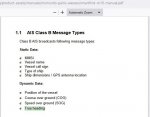
Heading and course are two very different things. I understand that Class B AIS transmits SOG and COG and that data is taken from the satellite data and calculations in the AIS.

This might help understand the message structure.

Topic: Class B vessel
 
Thanks - I think I understand that, but the AIS can only transmit heading when it has heading data. If there is no compass in the network it doesn't know the heading. Ever since I've given it access to the compass it broadcasts the heading as zero degrees. That's the issue.
 
Can you view heading information on any other display on your NMEA2000 network? i.e. do you have a small display or other plotter that can check out what the Navico kit is transmitting onto the NMEA2000 backbone.

As you say, the McMurdo M10 should transmit the heading information correctly. Mine does as soon as it's powered up.
 
Thanks - I think I understand that, but the AIS can only transmit heading when it has heading data. If there is no compass in the network it doesn't know the heading. Ever since I've given it access to the compass it broadcasts the heading as zero degrees. That's the issue.
If you remove the compass from the system does it transmit the COG? Which is the more useful data item.
 
I have the M10 transceiver as well. If you also use it as a multiplexor taking your existing nav data in and then outputting the same data plus the AIS data, I believe there is a programmable setting to disable the GPS output which you should do if your plotter also has access to the gps .
From memory, the M10 is actually a Camino 108 and it only provides heading data which it calculates from its own GPS aerial to provide COG, It shouldn't be even thinking about using the external heading data (or the boats main GPS).
My system is all using the NMEA 183 and despite all nav data (including heading data) being fed into the AIS unit it all works as it should. My suspicions would lie with how the NMEA2000 is implemented?
The only reason to use the M10 multiplexor is if you have a plotter with just a single fast data input to need to get the AIS traffic multiplexed with all the other boat data. If your plotter has 2 or more inputs, I would leave the AIS unit as just an AIS| without the multiplexing?
I found McMurdo very helpful but they di seem to be a way behind as regards the unit firmware revisions. I use the Camino firmware which uploaded just fine into the McMurdo unit and am currently on version 1.2.8.06 but Altec seem to have recently removed the firmware downloads from their web site. I do know that there have been updates since the product launched relating to NMEA2000 data streams.
 
That Alltec firmware is not always the best to use on the McMurdo. I updated a couple of M10s with it. One worked and the other seemed to take the upgrade but after the required power cycle it never came back up again. Dead. No lights, not even power. McMurdo recommend against anything other than their own firmware download if you wish to upgrade.

Back to true heading - As per any AIS transponder, it will only work out it's position, COG and SOG from the the internal GPS, but it should include True Heading within it's AIS transmissions if available from the network. I expect to switch the instruments on on board and find my vessel already pointing in the right direction on MarineTraffic even before moving anywhere.

M10 transmits.JPG

There should only be one soure of True Heading on the network though - and many heading sensors such as the Lowrance/Navico Point-1 will stop sending heading info onto NMEA2000 if it detects another source on the network.

MFDs have the capability to select which heading source they display but I wouldn't like to guess what an AIS transponder would transmit if it did see two heading sensors did transmit on the network. (Later firmware for the Point-1 allows you to give it 'instance' numbers, so you could put more than one on at once, but same caveat would apply to not being able to select which instance the AIS transponder sees or which it would choose).
 
If you remove the compass from the system does it transmit the COG? Which is the more useful data item.
I can remove the AIS box from the NMEA 2000 network. In this scenario it continues to transmit AIS data without the erroneous heading. It means others can see me but I can't see them.
 
I have the M10 transceiver as well. If you also use it as a multiplexor taking your existing nav data in and then outputting the same data plus the AIS data, I believe there is a programmable setting to disable the GPS output which you should do if your plotter also has access to the gps .
From memory, the M10 is actually a Camino 108 and it only provides heading data which it calculates from its own GPS aerial to provide COG, It shouldn't be even thinking about using the external heading data (or the boats main GPS).
My system is all using the NMEA 183 and despite all nav data (including heading data) being fed into the AIS unit it all works as it should. My suspicions would lie with how the NMEA2000 is implemented?
The only reason to use the M10 multiplexor is if you have a plotter with just a single fast data input to need to get the AIS traffic multiplexed with all the other boat data. If your plotter has 2 or more inputs, I would leave the AIS unit as just an AIS| without the multiplexing?
I found McMurdo very helpful but they di seem to be a way behind as regards the unit firmware revisions. I use the Camino firmware which uploaded just fine into the McMurdo unit and am currently on version 1.2.8.06 but Altec seem to have recently removed the firmware downloads from their web site. I do know that there have been updates since the product launched relating to NMEA2000 data streams.
Thanks for this - my plotter is NMEA 2000 only so I really need to fix the problem - otherwise the solution would be simple, i.e., to use the McMurdo NMEA 0183 output to plug into the plotter. I don't think I've got another option for getting NMEA 0183 data into the plotter although I do have all sorts of converters lurking in the system!
 
How many sources of heading data do you think you have on the network? Do you for example have something like the Point-1 still on the network then more recently added the Navico based autopilot with it's own heading sensor?

(I'm thinking back many years to when I added two heading sensors to the NMEA2000 backbone (for a bit of resiliency so that I could change source at will), I came across the Point-1 supressing it's Heading output (but still transmitting it's GPS output) and if other devices relying on heading had latched onto the Point-1 as a source of heading, then when the second source (and now only source) was noticed on the network, they wouldn't change to it automatically.)
 
I've seen a similar issue on my Raymarine/NMEA2000 network when there are 2 sources of GPS data. By default the raymarine instruments and plotter are set to auto-select a gps source, but that resulted in them occasionally getting confused and defaulting to a COG of 000. Solved by configuring the Raymarine devices to use one specific GPS source from the network.
 
Thanks both. I only have one source of heading data, which is my Simrad (Navico) fluxgate compass. The B&G (Navico) Vulcan plotter confirms this. The only other bits on the network aside from the Simard (Navico) autopilot computer - which uses the fluxgate compass for heading - are the wind and log instruments and a barometer. I think the easiest solution may be to install a one way NMEA 0183 -> converter between the McMurdo AIS unit and the NMEA 2000 network so the plotter can see the AIS data but the AIS unit remains ignorant of any output from the NMEA 2000 network.
 
I've seen a similar issue on my Raymarine/NMEA2000 network when there are 2 sources of GPS data. By default the raymarine instruments and plotter are set to auto-select a gps source, but that resulted in them occasionally getting confused and defaulting to a COG of 000. Solved by configuring the Raymarine devices to use one specific GPS source from the network.
I do have two sources of GPS data - the McMurdo AIS unit's own GPS mushroom, and the B&G plotter's inbuilt GPS. However they co-existed happily before I installed the fluxgate compass so I don't think this is the problem.
 
I do have two sources of GPS data - the McMurdo AIS unit's own GPS mushroom, and the B&G plotter's inbuilt GPS. However they co-existed happily before I installed the fluxgate compass so I don't think this is the problem.

I think the problem is more complex than you imagine - as far as I know, AIS doesn't use heading data at all, as it transmits COG. Therefore if your problem only appears when the compass is transmitting on the network, it's due to some more complicated interaction. Try looking at configuration of the plotter & instruments on the network and seeing what it says for GPS source. Try selecting one instead of allowing it to auto-select.
 
I think the problem is more complex than you imagine - as far as I know, AIS doesn't use heading data at all, as it transmits COG. Therefore if your problem only appears when the compass is transmitting on the network, it's due to some more complicated interaction. Try looking at configuration of the plotter & instruments on the network and seeing what it says for GPS source. Try selecting one instead of allowing it to auto-select.
AIS does use heading data from a compass if installed. McMurdo have confirmed in writing that this is the case. I'm thinking that one of these should provide the one-way isolation that would mean that the plotter can see AIS 0183 sentences but the AIS unit can't get corrupted by NMEA 2000 data: clicky
 
Last edited:
McMurdo have been really helpful but want me to log the data using an SD card but I can't get that to work despite formatting the right size of card with the correct formatting (if that makes sense!).
Start a new thread on this. Surely the best solution is to let the manufacturer have a look and see what's going on?

It's probably a FAT / EX-FAT / FAT32 issue.

Buying extra devices to interrupt your good NMEA 2000 network is just a bodge. I would plug in a laptop (or connect it via wifi) - the NMEA sentences can be examined using OpenCPN, but I don't know if this is available to you.
 
Ais transmits both heading and COG (as in my earlier post #7)

It's useful information to see from another vessel because it gives an indication on their course change rather than just relying on their GPS calculated course over ground.
 
Shuggy... In the absence of any easy way of monitoring the actual NMEA PGNs (packet data) are you able to check the NMEA health via the MFD... there should be a menu that will show bus voltage, load, collisions etc..

Are both 120 ohm terminators plugged in correctly? If you could plug in an extra 'T' and drop cable, with bare wires it should measure 60 ohms across blue and white (powered off bus). That's two 120 ohm resistors in parallel.
 
Top