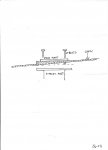
Mast Support Post

An epoxy resin chock should be easy to make. I would slacken off all the rigging by a set number of turns. This should relieve the pressure on the top of the mast and allow you to slip some thin polythene on to the top of the post. Then tape the front and sides of the polythene to the cabin top. Slide in some galss fibres for added strength into the gap and then tape up most of the back allowing a small hole for a syringe to inject the resin. Once set you can trim the excess polythene and epoxy off, retension the rigging (or get your rigger to set it up with a guage) and replace the headlining panels.
 
An epoxy resin chock should be easy to make. I would slacken off all the rigging by a set number of turns. This should relieve the pressure on the top of the mast and allow you to slip some thin polythene on to the top of the post. Then tape the front and sides of the polythene to the cabin top. Slide in some galss fibres for added strength into the gap and then tape up most of the back allowing a small hole for a syringe to inject the resin. Once set you can trim the excess polythene and epoxy off, retension the rigging (or get your rigger to set it up with a guage) and replace the headlining panels.

The strength is in the glass, mainly resin in compression is likely to fail. It should be easy enough to make a wedge shaped mould and lay it up properly. Final finish to fit by sanding. Otherwise, hardwood.
 
I am now left with deciding how to fix the problem. My surveyor has suggested "resin chocking" but it seems to me this more or less has to poured into a mould so would be almost impossible to do. My own thoughts would be a hardwood chock, assuming that would be man enough, or whether it might be possible to get the top plate welded on at and angle. All views and alternatives gratefully received.

Get the top plate welded on at the right angle, as it should have been done in the first place. Anything else is elastoplast.
 
Get the top plate welded on at the right angle, as it should have been done in the first place. Anything else is elastoplast.

Agree with JumbleDuck and this is easy to do. Cut the weld between the plate and the tube except for about 20mm at the front with an angle grinder, re-install the post with the rigging loosened off. Open the gap at the back with a chisel until the plate is in the correct position, grind two pieces of metal to the correct thickness to fill the gap on either side of the chisel and hammer them into the gap, remove the chisel leaving the wedges in place. Remove the post and re weld keeping the wedges in place then when the gap has been filled cut the wedges and weld over them. This should give the correct angle and a perfect fit.
 
I have to say I am not too keen on having the top plate at an angle; the bolts come through vertically and tightening them against a less than horizontal surface does not seem to be ideal.
 
Seems weird, a drawing would be useful.

Very odd and I'm wondering if there have been repairs in the past which haven't been properly done. Some Westerlies (not sure if it applies to this model) had problems with the mast support pad laminated into the deck rotting and needing replacement, it's not inconceivable that this was done from the underside rather than cutting out from the top as usual.
 
I am attempting to attach a diagram which will hopefully make thinks clearer. As you can see, there is a step moulded on the deck on which the deck plate for the mast sits horizontally. However there is no corresponding moulding on the underside and when the bolts are tightened there is a bending moment being applied to the deck post as it pulls the deck down at the rear end of the top plate. The consensus is that it is this and not the compression that is causing the post to bow. What is needed is a chock or something else to fill in the angle between the deck and the top plate so the bending moment is eliminated.
 
Unfortunately my attempt at attaching a file appears to have failed. It's an 84 KB .pdf file and I tried uploading it by going to the go advanced settings in the reply box but eventually got a message saying the file was too big which I find extraordinary given the photos some far cleverer than me seem to be able to upload. Any clues as to what I am doing wrong would be appreciated.
 
Unfortunately my attempt at attaching a file appears to have failed. It's an 84 KB .pdf file and I tried uploading it by going to the go advanced settings in the reply box but eventually got a message saying the file was too big which I find extraordinary given the photos some far cleverer than me seem to be able to upload. Any clues as to what I am doing wrong would be appreciated.
Make a screenshot .
 
I am attempting to attach a diagram which will hopefully make thinks clearer. As you can see, there is a step moulded on the deck on which the deck plate for the mast sits horizontally. However there is no corresponding moulding on the underside and when the bolts are tightened there is a bending moment being applied to the deck post as it pulls the deck down at the rear end of the top plate. The consensus is that it is this and not the compression that is causing the post to bow. What is needed is a chock or something else to fill in the angle between the deck and the top plate so the bending moment is eliminated.

Pure compression won#t cause the post to bow, although it may increase an existing bend. It's the lopsided loading at the top what does it, as you say, by applying a bending moment as well as compression to the top. I'm afraid I still think the idea of a triangular chock is a bodge, though I can see that bolts coming through the plate at an angle need some thinking about. How big is the angle?
 
Unfortunately my attempt at attaching a file appears to have failed. It's an 84 KB .pdf file and I tried uploading it by going to the go advanced settings in the reply box but eventually got a message saying the file was too big which I find extraordinary given the photos some far cleverer than me seem to be able to upload. Any clues as to what I am doing wrong would be appreciated.

I think the system says "too big" as a standard error message, even when what it really means is "I have been set up not to allow pdf attachments".
 
Mast_0001.jpg

Another try at a diagram! Looks like I'm successful this time!!

It would appear to be that the twisting moment on the top plate caused by tightening the bolts against the sloping deck is causing the post to bow.
 
Last edited:
Well, you've got a wedge under the deckplate. A matching wedge at the top of the post should do the trick. But as said earlier, the present geometry is putting prebend into the mast when the bolts are tightened.

Mike
 
Well, you've got a wedge under the deckplate. A matching wedge at the top of the post should do the trick. But as said earlier, the present geometry is putting prebend into the mast when the bolts are tightened.

Mike
I would stick a hardwood wedge underneath the deck with epoxy putty or thickened epoxy taking care to fill all the voids.Also the underside of the deck should be roughened to ensure good adhesion.That's a very similar situation to what I had on my Fulmar except that my post is wooden and cannot be removed so I did the repair from the outside.
 
Top